
Choosing an apostle name can feel different from choosing an ordinary baby name. These names carry centuries of religious history, recognizable biblical stories, and a remarkable range of personalities, from Peter’s boldness and John’s gentleness to Thomas’s questioning spirit and Matthew’s transformation.
For parents, writers, students, and anyone exploring Christian names, the appeal is not only historical. Many apostle names still feel remarkably wearable today: John, James, Matthew, Thomas, Andrew, Peter, Philip, and Paul can sound classic and familiar, while Bartholomew, Matthias, Thaddeus, and Jude offer something more distinctive.
The important distinction is that the Bible contains different groups and uses of the word “apostle.” The original Twelve are specifically listed in Matthew, Mark, Luke, and Acts, while Matthias later replaced Judas Iscariot among the Twelve. Paul is also explicitly called an apostle in the New Testament, although he was not one of the original Twelve.
Featured snippet
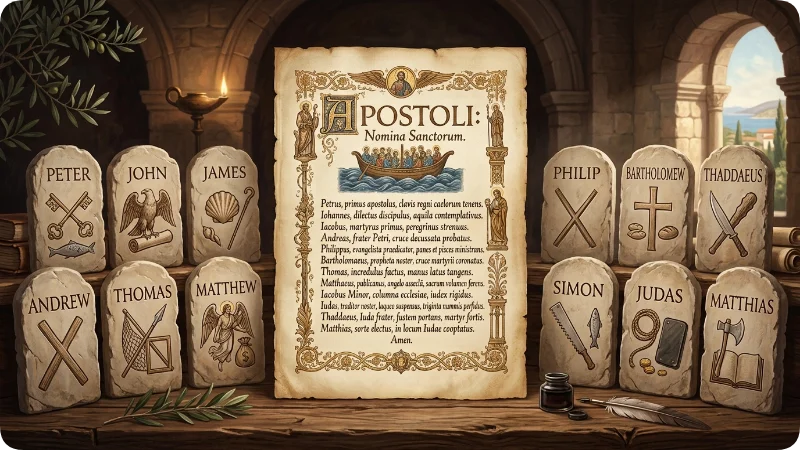
The twelve apostle names in the New Testament are Peter, Andrew, James, John, Philip, Bartholomew, Thomas, Matthew, James son of Alphaeus, Thaddaeus, Simon the Zealot, and Judas Iscariot. After Judas Iscariot’s departure, Matthias was chosen to join the Eleven and restore the group to twelve. Paul was a later apostle whose ministry became especially associated with the Gentiles.
Apostle Names at a Glance
| Apostle name | Meaning | Origin | Overall feel |
| Peter | Rock, stone | Greek / Aramaic | Strong, grounded |
| Andrew | Manly, masculine | Greek | Classic, confident |
| James | Form of Jacob | Hebrew via Greek | Traditional, familiar |
| John | Yahweh is gracious | Hebrew | Gentle, timeless |
| Philip | Friend/lover of horses | Greek | Refined, uncommon |
| Bartholomew | Son of Talmai | Aramaic | Rare, historic |
| Thomas | Twin | Aramaic | Literary, distinctive |
| Matthew | Gift of Yahweh | Hebrew | Warm, classic |
| James | Form of Jacob | Hebrew via Greek | Biblical, enduring |
| Thaddaeus | Traditionally associated with a meaning like “heart” | Aramaic/Greek tradition | Rare, antique |
| Simon | Heard / hearer | Hebrew | Biblical, understated |
| Judas | Praise | Hebrew via Greek | Ancient, complex |
| Matthias | Gift of Yahweh | Hebrew via Greek | Elegant, distinctive |
| Paul | Small, little | Latin | Quiet, classic |
The biblical lists themselves explain why some names appear differently. Matthew uses Thaddaeus, while Luke names Judas son of James; Acts likewise uses Judas son of James in its list.
The 12 Original Apostle Names

1. Peter
Meaning: Rock or stone
Origin: Greek, connected with Aramaic Cephas
Language: Greek / Aramaic
Gender: Masculine
Pronunciation: PEE ter
Biblical role: One of the Twelve and brother of Andrew
Peter is one of the most recognizable apostle names in Christianity. His original name was Simon, but Jesus gave him the name Peter, corresponding to the idea of a rock or stone. The Greek Petros is associated with “rock” or “stone,” while Cephas reflects the Aramaic form.
Personality vibe: Strong, courageous, outspoken, protective
Social impression: Dependable and traditional
Aesthetic: Classic, masculine, minimalist
Nicknames: Pete, Petey
Similar names: Paul, Peter, Patrick, Philip
Modern vs. classic: Deeply classic
Trend feel: Familiar rather than fashionable
Fictional/literary associations: Appears frequently in Christian literature, historical fiction, and biblical storytelling
Modern symbolic profile:
Lucky number: 7*
Lucky color: Deep blue*
Lucky stone: Sapphire*
Lucky day: Sunday*
Zodiac association: Not biblically assigned; modern naming symbolism often pairs Peter with earth/strength imagery.
Peter has a particularly solid emotional quality. It feels like a name chosen for someone you imagine growing into a steady, trustworthy adult.
2. Andrew
Meaning: Manly, masculine
Origin: Greek Andreas
Language: Greek
Gender: Masculine
Pronunciation: AN droo
Biblical role: Brother of Peter and one of the Twelve
Andrew comes from the Greek Andreas, related to aner, meaning “man,” with the associated sense of “manly” or “masculine.” He is identified in the New Testament as Simon Peter’s brother.
Personality vibe: Warm, capable, adventurous
Social impression: Friendly and dependable
Aesthetic: Coastal classic, traditional, polished
Nicknames: Andy, Drew
Similar names: Alexander, Adrian, Anthony
Modern vs. classic: Classic with an approachable edge
Trend feel: Familiar and enduring
Sibling pairings: Andrew & Matthew, Andrew & Daniel, Andrew & James
Modern symbolic profile:
Lucky number: 6*
Lucky color: Green*
Lucky stone: Emerald*
Lucky day: Thursday*
Zodiac association: No traditional biblical association.
Andrew is one of those names that feels strong without sounding severe. It works especially well if you want a biblical name that remains easy and natural in contemporary life.
3. James
Meaning: English form of Jacob; ultimately connected with Hebrew Jacob
Origin: Hebrew through Greek and Latin
Language: Biblical Hebrew / Greek / Latin / English
Gender: Masculine
Pronunciation: JAYMZ
Biblical role: Two different apostles are named James
James is especially interesting because two of the Twelve share the name: James son of Zebedee and James son of Alphaeus. The New Testament Greek form Iakobos corresponds to Jacob, making James part of the same historical name family as Jacob.
Personality vibe: Confident, refined, dependable
Social impression: Sophisticated and established
Aesthetic: Old money classic, literary, polished
Nicknames: Jamie, Jim, Jimmy
Similar names: Jacob, John, William, Henry
Modern vs. classic: Extremely classic
Trend feel: Perennially recognizable
Sibling pairings: James & John, James & Matthew, James & Thomas
Modern symbolic profile:
Lucky number: 3*
Lucky color: Navy*
Lucky stone: Garnet*
Lucky day: Thursday*
Zodiac association: No biblical zodiac association.
James is an especially versatile choice. It can feel traditional on a formal document, warm as “Jamie,” and effortlessly contemporary without losing its biblical roots.
4. John
Meaning: “Yahweh is gracious”
Origin: Hebrew Yoḥanan
Language: Hebrew, through Greek and Latin
Gender: Masculine
Pronunciation: JON
Biblical role: One of the Twelve; brother of James son of Zebedee
John ultimately comes from the Hebrew name Yoḥanan, commonly understood as “Yahweh is gracious.” The Greek form became Ioannes, followed by Latin Iohannes and eventually English John.
Personality vibe: Gentle, spiritual, intelligent
Social impression: Trustworthy and timeless
Aesthetic: Quiet luxury, classic, understated
Nicknames: Johnny, Jack in some historical naming traditions
Similar names: Jonathan, Jonah, Joseph
Modern vs. classic: Very classic
Trend feel: Traditional rather than trend driven
Sibling pairings: John & Matthew, John & James, John & Samuel
Modern symbolic profile:
Lucky number: 2*
Lucky color: White*
Lucky stone: Pearl*
Lucky day: Sunday*
Zodiac association: No historically assigned zodiac sign.
John has a softer emotional energy than Peter or James. It feels serene, familiar, and deeply rooted.
5. Philip
Meaning: Friend or lover of horses
Origin: Greek Philippos
Language: Greek
Gender: Masculine
Pronunciation: FIL ip
Biblical role: One of the Twelve
Philip comes from Greek elements associated with friendship or love and horses, giving the name its traditional meaning “friend of horses” or “lover of horses.”
Personality vibe: Cultured, thoughtful, elegant
Social impression: Refined and intelligent
Aesthetic: European classic, equestrian, aristocratic
Nicknames: Phil
Similar names: Felix, Phillip, Theodore, Alexander
Modern vs. classic: Classic
Trend feel: Less common feeling than John or James
Sibling pairings: Philip & Thomas, Philip & Andrew, Philip & Matthew
Modern symbolic profile:
Lucky number: 7*
Lucky color: Forest green*
Lucky stone: Jade*
Lucky day: Friday*
Zodiac association: No traditional biblical assignment.
Philip is particularly attractive if you want a biblical name that does not feel overused.
6. Bartholomew
Meaning: “Son of Talmai”
Origin: Aramaic
Language: Aramaic, represented through Greek
Gender: Masculine
Pronunciation: bar THOL uh myoo
Biblical role: One of the Twelve
Bartholomew is one of the most unusual apostle names because it appears to function as a patronymic, Bar Talmai, meaning “son of Talmai”, rather than necessarily being the person’s complete personal name. It appears in all four New Testament lists of the Twelve.
Personality vibe: Ancient, scholarly, mysterious
Social impression: Distinctive and intellectual
Aesthetic: Medieval, literary, gothic, historical
Nicknames: Bart, Tolly
Similar names: Baruch, Benjamin, Benedict
Modern vs. classic: Ancient classic
Trend feel: Highly distinctive
Sibling pairing: Bartholomew & Theodore, Bartholomew & Sebastian
Modern symbolic profile:
Lucky number: 8*
Lucky color: Burgundy*
Lucky stone: Garnet*
Lucky day: Saturday*
Zodiac association: No established biblical zodiac association.
If your goal is uniqueness, Bartholomew immediately stands apart from the more familiar biblical choices.
7. Thomas
Meaning: Twin
Origin: Aramaic
Language: Aramaic, through Greek
Gender: Masculine
Pronunciation: TOM us
Biblical role: One of the Twelve
Thomas comes from an Aramaic word meaning “twin.” His story is especially memorable because the Gospel of John portrays him as questioning the resurrection testimony of the other disciples before declaring his faith after encountering the risen Jesus.
Personality vibe: Intelligent, questioning, honest
Social impression: Dependable and thoughtful
Aesthetic: Literary, vintage, understated
Nicknames: Tom, Tommy
Similar names: Tobias, Theodore, Timothy
Modern vs. classic: Classic
Trend feel: Familiar but not overly fashionable
Sibling pairings: Thomas & James, Thomas & Matthew, Thomas & Benjamin
Modern symbolic profile:
Lucky number: 4*
Lucky color: Silver*
Lucky stone: Moonstone*
Lucky day: Monday*
Zodiac association: No historical biblical assignment.
Thomas is an excellent name for parents attracted to names that suggest curiosity rather than effortless certainty.
8. Matthew
Meaning: Gift of Yahweh
Origin: Hebrew
Language: Hebrew, through Greek and Latin
Gender: Masculine
Pronunciation: MATH yoo
Biblical role: One of the Twelve and identified as a tax collector
Matthew is traditionally connected with the Hebrew name Mattityahu, meaning “gift of Yahweh.” The name passed through Greek and Latin forms before developing into the English Matthew.
Personality vibe: Warm, intelligent, grateful
Social impression: Friendly and trustworthy
Aesthetic: Classic, polished, gentle
Nicknames: Matt, Matty
Similar names: Matthias, Nathaniel, Michael, Samuel
Modern vs. classic: Classic
Trend feel: Familiar and established
Sibling pairings: Matthew & James, Matthew & John, Matthew & Andrew
Modern symbolic profile:
Lucky number: 5*
Lucky color: Gold*
Lucky stone: Topaz*
Lucky day: Thursday*
Zodiac association: No biblically assigned zodiac sign.
Matthew may be one of the easiest apostle names to bring into modern family life. It feels biblical without sounding exclusively religious.
9. James Son of Alphaeus
The second apostle named James is traditionally distinguished as James son of Alphaeus.
Because the biblical text gives relatively little narrative detail about him, his name often carries more weight than his individual story. The name itself remains the same enduring James described above.
Personality vibe: Quiet, grounded, faithful
Aesthetic: Traditional, understated, heritage
Nickname options: James, Jamie, Jim
Modern impression: Familiar and sophisticated
This is a good reminder that not every biblical name needs an elaborate story to have naming value. Sometimes the appeal is the continuity of the name itself.
10. Thaddaeus
Meaning: Traditionally associated with an Aramaic name; exact etymological interpretation is debated
Origin: Aramaic/Greek tradition
Language: Aramaic and Greek forms
Gender: Masculine
Pronunciation: THAD ee us
Biblical role: One of the Twelve in Matthew and Mark
Thaddaeus is one of the most intriguing apostle names because the Gospel lists are not completely uniform. Matthew and Mark use Thaddaeus, while Luke and Acts identify an apostle as Judas son of James.
Personality vibe: Rare, scholarly, ancient
Social impression: Unusual and memorable
Aesthetic: Medieval, fantasy, gothic classic
Nicknames: Thad
Similar names: Matthias, Tobias, Theodore, Jude
Modern vs. classic: Ancient but distinctive
Trend feel: Rare
Modern symbolic profile:
Lucky number: 9*
Lucky color: Deep purple*
Lucky stone: Amethyst*
Lucky day: Tuesday*
Zodiac association: No established biblical zodiac assignment.
Thaddaeus is ideal for someone who loves the history of biblical names but wants something far less expected than Matthew or John.
11. Simon the Zealot
Meaning: Simon is associated with “hearing” or “hearer”
Origin: Hebrew Shimon, represented in Greek as Simon
Language: Hebrew / Greek
Gender: Masculine
Pronunciation: SYE mun
Biblical role: One of the Twelve, distinguished as “the Zealot”
Simon derives from the Hebrew Shimon, associated with the verb “to hear” and commonly interpreted as “hearer.”
The New Testament distinguishes this Simon from Simon Peter by calling him “the Zealot.”
Personality vibe: Serious, passionate, grounded
Social impression: Strong but restrained
Aesthetic: Ancient, minimalist, biblical
Nicknames: Si, Simi
Similar names: Simeon, Samuel, Simon
Modern vs. classic: Classic
Trend feel: Understated
Modern symbolic profile:
Lucky number: 3*
Lucky color: Olive green*
Lucky stone: Onyx*
Lucky day: Tuesday*
Zodiac association: No biblical zodiac assignment.
12. Judas Iscariot
Meaning: Judas is the Greek form of Judah, associated with praise
Origin: Hebrew through Greek
Language: Hebrew / Greek
Gender: Masculine
Pronunciation: JOO dus
Biblical role: One of the original Twelve
Judas Iscariot was one of the original Twelve and is identified in the Gospel lists as the disciple who betrayed Jesus.
The name Judas itself is historically related to Judah, commonly associated with “praise.” The negative cultural association with Judas Iscariot is therefore a consequence of the biblical character’s story, not the literal meaning of the name.
Personality vibe as a name: Ancient, dramatic, complex
Social impression: Strong historical association
Aesthetic: Biblical, dramatic, literary
Related names: Judah, Jude, Juda
Modern naming consideration: The association with Iscariot is extremely strong in many Christian cultures.
Modern symbolic profile:
Lucky number: 3*
Lucky color: Crimson*
Lucky stone: Ruby*
Lucky day: Friday*
Zodiac association: No biblical zodiac assignment.
For a modern baby name, Jude or Judah may preserve the broader historical name family while avoiding the immediate association many people have with Judas Iscariot.
Matthias: The Apostle Name of Restoration

Matthias deserves its own section because his story answers one of the most common questions about the Twelve: Who replaced Judas Iscariot?
After Judas’s departure, Acts records that the disciples identified candidates who had been with Jesus from the beginning of his ministry and witnessed the resurrection. Two men were nominated, Joseph called Barsabbas, also known as Justus, and Matthias. The group prayed, cast lots, and Matthias was added to the Eleven.
Meaning: Gift of Yahweh
Origin: Hebrew, through Greek
Gender: Masculine
Pronunciation: muh THY us / muh THEE us, depending on accent and tradition
Nicknames: Matt, Matty
Similar names: Matthew, Nathaniel, Matthias
Aesthetic: Elegant biblical, scholarly, European
Personality vibe: Quiet strength, faithfulness, renewal
Matthias is especially meaningful as a symbolic name because his biblical role is connected with restoration and continuity.
And unlike Judas, Matthias has no long narrative of betrayal attached to him. Acts simply records his selection and then provides little additional information about his later life.
Modern symbolic profile:
Lucky number: 5*
Lucky color: Gold*
Lucky stone: Citrine*
Lucky day: Thursday*
Zodiac association: No biblical zodiac assignment.
What Makes Apostle Names So Appealing Today?
They carry a story
A name like Thomas is not merely “a biblical name.” It immediately connects to a memorable story of questioning and faith.
Peter suggests transformation from Simon to a new identity.
Matthew connects with a dramatic change of vocation.
Matthias represents restoration within the Twelve.
Paul represents a later and enormously influential apostolic mission.
That narrative dimension makes apostle names particularly powerful for character naming.
They work across generations
Many apostle names have survived because they are not tied to one particular fashion cycle.
James can belong to a child, teenager, professional, grandfather, fictional hero, or historical figure without sounding out of place.
They offer different levels of religious visibility
There is a major difference between naming someone John and naming someone Bartholomew.
John may simply sound classic to someone unfamiliar with its biblical background.
Bartholomew announces its historical character immediately.
That makes apostle names unusually flexible for parents with different levels of religious naming preference.
Frequently Asked Questions About Apostle Names
What are the names of the 12 apostles?
The Twelve listed in Matthew include Peter, Andrew, James son of Zebedee, John, Philip, Bartholomew, Thomas, Matthew, James son of Alphaeus, Thaddaeus, Simon the Zealot, and Judas Iscariot.
Who replaced Judas Iscariot?
Matthias was selected to replace Judas Iscariot after the disciples prayed and cast lots between Matthias and Joseph Barsabbas, also known as Justus.
Was Paul one of the 12 apostles?
No. Paul was not one of the original Twelve. He became a major apostolic figure later and is explicitly described as an apostle in the New Testament. His ministry was especially associated with Gentiles.
Is Bartholomew the same person as Nathanael?
This is a traditional identification rather than something the biblical text states directly. Bartholomew appears in the lists of the Twelve, while Nathanael appears in John’s Gospel. Many Christian traditions identify them as the same person, but the identification should not be presented as certain.
Are James and John brothers?
Yes. The New Testament identifies James son of Zebedee and John as brothers and includes both among the Twelve.
Are there two apostles named James?
Yes. The lists distinguish James son of Zebedee and James son of Alphaeus.
Are there two Simons among the apostles?
Yes. Simon Peter and Simon the Zealot are both included among the Twelve.
Is Thaddaeus also called Judas?
The New Testament lists differ. Matthew and Mark use Thaddaeus, while Luke and Acts identify Judas son of James. Many Christian traditions understand these references as pointing to the same apostle, but the textual variation is worth noting.
Which apostle name means “gift of God”?
Matthew and Matthias are traditionally connected with the Hebrew name family meaning “gift of Yahweh.”
Which apostle name means “rock”?
Peter is associated with the Greek Petros, “rock” or “stone,” corresponding to the Aramaic Cephas.
Which apostle name means “twin”?
Thomas comes from an Aramaic term meaning “twin.”
Which apostle name means “Yahweh is gracious”?
John comes from Hebrew Yoḥanan, traditionally interpreted as “Yahweh is gracious.”
Choosing an Apostle Name for a Baby, Character, or Project
The best choice depends less on finding a name with the most impressive meaning and more on finding the right emotional fit.
If you want strength, consider Peter or Andrew.
If you want timeless elegance, James or John works beautifully.
And if you want warmth, Matthew is especially appealing.
If you want intellectual and literary energy, Thomas has a memorable identity.
Or you want rarity, Bartholomew or Thaddaeus stands out immediately.
If you want a distinctive but wearable biblical name, Matthias is an excellent middle ground.
And if you want a name with a broader Christian historical reach beyond the Twelve, Paul deserves consideration.
The most important distinction is between historical meaning and modern interpretation. A name’s etymology tells you where the word came from; the biblical character gives it a story; and your own naming context gives it its emotional meaning today.
Final Thoughts
Apostle names have survived for nearly two thousand years not simply because they are biblical, but because they contain something that modern naming still values: story.
Peter feels solid. John feels timeless. Andrew feels approachable. James feels polished. Thomas feels thoughtful. Matthew feels warm. Philip feels refined. Bartholomew feels rare. Thaddaeus feels mysterious. Matthias feels quietly distinctive. Paul feels understated and enduring.
And perhaps that is the greatest appeal of these names: they do not all sound alike, and their stories are not interchangeable.
Some still sound completely at home in a modern classroom, workplace, or family.
That gives apostle names a surprisingly rich naming palette, from simple classics like John and James to distinctive biblical choices like Matthias and Bartholomew.
*Lucky numbers, colors, gemstones, days, and zodiac pairings in this article are modern symbolic/numerological interpretations, not biblical or historical assignments.

Emma helps authors, screenwriters, and gamers find the perfect names for their fictional characters. She analyzes historical trends and linguistic styles to craft names that carry deep meaning. When she isn’t writing, she loves plotting her next fantasy novel at a local café.