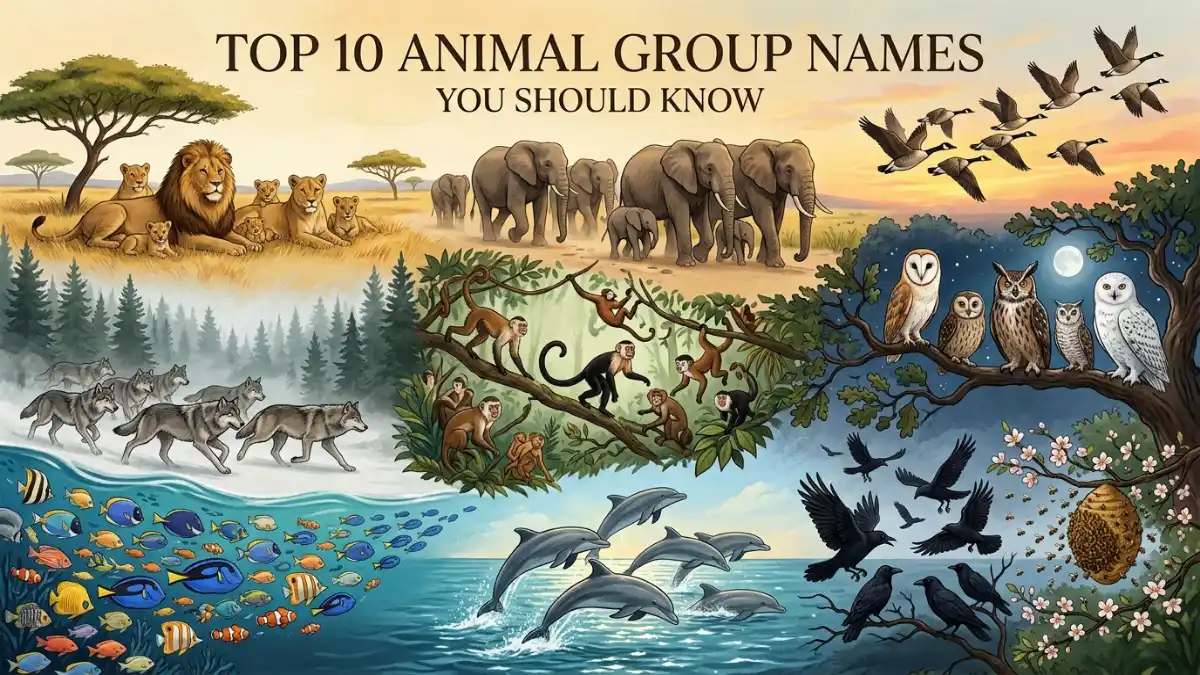
Imagine seeing dozens of lions resting beneath an acacia tree, a school of fish moving like silver ribbons underwater, or a parliament of owls watching from the branches.
English has a wonderfully expressive way of describing these scenes. Instead of simply saying “a group of animals,” we can use a collective noun, a special word that describes animals gathered together.
Some are familiar, such as herd, flock, and pack. Others are much more memorable: murder of crows, parliament of owls, and gaggle of geese.
These animal group names are useful for students, writers, trivia lovers, teachers, storytellers, and anyone who enjoys unusual English vocabulary.
Featured Snippet:
The top 10 memorable and widely recognized animal group names include a pride of lions, a pack of wolves, a school of fish, a herd of elephants, a troop of monkeys, a swarm of bees, a pod of dolphins, a gaggle of geese, a murder of crows, and a parliament of owls. These are collective nouns used to describe groups of particular animals.
What Are Animal Group Names?
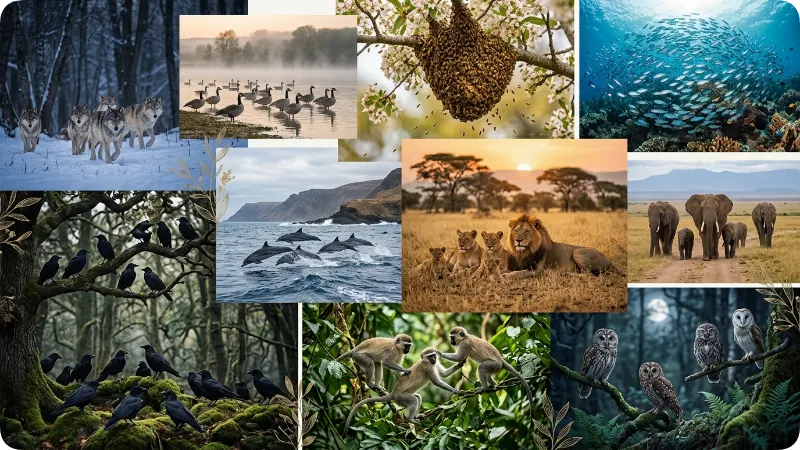
An animal group name is a collective noun used to describe several animals as a group.
For example:
- One lion → a lion
- Several lions → a pride of lions
- One wolf → a wolf
- Several wolves → a pack of wolves
- One fish → a fish
- Several fish → a school of fish
Collective nouns can make writing more vivid because the group word often creates an immediate image.
A pride sounds powerful.
A pack sounds coordinated and wild.
A school suggests synchronized movement.
A parliament feels thoughtful and mysterious.
Many specialized animal group terms belong to the long tradition of English terms of venery, a historical vocabulary associated with hunting and animal lore. The Book of Saint Albans, printed in 1486, became an important source for many such expressions, although some of its group terms were fanciful or humorous rather than practical everyday vocabulary.
Top 10 Animal Group Names at a Glance
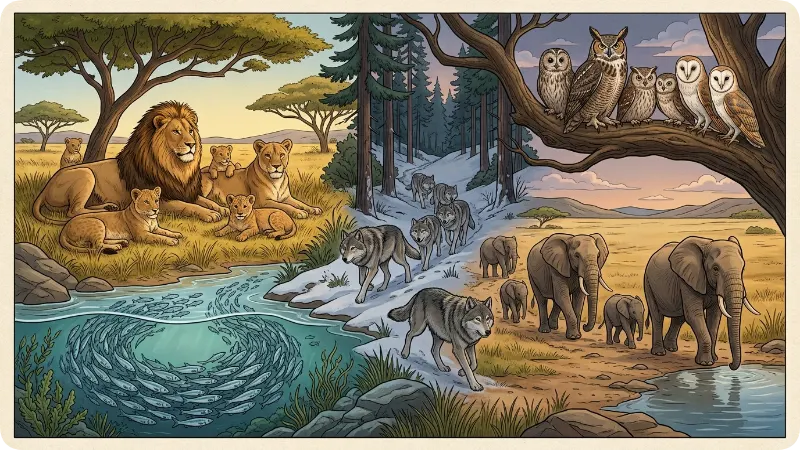
| # | Animal | Group Name | Overall Vibe |
| 1 | Lions | Pride | Powerful, royal |
| 2 | Wolves | Pack | Wild, loyal |
| 3 | Fish | School | Fluid, peaceful |
| 4 | Elephants | Herd | Strong, social |
| 5 | Monkeys | Troop | Playful, energetic |
| 6 | Bees | Swarm | Busy, organized |
| 7 | Dolphins | Pod | Intelligent, friendly |
| 8 | Geese | Gaggle | Playful, chaotic |
| 9 | Crows | Murder | Dark, mysterious |
| 10 | Owls | Parliament | Wise, mysterious |
These are selected for a combination of recognizability, usefulness, memorability, and the distinctive personality of each collective noun—not as a scientific ranking.
1. A Pride of Lions
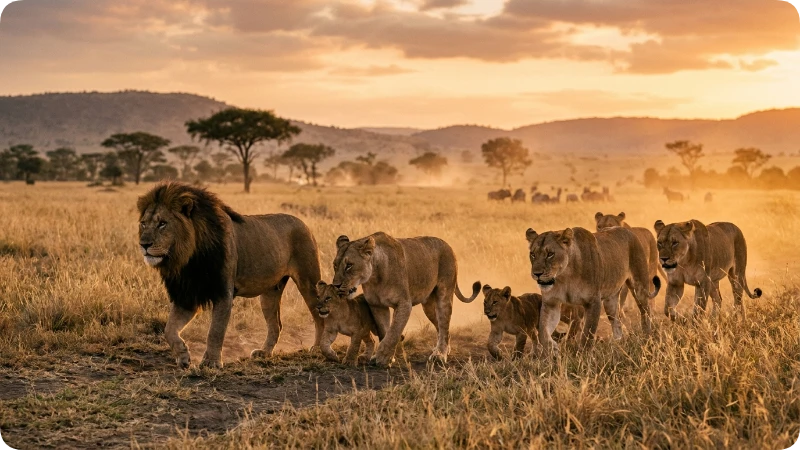
Animal: Lions
Collective noun: Pride
A pride of lions is one of the most recognizable animal group names in English.
The word pride gives the expression an especially strong emotional quality. It suggests confidence, dignity, strength, leadership, and family.
A pride can evoke the image of lions resting together, raising young, traveling across grasslands, or cooperating within their social group.
Example:
We watched a pride of lions resting near the waterhole.
Name enrichment
| Attribute | Description |
| Meaning | Pride, dignity, group identity |
| Origin | English collective noun |
| Language | English |
| Gender | Applies to a group rather than a gender |
| Pronunciation | pride |
| Personality vibe | Regal, confident, powerful |
| Social impression | Strong and commanding |
| Aesthetic | Royal, wild, luxury, safari |
| Modern vs. classic | Classic |
| Similar group terms | Herd, pack, troop |
| Pop culture feel | Strong association with lions in films, heraldry, sports, and fantasy |
The word lion itself also carries long standing associations with courage and strength, which helps make “pride” particularly memorable.
Creative attributes: Lucky number, lucky color, lucky stone, lucky day, zodiac association, and numerology are not traditionally assigned to the collective noun “pride.” Any such associations should be treated as creative interpretation rather than established tradition.
2. A Pack of Wolves
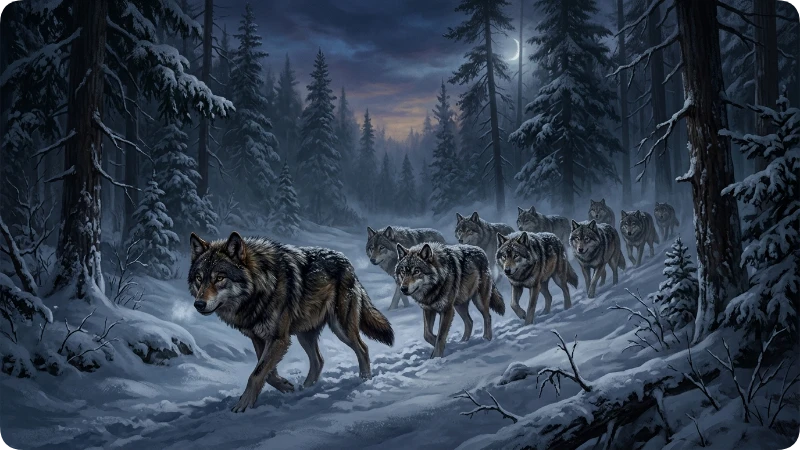
Animal: Wolves
Collective noun: Pack
Few animal group names feel as naturally connected to their animal as pack of wolves.
The word pack suggests cooperation, movement, survival, loyalty, and wilderness.
It has a darker, cinematic quality too. Think snowy forests, moonlit landscapes, fantasy novels, and adventure stories.
Example:
A pack of wolves moved quietly through the forest.
Name enrichment
| Attribute | Description |
| Meaning | A group traveling or living together |
| Origin | English |
| Language | English |
| Gender | Gender neutral group term |
| Pronunciation | pack |
| Personality vibe | Fierce, loyal, adventurous |
| Social impression | Strong and united |
| Aesthetic | Dark fantasy, wilderness, gothic, cinematic |
| Modern vs. classic | Classic |
| Similar terms | Pride, troop, herd |
| Cultural associations | Folklore, mythology, fantasy, wilderness literature |
| Fictional influence | Commonly used in werewolf and fantasy fiction |
Unlike more unusual collective nouns, pack remains a practical and familiar word in modern English.
3. A School of Fish
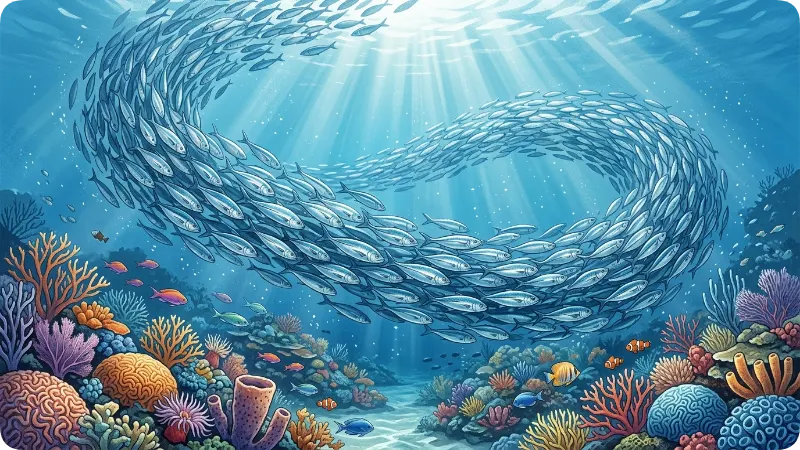
Animal: Fish
Collective noun: School
A school of fish is one of the most visually beautiful group expressions.
The word school suggests coordination and synchronized movement. When fish turn together underwater, the entire group can appear almost like one flowing organism.
Example:
A school of fish flashed beneath the surface.
Why this group name feels special
The metaphor is particularly interesting because “school” normally refers to a place where people learn. With fish, however, it creates an image of many individuals moving together in an organized way.
Name enrichment
| Attribute | Description |
| Meaning | A group of fish moving or swimming together |
| Origin | English |
| Language | English |
| Gender | Not applicable |
| Pronunciation | school |
| Personality vibe | Peaceful, coordinated, fluid |
| Social impression | Organized and harmonious |
| Aesthetic | Oceanic, aquatic, minimalist |
| Modern vs. classic | Classic |
| Similar terms | Shoal |
| Visual association | Coral reefs, blue water, synchronized movement |
Both school and shoal can be used for groups of fish, although “school” is particularly familiar in everyday English.
4. A Herd of Elephants
Animal: Elephants
Collective noun: Herd
A herd of elephants has a completely different emotional energy from a pack of wolves.
Where wolves suggest speed and wilderness, elephants suggest strength, family, stability, and social connection.
“Herd” is also one of the most broadly useful animal collective nouns. It is commonly associated with large grazing or social animals, including elephants and cattle.
Example:
A herd of elephants crossed the open grassland.
Name enrichment
| Attribute | Description |
| Meaning | A group of animals living or moving together |
| Origin | English |
| Language | English |
| Gender | Group term; not gender specific |
| Pronunciation | herd |
| Personality vibe | Grounded, protective, powerful |
| Social impression | Stable and communal |
| Aesthetic | Earthy, natural, safari |
| Modern vs. classic | Classic |
| Similar terms | Flock, troop, pack |
| Emotional association | Family, strength, togetherness |
Unlike “murder” or “parliament,” herd is not unusual—but its simplicity is exactly what makes it useful.
5. A Troop of Monkeys
Animal: Monkeys
Collective noun: Troop
A troop of monkeys feels energetic, social, curious, and playful.
The word troop has a sense of movement and togetherness. It is especially fitting for monkeys because many species live in social groups.
Example:
A troop of monkeys swung through the trees.
Name enrichment
| Attribute | Description |
| Meaning | A group or company |
| Origin | English |
| Language | English |
| Gender | Group term |
| Pronunciation | troop |
| Personality vibe | Playful, adventurous, social |
| Social impression | Energetic and lively |
| Aesthetic | Jungle, adventure, playful |
| Modern vs. classic | Classic |
| Similar terms | Pack, herd, group |
| Fictional association | Adventure stories and jungle fiction |
“Troop” is also used for some other primates, so it is not exclusive to one particular monkey species.
6. A Swarm of Bees
Animal: Bees
Collective noun: Swarm
A swarm of bees creates an immediate visual impression: movement, noise, activity, and thousands of tiny bodies working together.
“Swarm” is a common collective noun for bees and is also used for some other animals and insects.
Example:
A swarm of bees gathered near the hive.
The personality of “swarm”
Unlike herd, which feels calm and grounded, swarm feels:
- Busy
- Energetic
- Intense
- Coordinated
- Slightly intimidating
It is a great example of how collective nouns can create an emotional picture, not merely identify a group.
7. A Pod of Dolphins
Animal: Dolphins
Collective noun: Pod
A pod of dolphins has a softer, more modern feel.
“Pod” is short, memorable, and strongly associated with marine mammals. Dolphins are commonly described as traveling or living in pods.
Example:
A pod of dolphins appeared beside the boat.
Name enrichment
| Attribute | Description |
| Meaning | A group of marine mammals |
| Origin | English |
| Language | English |
| Gender | Gender neutral |
| Pronunciation | pod |
| Personality vibe | Friendly, intelligent, playful |
| Social impression | Modern and approachable |
| Aesthetic | Ocean, coastal, minimalist |
| Modern vs. classic | Modern feeling but established |
| Similar terms | School, shoal |
| Visual association | Waves, blue water, marine life |
“Pod” is also used for whales, so the term is not exclusive to dolphins.
8. A Gaggle of Geese
Animal: Geese
Collective noun: Gaggle
Now we get to one of the most charming animal group names.
A gaggle of geese sounds playful because gaggle itself has a slightly chaotic, noisy personality.
Dictionary.com defines a gaggle as a group of geese, particularly when they are not flying. The word can also be used informally for a disorderly group of people.
Example:
A gaggle of geese wandered across the field.
Name enrichment
| Attribute | Description |
| Meaning | A group of geese |
| Origin | English; recorded in Middle English |
| Language | English |
| Gender | Group term |
| Pronunciation | GAG uhl |
| Personality vibe | Funny, lively, chaotic |
| Social impression | Playful and informal |
| Aesthetic | Cottagecore, countryside, whimsical |
| Modern vs. classic | Classic but playful |
| Similar terms | Flock, skein |
| Cultural feel | Humorous English vocabulary |
This is a good example of why animal group names are so enjoyable: the word almost seems to imitate the personality of the animals.
9. A Murder of Crows
Animal: Crows
Collective noun: Murder
Few expressions attract as much attention as a murder of crows.
The word immediately creates a dark and mysterious atmosphere, making it popular in gothic writing, fantasy, horror, Halloween content, and dark academia aesthetics.
Example:
A murder of crows gathered in the bare branches.
The term is an established traditional collective noun, although many historical animal group expressions were fanciful and did not necessarily function as everyday scientific terminology. Modern references continue to recognize “murder” for a group of crows.
Name enrichment
| Attribute | Description |
| Meaning | Traditional collective noun for crows |
| Origin | Historical English usage |
| Language | English |
| Gender | Group term |
| Pronunciation | MUR der |
| Personality vibe | Dark, intelligent, mysterious |
| Social impression | Dramatic and memorable |
| Aesthetic | Gothic, dark academia, noir |
| Modern vs. classic | Old term with strong modern appeal |
| Similar terms | Flock, parliament |
| Fictional association | Gothic fiction, fantasy, mystery, horror |
Why is it called a “murder”?
This is where caution matters. Popular explanations often connect the term to old folklore about crows, death, or ominous behavior, but it is safer not to present one neat origin story as proven fact.
The expression belongs to the historical tradition of imaginative animal group terminology, much of which became detached from its original practical context over time.
So the dark aesthetic is a modern interpretive association, while the collective noun itself is established English vocabulary.
10. A Parliament of Owls
Animal: Owls
Collective noun: Parliament
A parliament of owls may be the most elegant expression on this list.
The word parliament brings associations of discussion, deliberation, wisdom, ceremony, and authority. Combined with an animal already associated in popular culture with wisdom and nighttime mystery, the result feels almost magical.
Example:
A parliament of owls watched from the ancient trees.
“Parliament of owls” is recognized as a traditional collective noun, although such specialized animal group terms should not be confused with scientific classifications.
Name enrichment
| Attribute | Description |
| Meaning | Traditional collective noun for owls |
| Origin | Historical English collective noun tradition |
| Language | English |
| Gender | Group term |
| Pronunciation | PAR luh ment |
| Personality vibe | Wise, mysterious, sophisticated |
| Social impression | Intellectual and elegant |
| Aesthetic | Gothic, scholarly, dark academia |
| Modern vs. classic | Classic with modern aesthetic appeal |
| Similar terms | Flock, parliament like assembly |
| Fictional association | Fantasy, mythology inspired fiction, magical stories |
This term is particularly attractive for writers because it instantly gives a nighttime forest scene a sense of atmosphere.
Animal Group Names by Vibe
Sometimes you are not looking for the technically correct term—you are looking for the one that feels right.
Powerful & Regal
- Pride of lions
- Herd of elephants
These work beautifully in writing that emphasizes strength, leadership, family, and majesty.
Wild & Mysterious
- Pack of wolves
- Murder of crows
- Parliament of owls
These have strong fantasy, gothic, nighttime, and cinematic energy.
Peaceful & Beautiful
- School of fish
- Pod of dolphins
- Herd of elephants
These feel more natural, calm, and visually flowing.
Playful & Whimsical
- Gaggle of geese
- Troop of monkeys
These are excellent choices for children’s writing, humorous captions, stories, and educational content.
Busy & Energetic
- Swarm of bees
- Troop of monkeys
Both suggest constant movement, although “swarm” carries a much more intense feeling.
Common Animal Group Names vs. Unusual Ones
Not every collective noun has the same level of everyday usefulness.
| Group Name | Animal | Familiarity | Best Use |
| Herd | Elephants | Very high | Everyday writing |
| Pack | Wolves | Very high | Stories and conversation |
| School | Fish | Very high | Schoolwork and writing |
| Pride | Lions | Very high | Writing and trivia |
| Swarm | Bees | Very high | Everyday description |
| Troop | Monkeys | High | Educational writing |
| Pod | Dolphins | High | Nature writing |
| Gaggle | Geese | High | Fun vocabulary |
| Murder | Crows | High recognition | Trivia and creative writing |
| Parliament | Owls | High recognition | Creative and descriptive writing |
A useful distinction is that recognition does not always equal everyday usage. Someone may instantly recognize “murder of crows” without actually using it in ordinary conversation.
Are Animal Group Names Scientific Terms?
Usually, these expressions are best understood as English collective nouns, not scientific classifications.
For example, “a pride of lions” does not represent a formal biological taxonomic category. It is a linguistic expression used to describe a group.
This distinction is important because online lists sometimes present every unusual animal collective noun as though each were a universally standardized scientific term.
They are not.
Some expressions are extremely familiar—such as herd, flock, pack, and school. Others are traditional, literary, humorous, regional, or relatively uncommon. Historical sources also contain many imaginative terms that never became ordinary modern vocabulary.
How to Use Animal Group Names in a Sentence
The easiest structure is:
A + collective noun + of + animal
Examples:
- A pride of lions crossed the plain.
- A pack of wolves disappeared into the forest.
- A school of fish moved beneath the boat.
- A herd of elephants approached the river.
- A troop of monkeys climbed the trees.
- A swarm of bees surrounded the hive.
- A pod of dolphins surfaced nearby.
- A gaggle of geese crossed the road.
- A murder of crows settled in the trees.
- A parliament of owls watched from above.
This structure is especially useful for students learning English because it makes the relationship between the collective noun and the animal immediately clear.
Why Are Animal Group Names So Interesting?
The best collective nouns do more than tell us how many animals are together.
They give the group a personality.
A lion group becomes a pride.
A wolf group becomes a pack.
Fish become a school.
Crows become a murder.
Owls become a parliament.
That is why these words remain popular in books, games, classroom activities, quizzes, social media posts, fantasy stories, and nature writing.
The historical tradition behind many of these terms also explains why English has accumulated such an unusually imaginative vocabulary for animal groups. Medieval collections of “terms of venery” preserved many specialized expressions, while later writers continued to use, adapt, and popularize them.
Animal Group Name Cheat Sheet
For quick reference:
Lion → Pride
Wolf → Pack
Fish → School
Elephant → Herd
Monkey → Troop
Bee → Swarm
Dolphin → Pod
Goose → Gaggle
Crow → Murder
Owl → Parliament
If you only remember five, start with pride, pack, school, herd, and swarm. They are among the most useful core collective nouns for animal groups.
FAQs About Animal Group Names
What is a group of lions called?
A group of lions is called a pride of lions.
What is a group of wolves called?
A group of wolves is called a pack of wolves.
What is a group of fish called?
A group of fish can be called a school of fish or a shoal of fish.
What is a group of elephants called?
A group of elephants is called a herd of elephants.
What is a group of monkeys called?
A group of monkeys is commonly called a troop of monkeys.
What is a group of bees called?
A group of bees is called a swarm of bees.
What is a group of dolphins called?
A group of dolphins is called a pod of dolphins.
What is a group of geese called?
A group of geese on the ground is commonly called a gaggle of geese. When geese are flying, other terms such as flock or skein may be used depending on the context.
What is a group of crows called?
A group of crows is traditionally called a murder of crows.
What is a group of owls called?
A group of owls is traditionally called a parliament of owls.
Are animal group names always scientifically official?
No. Most are collective nouns in English, not formal scientific classifications. Some are common everyday terms, while others are traditional or literary expressions.
Conclusion
Animal group names are tiny pieces of vocabulary with surprisingly big personalities.
Pride feels regal.
The pack feels wild.
A school feels fluid.
A herd feels grounded.
A troop feels playful.
A swarm feels energetic.
A pod feels friendly.
A gaggle feels wonderfully chaotic.
A murder feels dark and mysterious.
And a parliament feels wise and almost magical.
That combination of accuracy and imagination is what makes collective animal names so memorable. They don’t simply tell us that animals are together, they give that gathering its own identity.

Emma helps authors, screenwriters, and gamers find the perfect names for their fictional characters. She analyzes historical trends and linguistic styles to craft names that carry deep meaning. When she isn’t writing, she loves plotting her next fantasy novel at a local café.