Russian boy names have a distinctive appeal. Some feel powerful and timeless, like Alexander and Vladimir. Others feel gentle and artistic, like Mikhail and Nikolai. Then there are short, modern favorites such as Lev and Maksim, names that look effortlessly stylish on a birth announcement, a family tree, or a Pinterest mood board.
If you’re choosing a name for your baby, exploring your Russian heritage, writing a fictional character, or searching for a name with a mysterious Slavic aesthetic, the best choice is one that feels meaningful as well as beautiful.
Russian naming traditions offer a rich mix of Slavic roots, Greek and Hebrew influences, Christian history, literary associations, and affectionate short forms. Many names also have longer formal versions, giving you the flexibility to choose a name that feels dignified in adulthood and warm at home.
This guide explores Russian boy names by meaning, sound, personality, cultural background, and aesthetic, helping you find a name that fits the person you imagine it belonging to.
Featured Snippet:
Russian boy names include Alexander, Dmitri, Mikhail, Nikolai, Ivan, Lev, Maksim, Yuri, Roman, and Vladimir. Popular traditional choices often have Greek, Hebrew, Latin, or Slavic roots. Alexander means “defender of men,” Dmitri is associated with Demeter, Ivan means “God is gracious,” and Lev means “lion” in Russian usage. The best name depends on If you prefer a classic, modern, strong, soft, or distinctly Slavic style.
Russian Boy Names at a Glance
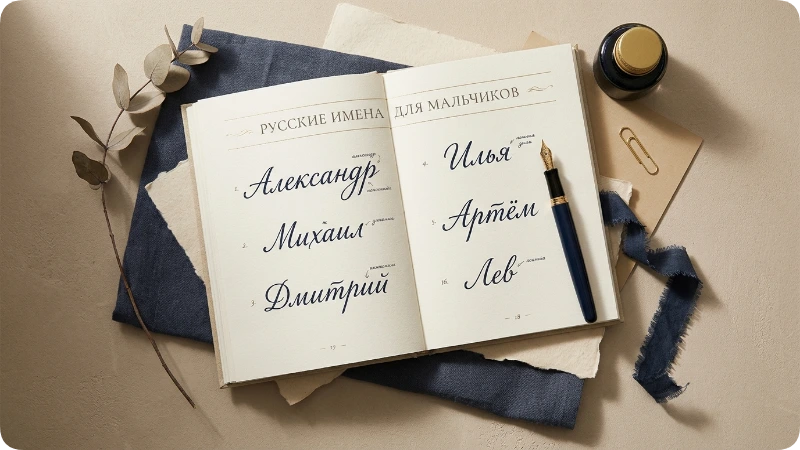
The easiest way to choose a name is to begin with the feeling you want it to create. Do you picture a confident, traditional name, a quiet literary name, or something short and contemporary?
| Name | Commonly accepted meaning | Style | Familiar nickname |
| Aleksandr | Defender of men | Strong, timeless | Sasha |
| Mikhail | Who is like God? | Gentle, classic | Misha |
| Dmitri | Associated with Demeter | Intellectual, distinctive | Dima |
| Ivan | God is gracious | Simple, traditional | Vanya |
| Nikolai | Victory of the people | Elegant, literary | Kolya |
| Lev | Lion | Minimalist, bold | Lyova |
| Maksim | Greatest | Modern, confident | Max |
| Vladimir | Traditionally associated with rule and power | Regal, historic | Vova |
| Roman | Roman, from Rome | Sleek, cosmopolitan | Roma |
| Yuri | Russian form of George | Understated, classic | Yura |
| Fyodor | Gift of God | Vintage, literary | Fedya |
| Andrei | Manly, brave | Refined, versatile | Andryusha |
Meanings are based on commonly accepted name etymologies. Nicknames reflect Russian usage; spellings and transliterations can vary.
Behind the Name
+3
1. Popular Russian Boy Names for Modern Parents

If you want a name that feels authentically Russian without sounding old fashioned, start with these established choices. They combine cultural familiarity with a range of sounds, lengths, and nickname possibilities.
Recent official Russian statistics reported for 2024 put Mikhail, Aleksandr, Artem, Matvey, and Maksim among the leading boys’ names. Ivan, Lev, Mark, and Dmitri also appeared in the national top ten. This is useful evidence of contemporary usage, although popularity can differ by region and year.
1. Aleksandr (Александр)
- Meaning: Defender of men
- Origin: Greek, through the Russian form of Alexander
- Pronunciation: ah leek SAHN dr, approximately
- Nicknames: Sasha, Sanya, Aleks
- Vibe: Confident, intelligent, enduring
- Cultural connection: Aleksandr Pushkin, one of Russia’s most influential literary figures
Aleksandr has the kind of presence that works at every age. It sounds formal on a graduation certificate, familiar in conversation, and affectionate when shortened to Sasha.
Its biggest advantage is versatility. It feels traditional without being tied to one particular generation, and the nickname gives it a softer, more relaxed side.
Behind the Name
+1
2. Mikhail (Михаил)
- Meaning: Who is like God?
- Origin: Hebrew, through the name Michael
- Nicknames: Misha, Mishka
- Vibe: Warm, thoughtful, quietly confident
- Cultural feel: Deeply established in Russian naming traditions
Mikhail is an especially appealing choice if you want a name that sounds gentle without feeling fragile. The full version has a dignified rhythm, while Misha feels playful and affectionate.
Its meaning comes from a rhetorical question in the Hebrew name tradition, rather than a claim that someone is divine. For families drawn to religious heritage, it has a long Christian history as well.
3. Artem (Артём)
- Meaning: Commonly connected with the Greek name Artemios; its precise historical interpretation is more complex than a simple translation
- Origin: Greek derived name used in Russian
- Nicknames: Tyoma, Artyomka
- Vibe: Youthful, energetic, contemporary
- Style: Modern classic
Artem feels brisk and self assured. It has fewer syllables than Aleksandr or Vladimir, making it attractive to parents who prefer compact names with a distinctly Russian sound.
Its place among Russia’s leading boys’ names in 2024 makes it a useful option if you want a name that is culturally current rather than merely inspired by Russian history.
Социальный фонд России
+2
4. Matvey (Матвей)
- Meaning: Gift of God
- Origin: Hebrew, through the Matthew name tradition
- Nickname: Matveyka
- Vibe: Gentle, sincere, youthful
- Style: Soft traditional
Matvey has a rounded, friendly sound. It feels less imposing than Vladimir and less formal than Aleksandr, making it a lovely middle ground between a traditional name and a modern baby name favorite.
5. Maksim (Максим)
- Meaning: Greatest
- Origin: Latin, from Maximus
- Nicknames: Max, Maks
- Vibe: Energetic, polished, confident
- Style: International modern classic
Maksim is one of the easiest Russian boy names to use in a multilingual family. Max is immediately recognizable in many English speaking settings, while Maksim preserves the Russian spelling and identity.
Choose it if you like names that feel active, clean, and uncomplicated.
6. Ivan (Иван)
- Meaning: God is gracious
- Origin: Hebrew, through the John name tradition
- Nickname: Vanya
- Vibe: Grounded, familiar, quietly strong
- Style: Timeless classic
Ivan proves that a short name can carry considerable cultural depth. It has a strong presence in Russian literature and folklore, yet its simple spelling makes it accessible internationally.
Vanya softens the name considerably, giving it a warm family nickname without changing its recognizable identity.
7. Lev (Лев)
- Meaning: Lion in Russian
- Origin: Russian and Ukrainian usage; a vernacular form of Leo
- Nickname: Lyova
- Vibe: Bold, artistic, minimalist
- Style: Short and distinctive
Lev is a particularly attractive option for parents who love concise names with visual impact. Three letters make it easy to write, while its meaning suggests courage and strength.
The name is also associated with Leo Tolstoy, whose Russian given name was Lev. That literary connection adds depth without making the name feel elaborate.
Behind the Name
+1
8. Dmitri (Дмитрий)
- Meaning: Associated with Demeter, the ancient Greek goddess of agriculture
- Origin: Greek, through Demetrius
- Nicknames: Dima, Mitya
- Vibe: Intellectual, composed, distinctive
- Style: Traditional with a cosmopolitan edge
Dmitri has a more dramatic sound than Ivan and a more scholarly impression than Maksim. It also offers two familiar short forms, allowing the name to feel different in formal and personal settings.
For readers who appreciate science, the name may recall Dmitri Mendeleev, the Russian chemist associated with the periodic table.
9. Nikolai (Николай)
- Meaning: Victory of the people
- Origin: Greek, through Nicholas
- Nickname: Kolya
- Vibe: Literary, elegant, quietly romantic
- Style: Vintage sophistication
Nikolai is a strong choice for parents who love longer names with graceful sounds. It can feel stately in full and remarkably soft when shortened.
It also works well in historical fiction, period inspired naming, and families who want a name that carries a clear Russian identity.
10. Roman (Роман)
- Meaning: Roman, or from Rome
- Origin: Latin
- Nickname: Roma
- Vibe: Sleek, confident, understated
- Style: International classic
Roman is familiar across several languages, which makes it appealing for families with connections to different countries. Its spelling is straightforward, and the nickname Roma gives it a softer Russian form.
The name feels contemporary without needing a fashionable spelling or an invented meaning.
2. Strong Russian Boy Names With Powerful Meanings
Some names feel commanding before you even learn what they mean. For this category, the appeal comes from a combination of sound, established meaning, history, and the impression the name creates.
Vladimir (Владимир)
Traditional Slavic name associated with rule and power; Vova is a familiar nickname.
Vladimir has a substantial, regal sound. It suits parents who prefer names with historical weight and a confident adult presence.
Viktor (Виктор)
Meaning: “victor” or “conqueror”; Latin origin.
Viktor feels decisive and direct. Its meaning makes it a natural fit for families drawn to achievement, perseverance, and resilience.
Boris (Борис)
Origin is disputed; a connection with Bulgar or Slavic roots is commonly proposed.
Boris feels compact, sturdy, and old world. Its appeal lies in its strong sound and established Eastern European presence, not a confidently established literal meaning.
Andrei (Андрей)
Meaning: “manly”; Greek origin.
Andrei feels balanced, capable, and refined. It is a good option for parents who want strength without the heavier sound of a long royal style name.
Yaroslav (Ярослав)
Slavic compound name traditionally interpreted through elements associated with fierceness or vigor and glory.
Yaroslav has an unmistakable Slavic character. Its longer form feels historic and distinguished, while the familiar short form Slava adds warmth.
Best picks by impression: Choose Viktor for victory, Lev for lion like simplicity, Vladimir for a regal feel, or Yaroslav for a more distinctly Slavic style.
A useful distinction: a name’s historical meaning is not a prediction of a child’s personality. The words above describe etymology and aesthetic impressions, not fixed character traits.
3. Elegant Russian Boy Names With a Refined Feel

If your taste leans toward understated luxury, literature, classical music, or vintage European aesthetics, look for names with flowing vowels, balanced syllables, and recognizable traditional forms.
| Name | Meaning or origin | Why it feels elegant |
| Nikolai | Greek; victory of the people | Long, graceful, literary |
| Mikhail | Hebrew; who is like God? | Soft yet dignified |
| Aleksei (Алексей) | Greek name tradition; commonly associated with defending or helping | Gentle, polished |
| Konstantin (Константин) | Latin; steadfast | Formal and stately |
| Pavel (Павел) | Latin; traditionally interpreted as small or humble | Understated and classic |
| Anton (Антон) | Latin name tradition; exact earlier meaning is uncertain | Simple and European |
| Valentin (Валентин) | Latin; associated with strength and health | Romantic and vintage |
| Fyodor (Фёдор) | Greek; gift of God | Literary and distinctive |
| Sergei (Сергей) | From the Roman family name Sergius; earlier meaning uncertain | Familiar and composed |
| Evgeny (Евгений) | Greek; well born | Refined and traditional |
The most sophisticated choices
Konstantin is ideal if you love formal names with an almost classical grandeur. It has a measured rhythm and a strong adult identity.
Aleksei feels more approachable. It combines a gentle sound with a substantial traditional background, and the affectionate nickname Alyosha is well established in Russian usage.
Fyodor has a different kind of elegance: literary, slightly old fashioned, and memorable. It is especially appealing to families who appreciate classic Russian writing.
Pavel is a good choice if you prefer subtlety. It is compact and recognizable without the dramatic quality of Konstantin or Vladimir.
4. Cute Russian Boy Names and Sweet Nicknames
One of the loveliest things about Russian naming is the difference between a formal given name and the affectionate forms used by family and friends. A name can sound serious on paper but become playful at home.
| Full name | Common short or affectionate forms | Overall feel |
| Aleksandr | Sasha, Sanya | Friendly and versatile |
| Mikhail | Misha, Mishenka | Warm and tender |
| Dmitri | Dima, Mitenka | Casual and familiar |
| Ivan | Vanya, Vanechka | Gentle and traditional |
| Nikolai | Kolya, Kolenka | Sweet and approachable |
| Vladimir | Vova, Volodya | Familiar and affectionate |
| Maksim | Max, Maks | Short and contemporary |
| Roman | Roma, Romochka | Soft and playful |
| Pavel | Pasha, Pavlik | Cheerful and approachable |
| Pyotr (Пётр) | Petya, Petenka | Classic and endearing |
| Yuri | Yura, Yurochka | Relaxed and friendly |
| Fyodor | Fedya, Fedenka | Cozy and vintage |
Russian diminutives can vary by family, region, and relationship. Some forms are neutral everyday nicknames; others are especially affectionate, and not every person will use the same one.
Russian boy names that sound especially sweet
- Misha: Soft, familiar, and easy to say.
- Vanya: Gentle, traditional, and warm.
- Kolya: Friendly with a slightly vintage charm.
- Roma: Simple and international.
- Pasha: Playful and approachable.
- Fedya: Distinctive, cozy, and old fashioned in an appealing way.
If nickname flexibility matters, Aleksandr and Mikhail are particularly useful. Their formal versions have gravitas, while their familiar forms feel personal and affectionate.
5. Short Russian Boy Names That Feel Modern and Minimalist
Short names are ideal if you love clean typography, simple spelling, and names that make an impression without needing extra syllables. They also work well with longer surnames and can feel natural in international settings.
Lev
Лев · “Lion”
Bold and artistic, Lev is a standout for parents who want a short name with genuine Russian usage and a meaningful association.
Mark (Марк)
Latin name tradition; associated with Marcus.
Crisp, polished, and easy to recognize in many languages. Mark is a natural choice for a contemporary, understated style.
Oleg (Олег)
An established Russian name with Old Norse roots.
Oleg feels distinctive without being elaborate. It is a good option if you want a name that sounds clearly Eastern European.
Igor (Игорь)
Russian form connected to the Old Norse name Ingvarr.
Igor has a compact, slightly mysterious sound. It works particularly well for parents who like recognizable names with an unusual edge.
Yuri (Юрий)
Russian form of George, ultimately from Greek.
Yuri is smooth and understated. Its association with cosmonaut Yuri Gagarin also gives it a memorable connection to space exploration.
More short Russian boy names
- Danil (Данил): A Russian name form from the Daniel tradition.
- Yegor (Егор): Russian form of George.
- Ruslan (Руслан): A name with Turkic and literary associations in Eastern Europe; its deeper etymology is debated.
- Ilya (Илья): Russian form of Elijah, from Hebrew.
- Nikita (Никита): Greek derived name associated with victory.
- Stepan (Степан): Russian form of Stephen, associated with a crown or wreath.
Naming tip: Short names are especially easy to combine with a longer middle name. Lev Alexander, Mark Mikhail, or Yuri Konstantin each has a different rhythm, so say your favorite combination aloud before deciding.
6. Rare and Unusual Russian Boy Names
Not every parent wants a name that appears in every classroom. If you prefer something distinctive, consider names with a strong Russian or wider Slavic tradition that are less familiar to English speaking audiences.
Rare does not automatically mean newly invented. Some of the most interesting names are older forms that have simply become less common in particular places.
| Name | Meaning or background | Aesthetic |
| Yaroslav | Slavic compound associated with vigor and glory | Heroic, historic |
| Svyatoslav (Святослав) | Slavic elements traditionally associated with holiness and glory | Noble, medieval |
| Rostislav (Ростислав) | Slavic compound traditionally associated with growth and glory | Grand, distinctive |
| Dobrynya (Добрыня) | Traditional Slavic name associated with the word for good | Folkloric, warm |
| Rodion (Родион) | Russian form of the Greek derived Herodion | Literary, unusual |
| Arkady (Аркадий) | Greek derived name associated with Arcadia | Gentle, pastoral |
| Innokenty (Иннокентий) | Russian form of Innocentius, from Latin | Vintage, scholarly |
| Lavrenty (Лаврентий) | Russian form of Laurentius, associated with Laurentum and laurel traditions | Old world, stately |
| Lukyan (Лукьян) | Russian form related to Lucianus, from the Latin lux name tradition | Vintage, distinctive |
| Semyon (Семён) | Russian form of Simon, from Hebrew | Traditional, understated |
| Timofey (Тимофей) | Russian form of Timothy; Greek derived | Gentle, classic |
| Savva (Савва) | Russian form of Sabbas, with an ancient religious naming history | Short, memorable |
Three uncommon names worth a closer look
Svyatoslav is a strong choice for families drawn to early Slavic history. Its length gives it a ceremonial quality, while the shorter form Slava can feel more relaxed.
Rodion is a particularly interesting option for literary minded parents. It is distinctive in English speaking settings and has a recognizable place in Russian literature through Fyodor Dostoevsky’s Crime and Punishment.
Arkady has a quieter appeal. Rather than sounding forceful or royal, it feels thoughtful and slightly nostalgic.
Are rare Russian boy names a good choice?
They can be excellent, particularly when the name is meaningful to your family. Before committing, consider three things:
- Pronunciation: Will relatives, teachers, and friends be able to learn it comfortably?
- Transliteration: Will you use one spelling consistently across passports, records, and everyday life?
- Nickname options: Does the full name have a shorter form you like?
A distinctive name should feel special to you, not like an obligation to explain it at every introduction.
7. Traditional Russian Boy Names With History and Heritage
Traditional names are appealing because they connect a child to generations of family, literature, religious practice, and national history. Many also have a useful balance between a formal full name and a familiar nickname.
| Name | Russian spelling | Traditional background | Familiar form |
| Pyotr | Пётр | Russian form of Peter, from Greek | Petya |
| Vasily | Василий | Russian form of Basil, from Greek | Vasya |
| Grigory | Григорий | Russian form of Gregory, from Greek | Grisha |
| Nikolai | Николай | Russian form of Nicholas, from Greek | Kolya |
| Mikhail | Михаил | Russian form of Michael, from Hebrew | Misha |
| Aleksei | Алексей | Russian form of Alexios, from Greek | Alyosha |
| Ivan | Иван | Russian form of John, from Hebrew | Vanya |
| Yevgeny | Евгений | Russian form of Eugene, from Greek | Zhenya |
| Konstantin | Константин | From Latin Constantinus | Kostya |
| Anatoly | Анатолий | Greek derived, associated with the east or sunrise | Tolya |
Names for families with Orthodox Christian traditions
Names such as Mikhail, Ivan, Nikolai, Pyotr, and Aleksei have longstanding associations with Eastern Orthodox Christian naming traditions. Families who follow this tradition may consider a saint’s name, a baptismal name, or the calendar associated with a child’s birth.
However, Russian culture is not religiously uniform. A Russian name does not automatically imply that its bearer is Orthodox Christian, and many names are used by people with different religious or secular backgrounds.
A note on Russian naming customs
In traditional Russian full names, the patronymic is generally derived from the father’s given name. For example, a son of someone named Ivan might have a patronymic such as Ivanovich. This is separate from the child’s first name and surname.
Wikipedia
Understanding this distinction can be helpful when choosing a name for a Russian character, researching family history, or selecting a name that fits naturally into Russian language settings.
8. Russian Boy Names With Literary, Historical, and Pop Culture Connections
A name can become memorable because of a person, a story, or a cultural moment. These connections are useful sources of inspiration, especially if you want a name that carries a recognizable association without choosing a name solely because it is fashionable.
| Name | Association | What it adds to the name’s impression |
| Lev | Leo Tolstoy and Russian literature | Literary, thoughtful |
| Aleksandr | Aleksandr Pushkin | Artistic, historic |
| Dmitri | Dmitri Mendeleev | Scientific, intellectual |
| Yuri | Yuri Gagarin | Exploratory, adventurous |
| Vladimir | Vladimir Nabokov and other historical figures | Literary or historic, depending on context |
| Rodion | Rodion Raskolnikov in Crime and Punishment | Psychological, dramatic |
| Nikolai | Nikolai Gogol and other literary figures | Classic, literary |
| Fyodor | Fyodor Dostoevsky | Serious, reflective |
These are associations, not definitions. A child’s name does not determine their interests or personality, and one cultural reference may feel very different to different readers.
Russian names for fictional characters
If you’re naming a character for a novel, screenplay, role playing game, or fantasy story, match the name to the character’s age, background, and setting.
- For a thoughtful protagonist: Mikhail, Lev, or Rodion.
- For a commanding historical figure: Vladimir, Aleksandr, or Konstantin.
- For a contemporary, everyday character: Maksim, Artem, or Ivan.
- For a quiet, literary character: Nikolai, Fyodor, or Yuri.
- For a character from an early Slavic inspired setting: Yaroslav, Svyatoslav, or Rostislav.
For historical fiction, verify the period before choosing. Modern spellings, naming fashions, and the popularity of certain forms have changed over time.
What about anime, gaming, and fantasy aesthetics?
Russian names sometimes appear in international fiction and games as shorthand for a particular atmosphere: reserved, formidable, mysterious, or connected to a character’s Eastern European background. But that is a creative convention, not an inherent quality of Russian people or names.
For a subtle fantasy feel, consider Lev, Igor, Oleg, or Yuri. For a grander, more epic sound, Yaroslav, Svyatoslav, or Vladimir may fit better.
If the name is for a real child rather than a fictional character, prioritize cultural authenticity and long term usability over a temporary fandom trend.
9. Soft, Dark, Royal, and Vintage Russian Boy Names by Aesthetic
Sometimes the most useful way to choose a name is to start with an aesthetic rather than a meaning. You might love names that feel gentle and poetic, or you may prefer something dramatic, regal, or vintage.
These categories describe subjective impressions of the names’ sound and cultural associations, not verified personality traits.
Soft and gentle Russian boy names
Mikhail, Ilya, Matvey, Alyosha, and Arkady
These names have a gentle, lyrical quality. They suit parents who like warm sounds, affectionate nicknames, and a slightly romantic atmosphere.
Dark and mysterious Russian boy names
Igor, Rodion, Dmitri, Oleg, and Svyatoslav
Their appeal comes from their compact, dramatic, or historic sound. Rodion may particularly appeal to readers who enjoy psychologically complex literature.
Royal and powerful Russian boy names
Vladimir, Aleksandr, Konstantin, Yaroslav, and Svyatoslav
These names have a formal, substantial presence. Several have historical or dynastic associations, although not every bearer of a name belonged to a royal family.
Vintage Russian boy names
Fyodor, Pyotr, Vasily, Grigory, and Innokenty
These traditional forms offer an old world quality. They are particularly appealing if you prefer names that feel connected to family history, classic novels, or older generations.
Minimalist and modern Russian boy names
Lev, Mark, Maksim, Roman, and Ivan
Shorter names tend to feel visually clean and easy to use across languages. Their simplicity makes them suitable for parents who prefer a restrained, contemporary style.
Which aesthetic should you choose?
If you’re deciding between several favorites, ask yourself which name would still appeal to you outside its current aesthetic.
A dark, mysterious name might be perfect for a fictional character but less suitable for a family that prefers cheerful, familiar names. A royal sounding name may feel impressive but too formal for everyday use.
The best name balances the atmosphere you love with the practical reality of a person who will use it for a lifetime.
10. Russian Boy Names With Meaningful Cultural and Religious Roots
Russian names reflect centuries of contact between Slavic languages, Greek and Hebrew naming traditions, Latin names, Orthodox Christianity, and neighboring cultures. Understanding those layers helps distinguish a name’s actual origin from the feeling it creates today.
| Name | Etymological background | Cultural context |
| Ivan | Hebrew, through the John tradition | Widely established in Russian culture |
| Mikhail | Hebrew, through Michael | Strong Christian naming history |
| Matvey | Hebrew, through Matthew | Traditional religious name |
| Dmitri | Greek, through Demetrius | Connected linguistically with Demeter |
| Nikolai | Greek, through Nicholas | Established in Russian Orthodox tradition |
| Lev | Russian and Ukrainian usage; means lion | Literary and cultural significance |
| Yaroslav | Slavic compound | Early Slavic and East Slavic history |
| Oleg | Old Norse roots through East Slavic history | Associated with early Rus’ history |
| Ruslan | Turkic and regional literary associations | Broader Eastern European usage |
| Konstantin | Latin name tradition | Long historical and Christian use |
Russian versus Slavic names: What’s the difference?
A Russian name is used in Russian language culture, but that does not mean it originated in the Russian language.
For example, Ivan is Russian in form and usage but ultimately comes from a Hebrew name tradition. Dmitri has Greek roots, while Yaroslav is built from Slavic elements.
The distinction matters when you specifically want a name with a native Slavic linguistic origin rather than a name that simply has a long history in Russia.
Do Russian boy names have lucky numbers, colors, or gemstones?
You may see baby name websites assigning each name a lucky number, color, gemstone, weekday, or zodiac sign. These can be fun for personal inspiration, but they are not established facts about a name’s linguistic origin.
There is no single, authoritative Russian naming system that assigns every boy’s name a universally accepted lucky color, stone, or day.
If these associations matter to you, treat them as optional numerology or astrology interpretations rather than cultural facts.
For example, you could personally associate Lev with gold because of its lion meaning, or Mikhail with blue because you like the calm visual impression. Those are creative choices, not verified historical attributes.
11. How to Choose the Right Russian Boy Name
A name can look beautiful in a list but feel different when you say it alongside your surname, imagine calling it across a playground, or picture it on a future résumé.
Use these practical checks to narrow your shortlist.
1. Decide how important cultural authenticity is
If Russian heritage is central to your choice, consider the original Cyrillic spelling, common Russian pronunciation, traditional diminutives, and If the name fits the relevant region or generation.
If you’re choosing a name for its sound or aesthetic, you have more flexibility, but understanding its background still helps avoid misleading assumptions.
2. Test the full name aloud
Say the first and last names together. Listen for awkward repeated sounds, difficult consonant clusters, and If the rhythm feels natural.
For example, a short name such as Lev can balance a longer surname, while Konstantin may suit a short surname particularly well.
Neither is a universal rule. The sound of the complete name is what matters.
3. Think about nicknames before committing
Some names offer several everyday forms. Aleksandr can become Sasha, while Mikhail can become Misha.
Ask yourself If you like both the full name and the nickname. You may not be able to control which affectionate form friends or relatives eventually prefer.
4. Consider pronunciation across languages
If the child will grow up in a multilingual family, compare the Russian form with the spelling you plan to use in English or another language.
For example, Russian names may appear as Aleksandr or Alexander, Dmitri or Dmitry, and Fyodor or Fedor. These spellings can reflect different transliteration conventions rather than different underlying names.
Choose a consistent form for official documents and everyday use.
5. Check the sibling name combination
If you’re naming a second or third child, consider If the names share a comfortable level of formality.
Examples:
- Lev and Mikhail: Short and lyrical.
- Ivan and Nikolai: Traditional and balanced.
- Maksim and Roman: Modern and internationally familiar.
- Yaroslav and Konstantin: Long, formal, and distinctive.
- Aleksandr and Dmitri: Strongly rooted in Russian naming tradition.
These are style suggestions rather than fixed rules. Different names can work beautifully together when they reflect the family’s taste.
6. Choose meaning without expecting a personality
A name meaning “lion” may appeal to you because you value courage. A name meaning “gift of God” may express gratitude. And a name associated with victory may symbolize perseverance.
Those are meaningful reasons to choose a name. Just remember that a child will create their own identity, whatever their name means.
7. Make a shortlist and live with it
Write down your three to five favorites. Use them in ordinary sentences, imagine them on school forms, and revisit them after a few days.
Often, the right name is not the one that initially feels the most impressive. It is the one that continues to feel natural, meaningful, and right as you picture a real person growing into it.
12. Russian Boy Names: Frequently Asked Questions
What is the most popular Russian boy name?
Official Russian statistics for 2024 reported Mikhail as the leading boys’ name, followed by Aleksandr and Artem. Matvey and Maksim were also among the top five. Rankings change over time and may vary between regions.
What are the most traditional Russian boy names?
Aleksandr, Ivan, Mikhail, Dmitri, Nikolai, Vladimir, Pyotr, and Fyodor are established traditional choices. They have long histories in Russian language culture, although their linguistic origins differ.
What Russian boy names mean strong or powerful?
Viktor means “victor,” while Lev means “lion.” Vladimir has traditional associations with rule and power, and Yaroslav is associated with vigor and glory through its Slavic elements.
These meanings and associations are not guarantees of personality.
What are some cute Russian boy names?
Misha, Vanya, Sasha, Dima, Kolya, Pasha, Roma, and Fedya are familiar short or affectionate forms. If you want a full name that offers a cute nickname, consider Mikhail, Ivan, Aleksandr, Dmitri, or Nikolai.
What are some rare Russian boy names?
Svyatoslav, Rostislav, Innokenty, Lavrenty, Rodion, and Arkady are distinctive options. How rare a name is depends on the country, region, generation, and spelling used.
What are some short Russian boy names?
Lev, Mark, Ivan, Oleg, Igor, Yuri, and Ilya are concise choices. Maksim and Roman are also relatively compact while offering a slightly longer sound.
What Russian boy names have royal or historical associations?
Aleksandr, Vladimir, Konstantin, Nikolai, and Yaroslav have historical associations through Russian and broader East European history. Specific royal or dynastic connections should be checked against the individual bearer rather than assumed from the name alone.
Are Russian boy names usually religious?
No. Some, including Mikhail, Ivan, Nikolai, and Matvey, have strong Christian naming histories. Others have Slavic, Norse, Latin, Greek, or mixed cultural backgrounds. A name’s history does not establish the religion of the person who bears it.
What is a good Russian boy name for an international family?
Maksim, Roman, Ivan, Mark, and Lev can work well for many multilingual families because they are relatively concise and have recognizable spellings. The best choice depends on how the name is pronounced in the languages the child will use.
What is the difference between Russian and Slavic boy names?
Russian boy names are names used in Russian language culture. Slavic boy names may originate from Slavic languages and naming traditions shared across several communities. A name can be traditionally Russian in usage while having Greek, Hebrew, Latin, or Norse roots.
Conclusion:
The beauty of Russian boy names lies in their variety. You can choose something bold and historic like Vladimir, gentle and familiar like Mikhail, literary like Nikolai, or short and striking like Lev.
If you want a timeless name, start with Aleksandr, Ivan, or Mikhail. For a modern feel, explore Maksim, Artem, or Roman. If you love uncommon names with a distinctly Slavic character, Yaroslav and Svyatoslav deserve a place on your shortlist.
Most importantly, look beyond the meaning alone. Think about the sound, the nickname, the cultural background, and how the name will feel throughout a child’s life.

Liam tracks digital culture, internet aesthetics, and social media branding. He creates unique, memorable usernames and handles for creators who want to stand out on TikTok, Instagram, and YouTube. In his free time, he edits aesthetic short-form videos.