
Featured Snippet: How Do You Find Texas Obituaries by Last Name?
To find Texas obituaries by last name, search the person’s surname along with their first name, Texas city, county, or approximate year of death. Check online newspaper archives, funeral home websites, public library genealogy collections, and historical obituary indexes. If the surname is common, narrow your search using a middle name, age, family member’s name, or place of residence. You can also use official Texas death record indexes to help verify dates and identify additional records.
Searching for Texas obituaries by last name can help you reconnect with family history, remember someone who has passed away, or learn more about a person’s life. Sometimes, you may have only a surname, a city, or an approximate year of death. Knowing which records to search and how to narrow the results can make the process much easier.
Texas is a large state, and obituary information is preserved across different sources, including local newspapers, funeral home websites, public libraries, historical archives, and genealogy databases. Some records are available online, while others may require visiting a library or contacting a local archive.
The most effective approach is to begin with the person’s last name and gradually add identifying details, such as their first name, city, county, or date of death. Comparing information across multiple sources can help you distinguish the correct person from others with similar names.
This guide explains how to search Texas obituaries by surname, where to find free and historical records, how to narrow results by location, and what to do when an obituary is difficult to locate.
The Portal to Texas History
The Portal to Texas History, maintained by the University of North Texas Libraries, provides access to historical materials, including digitized Texas newspapers. It is particularly useful when searching for older obituaries that may not appear on modern memorial websites.
You can search by a person’s name, surname, newspaper title, or approximate year. The portal also recommends using terms such as obit*, “death notice,” and “in memoriam” to find relevant newspaper content.
The Portal to Texas History+1
Texas State Library and Archives Commission
The Texas State Library and Archives Commission (TSLAC) provides newspaper research resources and historical vital statistics indexes. Its collections can help researchers identify a person’s recorded death date, county, and sometimes a certificate number.
The library’s historical indexes are not the same as original death certificates. Researchers can consult available materials in the reading room or explore microfilm access through participating libraries.
TXGenWeb Texas Obituary Index
TXGenWeb offers an index of known Texas obituaries, organized through birthplace and county categories. It can be helpful when you know that an ancestor was born in Texas but do not know which newspaper published the obituary.
One important detail is that this resource is an index, not a complete collection of obituary articles. Some entries also include a mother’s maiden surname, which can be particularly useful when researching Hispanic family histories. Use the index as a starting point and look for the original newspaper or funeral home notice to confirm the information.
FamilySearch and GenealogyBank
FamilySearch is useful for exploring historical records, family connections, and available Texas death collections. Some records may not be indexed, so browsing the relevant county collection can reveal information that a simple name search misses.
GenealogyBank is another option for searching historical newspaper content, including obituaries and death announcements. Some materials require a subscription, so it is worth checking free library resources first.
How to Search Texas Obituaries by Last Name

The most effective way to search Texas obituaries is to begin with the information you already know and gradually add details. A surname only search may return many unrelated results, but combining names, locations, and dates can make the process more accurate.
1. Start With the Person’s Last Name
Enter the surname into an obituary database, newspaper archive, or search engine. If you know the person’s first name, include it to reduce unrelated results.
For example:
- Anderson obituary Texas
- Margaret Anderson obituary Austin Texas
- Margaret Anderson death notice Texas
The first search may return numerous possibilities. Adding the first name and city can help narrow the results.
These are sample search queries, not verified obituary records.
2. Add the Texas City or County
Location is one of the most useful details when searching for an obituary. Texas has many local newspapers, and some death announcements appear only in the newspaper serving the person’s community.
Try searches such as:
- Smith obituary Houston Texas
- Johnson obituary Harris County
- Garcia death notice San Antonio
- Williams funeral home obituary Fort Worth
- Brown obituary Travis County
If the person lived in one city but died or was buried somewhere else, search both locations. Also consider nearby towns and counties because funeral announcements may be published where surviving relatives live.
3. Narrow the Search by Date
An approximate year of death can make a significant difference, particularly when researching people with common surnames.
If you believe someone died in 1998, try searching:
- Anderson obituary Texas 1998
- Margaret Anderson Houston 1998
- Margaret Anderson death notice 1998
If you do not know the exact date, begin with a broader range. You can also use family documents, cemetery records, death indexes, or other historical records to establish a more precise timeframe.
Remember that an obituary’s publication date may be different from the actual date of death.
4. Search Alternative Spellings and Full Names
Names are not always recorded consistently across newspapers and genealogy databases. A person may appear under a middle name, nickname, maiden name, married surname, or an alternative spelling.
Consider searching:
- Full first and last names
- Middle names and initials
- Maiden and married surnames
- Hyphenated or compound surnames
- Common spelling variations
- Nicknames and shortened first names
- Both surnames used in Hispanic naming traditions
For Hispanic genealogy research, remember that a person may use two family surnames. Some indexes include both paternal and maternal surnames, so searching only one part of the name may cause you to miss a relevant entry.
5. Verify the Obituary Before Saving It
Finding a matching surname does not automatically mean you have located the correct person.
Compare several identifying details before accepting an obituary as part of your family research:
- Full name and middle name
- Age or date of birth
- Date and place of death
- City or county of residence
- Names of parents, spouse, and children
- Occupation or military service
- Funeral arrangements and burial location
Whenever possible, locate the original newspaper notice or funeral home memorial page. An index entry can provide a useful lead, but the original source is generally better for confirming personal and family details.
Texas Obituary Search at a Glance
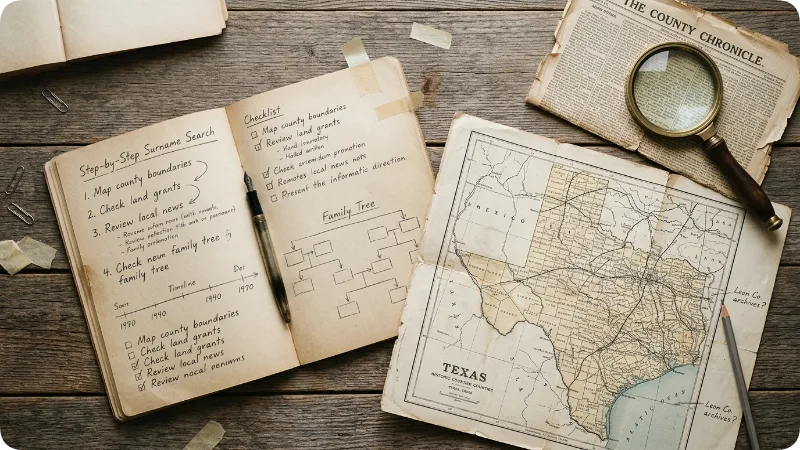
You do not need every detail to begin an obituary search. Even one identifying clue can help you find a useful starting point.
| What you know | What to search |
| Only a last name | Surname + Texas + obituary |
| First and last name | Full name + obituary |
| Last name and city | Surname + city + death notice |
| Approximate year of death | Surname + year + obituary |
| Maiden name | Maiden surname + married surname |
| Family member’s name | Surname + relative’s name |
| Historical family details | Surname + county + historical newspaper |
| Possible alternate spelling | Original surname + spelling variation |
This approach works for recent death announcements, older newspaper obituaries, and family history research. However, the number of available results depends on the newspaper, location, publication year, and digitization coverage.
Search Texas Obituaries by City and County

When a statewide search produces too many results, narrowing the search by city or county is often more effective. Local newspapers, libraries, and historical societies may preserve obituaries that are not available through national databases.
Houston and Harris County
For someone who lived in Houston or the surrounding area, begin with local newspaper archives, funeral home memorial pages, and Harris County genealogy resources.
Try searches combining the surname with Houston, Harris County, or nearby communities. If you cannot find a recent obituary, check the websites of funeral homes that serve the person’s last known residence.
Dallas and Tarrant County
Dallas and Fort Worth have extensive newspaper histories, making regional newspaper collections useful for historical research.
Search the person’s surname alongside Dallas, Fort Worth, Dallas County, or Tarrant County. The Dallas Public Library also provides access to historical newspaper collections, including print, microfilm, and selected digital resources.
Dallas Public Library+1
San Antonio and Bexar County
For people connected to San Antonio, explore local newspaper archives, funeral home websites, and historical collections.
Older records may appear in different newspaper titles or language editions. If the person or family had connections to Spanish language publications, try searching Spanish variations of the name and relevant death related terms.
Austin and Travis County
Austin area obituary research can begin with local newspaper archives, funeral homes, and resources maintained by the Texas State Library and Archives Commission.
For older records, search by surname and approximate publication year. If you cannot locate the original obituary online, contact a local library to ask about newspaper issues available on microfilm.
El Paso and West Texas
Search regional newspaper archives and local historical collections for people connected to El Paso and surrounding West Texas communities.
Older English and Spanish language notices may be indexed differently. Try both language variations and include nearby towns or counties when the person’s exact residence is uncertain.
How to Find Recent Texas Obituaries
Recent Texas obituaries are often easier to find through funeral home websites and local newspaper pages than through historical genealogy indexes.
Check Funeral Home Obituary Pages
Funeral homes frequently publish memorial notices for people whose services they arrange. These pages may include a full name, life dates, surviving relatives, service information, photographs, and guestbook messages.
Search for the person’s surname with the city and phrases such as:
- Funeral home obituary
- Memorial announcement
- Celebration of life
- Funeral services
- Memorial page
If you know which funeral home handled the arrangements, visit its website directly.
Search Local Newspaper Websites
Regional newspapers may publish full obituaries, short death notices, or paid memorial announcements.
These publications are not necessarily the same. A death notice may provide only the person’s name and service details, while a full obituary may describe their life, family, achievements, and community involvement.
Search the newspaper’s website using the person’s full name and approximate publication date.
Try Multiple Date Formats
Some websites organize obituaries according to publication date rather than the actual date of death.
If you know when the person passed away, try searching with:
- The complete date of death
- The month and year
- The approximate publication week
- The year alone
Using more than one date format can help uncover results that a narrow search misses.
Look Beyond the First Page of Results
A recently published obituary may not immediately appear in general search engine results. Some funeral home pages also take time to become searchable.
If you cannot find the notice, check the funeral home’s website directly, contact the provider, or repeat the search with a different combination of the person’s name and location.
Finding Historical Texas Obituaries for Family Research
Historical obituaries can provide valuable information about family connections, migration, and community history. They may mention parents, spouses, children, siblings, occupations, religious affiliations, military service, and burial locations.
For family history research, an obituary can offer clues that help you locate other records and understand how different generations were connected.
Use the Portal to Texas History
The Portal to Texas History is one of the most useful starting points for researching historical Texas newspapers.
Search for the person’s full name or surname, then narrow the results by publication date or newspaper title.
The portal recommends using search terms such as obit* to locate obituary related content. You can also try:
- Death notice
- In memoriam
- Funeral
- Passed away
- Memorial
If a search does not produce a result, try searching for the person’s name and approximate year without additional keywords. Older newspaper text recognition may not always identify names accurately.
The Portal to Texas History+1
Explore the Texas Obituary Index
The TXGenWeb Texas Obituary Index can help you identify possible obituary references for people born in Texas.
Search the relevant county or birthplace category and record any identifying details. If you locate a potential match, use the information to search newspaper archives, local libraries, funeral home records, or historical societies.
Keep in mind that the index does not provide every original obituary. Its purpose is to help researchers discover leads and locate the underlying publication.
TXGenWeb
Check Historical Death Indexes
The Texas State Library and Archives Commission provides access to historical vital statistics indexes containing information about selected Texas births, deaths, marriages, and divorces.
These indexes can help identify a person’s recorded death date, county, and sometimes a certificate file number. However, the library does not hold the original death certificates in this collection.
The Texas Department of State Health Services also provides information about death records and historical indexes. State death records date back to 1903, although the availability of particular indexes and records varies by year.
Texas State Library+1
For deaths before statewide registration began, county level records, church registers, cemetery records, and historical newspapers may be particularly important.
Obituaries vs. Texas Death Records: What’s the Difference?
An obituary and a death certificate serve different purposes. An obituary generally describes a person’s life and family, while a death certificate is an official vital record.
Understanding the difference can help you choose the right source for your research.
| Record type | What it may tell you | Best use |
| Obituary | Life story, relatives, achievements, and service details | Family history and remembrance |
| Death notice | Basic information about a death or funeral | Finding published announcements |
| Death index | Name, date, county, or certificate reference | Locating a death record |
| Death certificate | Official information about a person’s death | Legal and genealogical verification |
| Cemetery or burial record | Burial location, dates, or plot information | Locating a grave and researching ancestry |
Can You Access Texas Death Records?
The Texas Department of State Health Services (DSHS) maintains state death records and provides instructions for requesting certified death certificates and death verifications.
A death verification letter can confirm if a death record is on file and provide the person’s name, date of death, and county of death. DSHS states that these verifications are available for deaths recorded since 1903, but they are not legal substitutes for certified death certificates.
Access to certified death certificates is restricted. For deaths within the past 25 years, only qualified applicants, including eligible immediate family members or people who can establish the required legal interest, may obtain certified copies. Death records generally become public information after the 25th anniversary of the date of death, subject to applicable rules.
What to Do When You Cannot Find an Obituary
Not every death results in a published obituary, and not every newspaper notice has been digitized. A missing search result does not necessarily mean that an obituary never existed.
If your initial search is unsuccessful, try these steps:
- Broaden the date range: The obituary may have appeared several days after the death.
- Search alternative surnames: Try maiden names, married names, nicknames, and spelling variations.
- Check neighboring counties: The notice may have appeared in the community where the person was buried or where relatives lived.
- Contact a local library: Ask if its newspaper collection includes the relevant publication and year.
- Search funeral home archives: Older memorial pages may be organized by service date rather than name.
- Use death indexes: An index may help establish the approximate death date and county, giving you a more focused starting point.
You can also contact a local historical society or genealogy organization for guidance when researching older family records.
Tips for Searching Common Texas Last Names
Common surnames such as Smith, Johnson, Williams, Brown, and Garcia can produce hundreds of unrelated results. The best approach is to combine multiple identifying details rather than relying on the surname alone.
| Search challenge | Better approach |
| Common surnames such as Smith or Johnson | Add first name, city, and approximate year |
| Multiple people with the same full name | Compare ages, relatives, and residence |
| Name changed after marriage | Search both maiden and married surnames |
| Uncertain spelling | Try spelling variations and initials |
| Older newspaper with poor text recognition | Search fewer terms or browse newspaper pages manually |
| Family member born in another state | Search Texas records and the person’s earlier home state |
| Hispanic family naming traditions | Search both paternal and maternal surnames |
One useful technique is to search for a known family member. A spouse’s name, parent’s maiden name, or adult child’s name may lead to an obituary that a surname only search misses.
If you are building a family tree, record the original source, publication name, and publication date alongside each discovery. This makes it easier to distinguish verified information from possible matches.
Frequently Asked Questions
How can I search Texas obituaries by last name for free?
Start with the Portal to Texas History, TXGenWeb Texas Obituary Index, FamilySearch, public library genealogy collections, and funeral home websites. These resources provide free access to various historical records and obituary information. Some newspaper databases offer additional content through paid subscriptions or participating libraries.
Can I find old Texas obituaries by surname?
Yes. Historical newspaper archives, genealogy indexes, and local library collections can help you locate older Texas obituaries. Search by surname, county, and approximate year of death. Coverage varies depending on the newspaper, location, and publication period.
Can I search Texas obituaries without knowing the first name?
Yes. Begin with the last name and combine it with a likely city, county, or approximate year. If the surname is common, search for relatives’ names or browse newspaper issues from the relevant period.
Are Texas obituaries public records?
Published obituaries are generally accessible through the newspapers, funeral homes, and archives that host them, although some websites require registration or payment. Official death certificates are different. Texas generally restricts access to certified death records for the first 25 years after death, with eligibility requirements applying to recent records.
How do I find a Texas obituary from many years ago?
Search historical newspapers through the Portal to Texas History, TXGenWeb, and local library collections. Use the person’s surname, approximate year, and known city or county. For older deaths, county records, church registers, and original newspaper issues may provide additional information.
What is the difference between a Texas obituary and a death certificate?
An obituary is a published account of someone’s death and life. It may describe family relationships, personal achievements, and funeral arrangements. A death certificate is an official vital record documenting the death. An obituary is useful for family research, while a death certificate provides formal verification.
Can I find a Texas obituary by county?
Yes. County based searches can help narrow your results and identify local newspapers, libraries, and genealogy resources. TXGenWeb provides county based research leads, while the Texas State Library and Archives Commission can help you locate historical newspaper and vital statistics collections.
Why can’t I find an obituary even though I know the person died in Texas?
The family may not have published an obituary, the notice may not be digitized, or the record may appear under another name or in a neighboring community’s newspaper. Try funeral home archives, historical newspapers, local libraries, and official death indexes as alternative sources.
Can I find a Texas death record from before 1903?
Yes, but research may require additional effort. Texas statewide death registration began in 1903, so earlier deaths may not appear in state death indexes. Search county courthouse records, church registers, cemetery records, historical newspapers, and genealogy collections instead.
Conclusion
Finding Texas obituaries by last name becomes easier when you combine a surname with a location, date range, or family connection. Start with free online newspaper archives and obituary indexes, then explore funeral home websites, local libraries, and historical records when you need additional information.
For recent deaths, funeral home memorial pages and local newspapers are often useful starting points. For older family history research, the Portal to Texas History, TXGenWeb, and Texas State Library collections can help uncover valuable records.
If you are remembering someone you knew or tracing a family connection across generations, every discovery can reveal another part of a person’s story. Take time to compare names and dates, verify important details, and preserve your sources for future research.

Liam tracks digital culture, internet aesthetics, and social media branding. He creates unique, memorable usernames and handles for creators who want to stand out on TikTok, Instagram, and YouTube. In his free time, he edits aesthetic short-form videos.