Use up and down arrow keys to resize the meta box pane.
A last name can be a tiny piece of history carried through generations.
Use up and down arrow keys to resize the meta box pane.
Some Germanic surnames preserve the occupation of an ancestor. Others point toward a village, landscape, family relationship, physical characteristic, or an old personal name. A surname such as Schmidt can take you back to the work of a blacksmith, while Berg evokes a hill or mountain landscape. Wolf carries an entirely different kind of imagery, rooted in an ancient Germanic animal symbol.
That is what makes Germanic last names so fascinating. They are not simply old fashioned family labels. They can preserve clues about language, geography, occupation, ancestry, and the communities in which earlier generations lived.
If you’re researching a family tree, writing a historical character, looking for a surname for a story, or simply searching for a strong Germanic family name, the most useful place to begin is understanding where these surnames came from.
What Are Germanic Last Names?
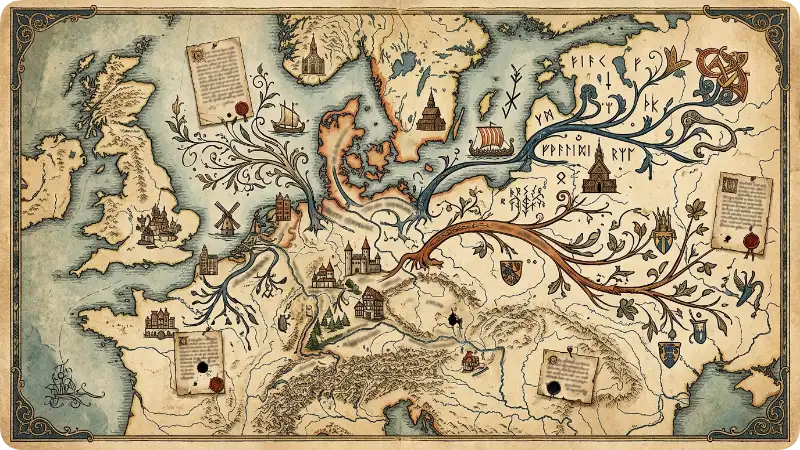
Germanic last names are surnames associated with Germanic language cultures and naming traditions, including German speaking regions as well as Scandinavian, Dutch, English, and related historical traditions.
The term is broader than German surnames.
For example, Berg can occur in German and Dutch traditions as well as Scandinavian naming traditions, while Anderson has German, Scottish, northern English, and Scandinavian connections.
Historically, surnames could develop from several sources:
- Occupations — Schmidt, Schneider, Weber, Becker
- Places and landscapes — Berg, Bergmann
- Parentage — Anderson, Peterson
- Personal characteristics — Klein, Krause
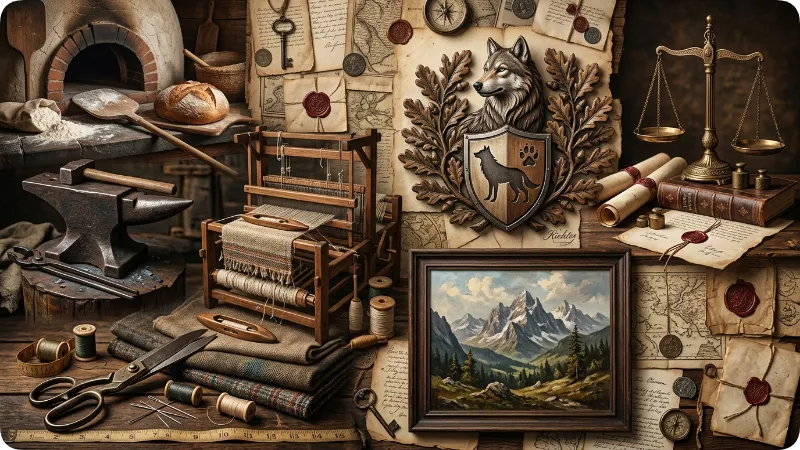
- Animals and natural imagery — Wolf
- Status or social roles — Richter, Hoffmann
- Personal names that eventually became hereditary surnames
German surname research sources identify occupation, residence, place of origin, patronymics, and physical or character traits among the major categories.
Germanic vs. German: What Is the Difference?
This distinction matters.
German generally refers specifically to Germany and the German language or German speaking traditions.
Germanic is a much broader historical and linguistic category. It includes German alongside languages such as English, Dutch, Danish, Swedish, Norwegian, and others.
So a surname can have Germanic roots without being specifically German.
How Germanic Surnames Developed
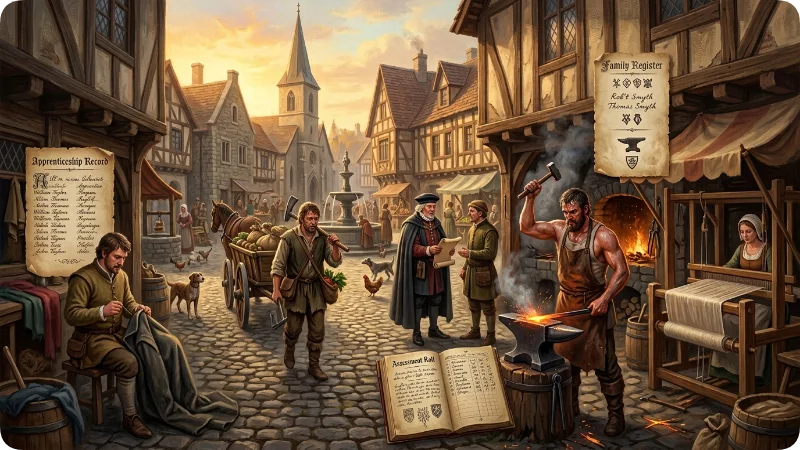
Hereditary surnames did not appear everywhere at exactly the same time.
In German speaking areas, surnames developed gradually, with many emerging between roughly the 12th and 14th centuries and becoming increasingly necessary for administrative purposes such as taxation and military service.
Early bynames might distinguish one person from another:
- the blacksmith
- the person from the mountain
- someone’s son
- the farmer at a particular estate
- the person with curly hair
- the person associated with a particular animal
Over time, these descriptions could become inherited family names.
German surname spelling also wasn’t always fixed. Historical records can contain multiple spellings of what is essentially the same family name because scribes wrote names phonetically or according to regional conventions.
That is why genealogy sometimes turns into detective work.
The Main Types of Germanic Last Names
| Type | What it describes | Examples |
| Occupational | An ancestor’s profession | Schmidt, Weber, Schneider |
| Patronymic | A father’s or ancestor’s given name | Anderson, Peterson |
| Topographic | Landscape or physical location | Berg, Bergmann |
| Habitational | A particular place of residence or origin | Various regional forms |
| Status based | Position or social role | Richter, Hoffmann |
| Descriptive | Appearance or character | Klein, Krause |
| Animal based | Animal imagery or bynames | Wolf |
| Personal name based | An older given name | Many regional surname forms |
The categories often overlap. A single surname can have more than one historical explanation depending on region and family line.
That is an important point when researching surname meanings: a dictionary meaning is not automatically the story of every family carrying that name.
Famous Germanic Last Names and Their Meanings
Schmidt
Meaning: Blacksmith
Origin: German
Language: German
Type: Occupational surname
Pronunciation: Approximately “shmit”
Gender: Unisex surname
Historical meaning: Schmidt derives from German Schmied, referring to a blacksmith. Related historical spellings include Schmid, Schmitt, Schmit, and others.
Personality vibe: Strong, practical, hardworking
Aesthetic: Traditional, industrial, sturdy
Social impression: Familiar and established
Similar surnames: Schmid, Schmitt, Schmied
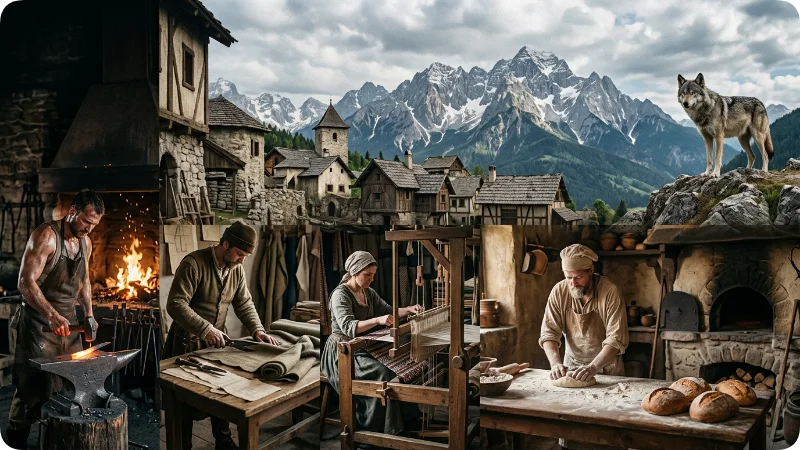
Schmidt is one of those surnames whose original meaning immediately gives you a picture: fire, metal, tools, and skilled craftsmanship.
It is an excellent example of how an ordinary occupation could become a lasting family identity.
Schneider
Meaning: Tailor; literally connected with “cutter”
Origin: German
Language: German
Type: Occupational surname
Pronunciation: Approximately “SHNAY der”
Gender: Unisex surname
Schneider comes from Middle High German snīder and German Schneider. It traditionally referred to a tailor, although the term could also be associated with a woodcutter.
Personality vibe: Creative, precise, refined
Aesthetic: Vintage European
Social impression: Traditional and sophisticated
Similar names: Snyder, Snider, Schmieder
For fiction, Schneider can work particularly well for a character connected with fashion, craftsmanship, or an old European family.
Weber
Meaning: Weaver
Origin: German
Language: German
Type: Occupational surname
Pronunciation: Approximately “VAY ber”
Gender: Unisex surname
Weber comes from the German word associated with weaving and was an occupational surname for a weaver.
Personality vibe: Artistic, patient, meticulous
Aesthetic: Old world artisan
Social impression: Traditional and grounded
Similar surnames: Weaver, Webber
There is something particularly evocative about Weber because its original occupation suggests textile work, craft, and patience.
Becker
Meaning: Baker
Origin: German/Dutch
Language: German and Dutch
Type: Occupational surname
Pronunciation: Approximately “BEK er”
Gender: Unisex surname
Becker is an occupational surname associated with a baker. Its roots connect with Middle High German and Middle Dutch words related to baking.
Personality vibe: Warm, practical, traditional
Aesthetic: Rustic European
Social impression: Familiar and approachable
Similar surnames: Bäcker, Backer, Beck
It has a warmer emotional character than surnames associated with metalworking or military imagery.
Wagner
Meaning: Carter or cartwright
Origin: German
Language: German
Type: Occupational surname
Pronunciation: Approximately “VAHG ner”
Gender: Unisex surname
Wagner comes from a term associated with a wagon or cart and historically referred to a carter or, in some dialects, a cartwright.
Personality vibe: Strong, mobile, industrious
Aesthetic: Historic European
Social impression: Established and substantial
Similar surnames: Wagener, Waggoner
The name is also strongly recognizable because of its association with the German composer Richard Wagner, although that cultural association should not be confused with the surname’s occupational origin.
Richter
Meaning: Judge or arbiter
Origin: German
Language: German
Type: Occupational/status surname
Pronunciation: Approximately “RIKH ter”
Gender: Unisex surname
Richter comes from Middle High German rihtære and referred to an arbiter or judge. In some regions, the term could also refer to a village headman.
Personality vibe: Authoritative, serious, disciplined
Aesthetic: Formal, traditional, scholarly
Social impression: Strong and respectable
Similar surnames: Rihtar, Rihter
For a fictional character, Richter immediately gives a surname a formal, authoritative tone.
Hoffmann
Meaning: Steward or person associated with a farm/manor
Origin: German
Language: German
Type: Status/occupational surname
Pronunciation: Approximately “HOFF man”
Gender: Unisex surname
Hoffmann comes from Hof, referring to a farm, manor farm, or courtyard, combined with Mann, “man.” It historically referred to a farmer or steward associated with an estate.
Personality vibe: Established, responsible, traditional
Aesthetic: Old European estate
Social impression: Formal and historic
Similar surnames: Hofmann, Hofman, Homann
Berg
Meaning: Mountain or hill
Origin: German/Dutch and Scandinavian traditions
Language: Germanic
Type: Topographic or habitational surname
Pronunciation: Approximately “beark” in German
Gender: Unisex surname
Berg is associated with a hill or mountain. In German and Dutch contexts it can describe someone who lived by a hill or mountain; Scandinavian forms have related landscape origins.
Personality vibe: Strong, independent, outdoorsy
Aesthetic: Alpine, Nordic, minimalist
Social impression: Clean and powerful
Similar surnames: Bergmann, Bergman, Vandenberg
Berg is particularly attractive if you want a surname with a simple form but a vivid natural image.
Bergmann
Meaning: Mountain man; mountain dweller; sometimes miner
Origin: German
Language: German
Type: Topographic/occupational surname
Pronunciation: Approximately “BERK man”
Gender: Unisex surname
Bergmann combines Berg (“mountain”) with Mann (“man”). It could describe a mountain dweller and, in some contexts, a miner.
Personality vibe: Rugged, resilient, outdoorsy
Aesthetic: Alpine, industrial, old world
Similar surname: Berg
Wolf
Meaning: Wolf
Origin: Germanic
Language: German, English, Dutch, Danish traditions
Type: Animal based/personal name surname
Pronunciation: Approximately “vulf” in German
Gender: Unisex surname
Wolf is particularly interesting because it can come from shortened ancient Germanic compound personal names containing wolf, from a nickname, or from a house or place associated with a wolf.
Personality vibe: Fierce, independent, mysterious
Aesthetic: Nordic, forest, gothic
Social impression: Strong and memorable
Similar surnames: Wolfe, Wolff
The wolf also had an important place in ancient Germanic mythology, although the surname’s specific origin depends on the individual family history.
Germanic Last Names by Meaning
Germanic Last Names Meaning Strength
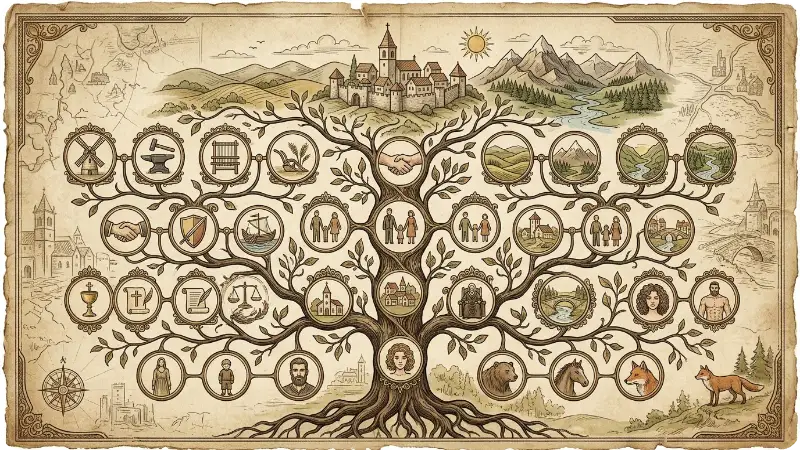
If you want a surname with a strong emotional impression, consider names connected with physical power, authority, or resilient landscapes.
- Wolf
- Berg
- Bergmann
- Richter
- Schmidt
- Wagner
These do not all literally mean “strength.” Rather, their historical meanings create different associations: wolf imagery, mountains, authority, craftsmanship, and hard physical work.
Germanic Last Names Connected to Nature
- Berg — mountain/hill
- Wolf — wolf
- Linden related surnames — associated with the linden tree
- Schwarz — black
- Braun — brown
Nature based surnames can have a particularly strong fantasy and historical fiction quality.
Germanic Occupational Last Names
Some of the clearest Germanic surname meanings come from occupations.
- Schmidt — blacksmith
- Schneider — tailor
- Weber — weaver
- Becker — baker
- Wagner — carter/cartwright
- Richter — judge or arbiter
Occupational surnames are a major category in German naming history.
Germanic Last Names With a Powerful Sound
If your priority is the sound rather than the literal translation, these surnames have a particularly strong visual or phonetic presence:
- Adler
- Berg
- Brandt
- Falk
- Fischer
- Grimm
- Kaiser
- Keller
- König
- Krüger
- Richter
- Ritter
- Schwarz
- Stein
- Wolf
- Wagner
A powerful sounding surname does not necessarily have a “powerful” historical meaning. This is an important distinction between verified etymology and modern aesthetic interpretation.
For example, Wolf genuinely has animal related historical origins, while the feeling of “dangerous” or “fierce” is a modern interpretation of that imagery.
Germanic Last Names With a Noble or Aristocratic Feel
Some surnames feel aristocratic because of their historical associations, sound, geographic connections, or literary use.
- von Hohenberg
- von Stein
- von Berg
- von Falken
- König
- Kaiser
- Ritter
- Adelmann
- Falkenberg
- Schönberg
A note about “von”
The particle von has a complicated history and should not automatically be interpreted as proof of nobility.
It can occur in German surnames connected with places or geographic descriptions. While von became strongly associated with parts of the German nobility, not every surname containing von should be casually treated as evidence that a family was aristocratic.
That distinction matters if you are researching an actual family rather than choosing a fictional surname.
Germanic Last Names for Characters
Germanic surnames can be particularly useful for historical fiction, fantasy, role playing characters, games, novels, and worldbuilding.
The scholar
Richter, Weber, Hoffmann, Stein
These have an academic, professional, or serious sound.
The warrior
Wolf, Falk, Brandt, Ritter
These create a harder, more dramatic impression.
The noble character
Falkenberg, Hohenberg, Schönberg, von Stein
These work particularly well when the story calls for an aristocratic or old European atmosphere.
The mysterious character
Schwarz, Wolf, Nachtmann, Vesper like invented forms
For invented surnames, be careful not to present a newly created combination as a historically verified German surname.
The village artisan
Schmidt, Schneider, Weber, Becker
These are especially useful when you want a character’s family background to subtly reflect an inherited occupation.
Germanic Last Names for Baby Names
Some parents choose surnames because they want something that feels distinctive as a first name or middle name.
The most wearable options tend to be relatively short:
- Berg
- Wolf
- Adler
- Brandt
- Falk
- Stein
- Keller
- Fischer
- Wagner
- Richter
However, surname as first name trends are modern naming choices. They should not be confused with the historical purpose of the original surname.
What makes a good surname style baby name?
Look for:
Easy pronunciation
A name that people can read and say without constant correction.
Strong visual identity
Names such as Wolf, Berg, and Stein are visually memorable.
Cultural accuracy
If heritage matters, investigate the actual family or regional connection instead of selecting a surname solely because it “sounds German.”
Sibling compatibility
A dramatic surname style first name may work beautifully beside a simple sibling name—or feel excessive beside another highly elaborate name.
Germanic Surname Variations and Spelling
One of the most overlooked parts of German surname research is spelling.
A family name may appear in historical records in several forms because spelling conventions were not standardized.
For example, Schmidt has historical variants including Schmid, Schmitt, Schmit, and related forms.
Migration could create another layer of change.
German immigrants to North America sometimes saw surnames altered or anglicized, either intentionally or because officials recorded names according to how they heard them. Examples include Müller → Mueller and Braun → Brown.
That means searching only one spelling can cause genealogy research to miss important records.
Germanic Last Names and Cultural Identity
A surname can preserve cultural information, but it does not automatically prove a person’s complete ancestry.
A surname can move across borders.
Schmidt, for example, became established in numerous European countries, while Berg occurs in German, Dutch, Norwegian, Danish, and Swedish contexts.
Migration, marriage, language change, translation, and administrative spelling all influence how surnames travel.
This is why the strongest genealogy research combines the surname with:
- Birth records
- Marriage records
- Death records
- Census information
- Immigration documents
- Historical locations
- Church records
- Variant spellings
- Family relationships
A surname is a clue—not a complete family history.
Germanic Last Names: Quick Reference
| Last name | Historical meaning/origin | Type | Overall vibe |
| Schmidt | Blacksmith | Occupational | Strong, practical |
| Schneider | Tailor/cutter | Occupational | Skilled, refined |
| Weber | Weaver | Occupational | Artistic, traditional |
| Becker | Baker | Occupational | Warm, familiar |
| Wagner | Carter/cartwright | Occupational | Industrious, historic |
| Richter | Judge/arbiter | Status/occupation | Authoritative |
| Hoffmann | Farm/estate steward | Status/occupation | Established |
| Berg | Hill/mountain | Topographic | Rugged, natural |
| Bergmann | Mountain dweller/miner | Topographic/occupational | Rugged |
| Wolf | Wolf; several possible origins | Animal/personal name | Fierce, mysterious |
| Anderson | Son of Anders / related forms | Patronymic | Familiar, northern European |
| Peterson | Son of Peter / related forms | Patronymic | Traditional |
Meanings in this table refer to documented surname origins, while the “overall vibe” column is an editorial interpretation rather than historical fact.
Lucky Attributes and Numerology
Surname websites often attach lucky numbers, gemstones, colors, zodiac signs, or numerology meanings to names.
These can be entertaining modern naming interpretations, but there is no reliable historical basis for claiming that a Germanic surname inherently possesses a lucky number, lucky day, gemstone, or zodiac sign.
For example:
| Surname | Modern aesthetic color | Fun gemstone association | Style |
| Wolf | Charcoal | Onyx | Dark, wild |
| Berg | Forest green | Emerald | Natural, rugged |
| Schmidt | Iron gray | Hematite | Industrial |
| Ruby related names | Deep red | Ruby | Vintage |
| Richter | Navy | Sapphire | Formal |
| Weber | Warm brown | Amber | Artisan |
These are creative associations, not etymological facts.
The same principle applies to numerology. A numerology system may assign a number based on spelling, but that number is a modern interpretive practice rather than a historical property of the surname.
How to Choose a Germanic Last Name
The right surname depends on what you are using it for.
For genealogy
Prioritize:
- Historical spelling
- Region
- Earliest documented ancestor
- Migration records
- Variant spellings
For a baby name
Prioritize:
- Pronunciation
- Cultural connection
- First and middle name flow
- Sibling compatibility
- Long term usability
For fiction
Prioritize:
- Historical setting
- Geographic accuracy
- Character personality
- Social background
- Pronunciation and readability
For fantasy
You can take more creative liberties, but separate authentic historical surnames from invented names.
That small distinction makes a world feel much more believable.
FAQs About Germanic Last Names
What are Germanic last names?
Germanic last names are surnames associated with Germanic language cultures and historical naming traditions. The category is broader than German surnames and can include German, Scandinavian, Dutch, English, and related surname traditions.
What are common types of Germanic surnames?
Major categories include occupational, patronymic, geographical, topographic, descriptive, animal based, and status related surnames.
What is the most famous German occupational surname?
Schmidt is one of the best known examples. It derives from the German occupational term for a blacksmith.
What Germanic last name means blacksmith?
Schmidt is a German surname derived from Schmied, meaning blacksmith. Related forms include Schmid and Schmitt.
What Germanic surname means mountain?
Berg is associated with “mountain” or “hill” and occurs in German, Dutch, and Scandinavian surname traditions.
What Germanic surname means wolf?
Wolf can derive from ancient Germanic personal names containing the element wolf or from a nickname or other wolf related designation.
What German surname means weaver?
Weber is an occupational surname meaning a weaver.
What German surname means tailor?
Schneider is an occupational surname associated with a tailor and literally connects with the idea of a cutter.
Are all Germanic surnames actually German?
No. “Germanic” is a broader category. A surname can belong to a Scandinavian, Dutch, English, or German tradition while sharing a wider Germanic linguistic heritage.
Can a Germanic surname prove German ancestry?
No. A surname can provide a useful research clue, but migration, spelling changes, translation, and adoption of surnames across regions mean that a surname alone cannot establish someone’s complete ancestry.
Why do German surnames have different spellings?
Historical spelling was not always standardized. Scribes could record the same surname differently, and later migration could introduce additional spelling or anglicization changes.
Final Thoughts
Germanic last names are miniature records of everyday life.
A Schmidt points toward metalworking.
A Weber preserves the memory of weaving.
A Schneider recalls tailoring.
A Berg connects a family name with landscape.
A Wolf carries an older animal image into a modern surname.
A Richter remembers a legal or administrative role.
And that is the real appeal of Germanic surnames: their meanings often begin with something ordinary—a job, a place, a parent, a landscape, or a nickname—and eventually become part of a family’s identity.
If you’re researching your own surname, don’t stop at the translation. Look for the oldest spelling you can document, identify the region where your family lived, compare historical variants, and trace the records of individual ancestors.

Liam tracks digital culture, internet aesthetics, and social media branding. He creates unique, memorable usernames and handles for creators who want to stand out on TikTok, Instagram, and YouTube. In his free time, he edits aesthetic short-form videos.