A last name can look like an ordinary part of your identity, but many surnames began as tiny clues about a person: who their father was, where they lived, what work they did, what they looked like, or which community they belonged to.
The fascinating part is that most people did not simply sit down one day and choose a permanent family name. In many societies, surnames developed gradually from descriptive bynames used to distinguish people with the same first name. Over generations, some of those bynames became fixed and hereditary.
The exact process differed enormously from one culture to another. There was no single moment when the world “invented” last names.
How Were Last Names Created?
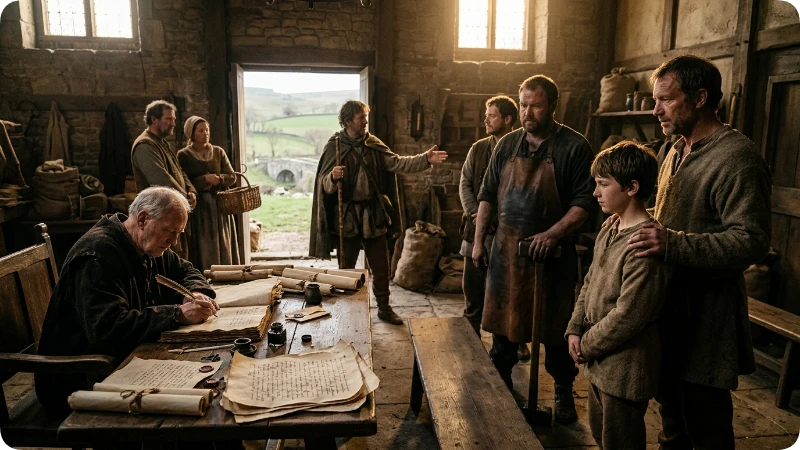
Last names were generally created from information that helped distinguish one person from another. Common sources included parents, occupations, places, physical characteristics, nicknames, and family or clan relationships.
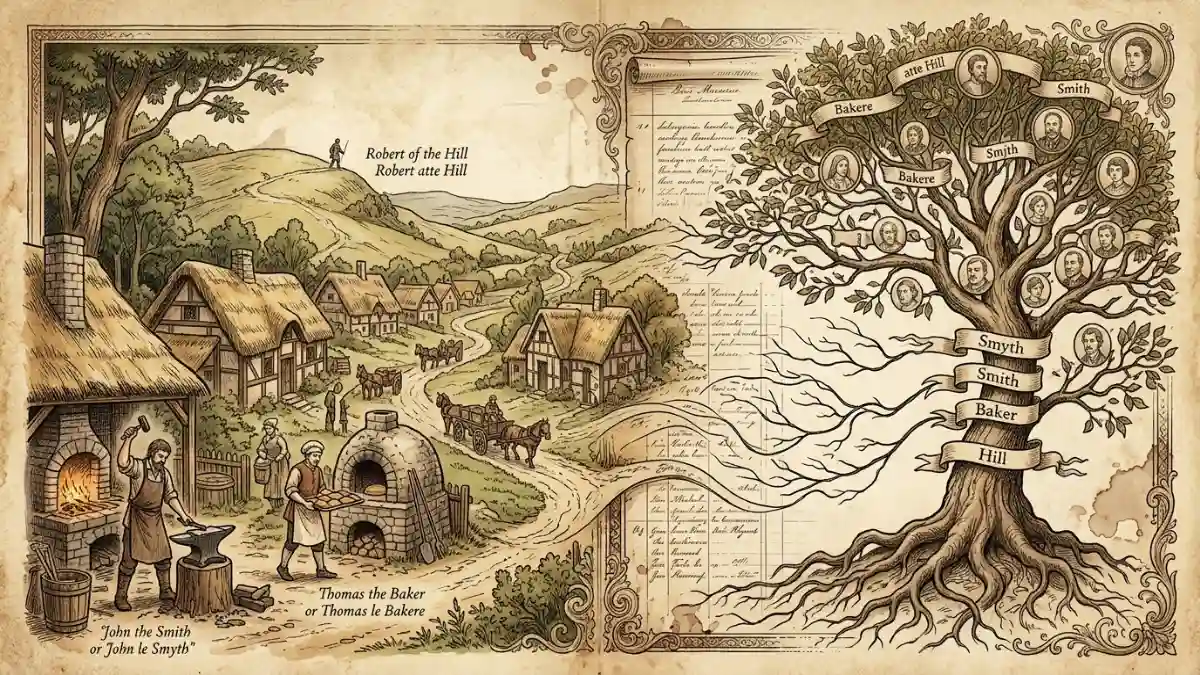
Imagine a village where several men are named John. People might distinguish them as:
- John, the son of William
- John the baker
- John from the hill
- John who lived near the wood
- John the young
- John from a particular farm or settlement
Eventually, expressions like these could become surnames.
The important distinction is that an early byname was not always a permanent family name. In many places, surnames only gradually became inherited from parents to children.
In England, for example, surname use became widespread by about the 1300s, but surnames were not yet completely consistent or necessarily passed from parent to child. Spelling could also vary considerably between records.
Why Were Last Names Needed?
Population growth made individual identification more difficult.
When a community was small, a single given name might be enough. But as towns expanded and more people shared common first names, additional identifiers became useful. The Library of Congress notes that the growing size of European towns contributed to the use of additional names for distinguishing people.
Records, property ownership, taxation, legal documents, churches, and government administration also encouraged more consistent identification.
That practical need helped turn temporary descriptions into names that could survive across generations.
The Main Ways Last Names Were Created
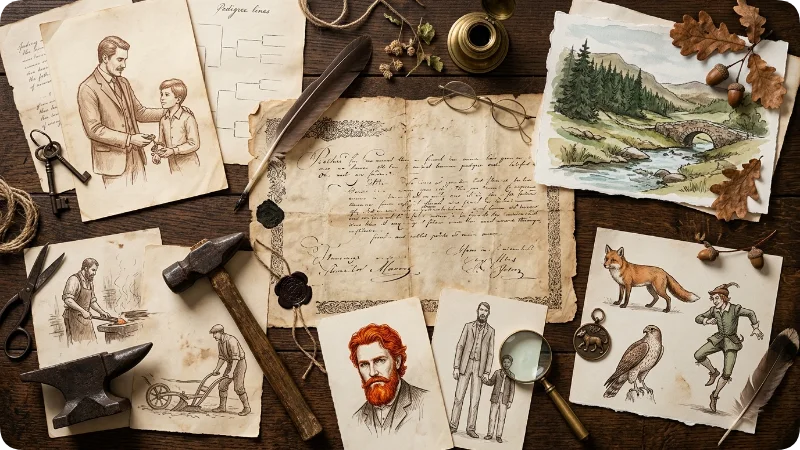
| Type of surname | How it developed | Examples |
| Patronymic | From a father’s or ancestor’s given name | Johnson, Hansen |
| Matronymic | From a mother’s name | Some surnames derived from female ancestors |
| Occupational | From a person’s work | Smith, Baker, Miller |
| Locational | From a place or landscape | Hill, Woods, Lake |
| Descriptive | From appearance or personality | Young, Little, Strong |
| Clan or family based | From lineage or ancestral groups | MacDonald and similar forms |
| Natural/ornamental | From animals, plants, objects, or nature | Fox, Stone, Berg |
These categories overlap. A single surname can also have different origins in different regions, so a familiar looking surname should not automatically be assigned one universal meaning.
Patronymic Last Names: “Son of” and Family Lineage
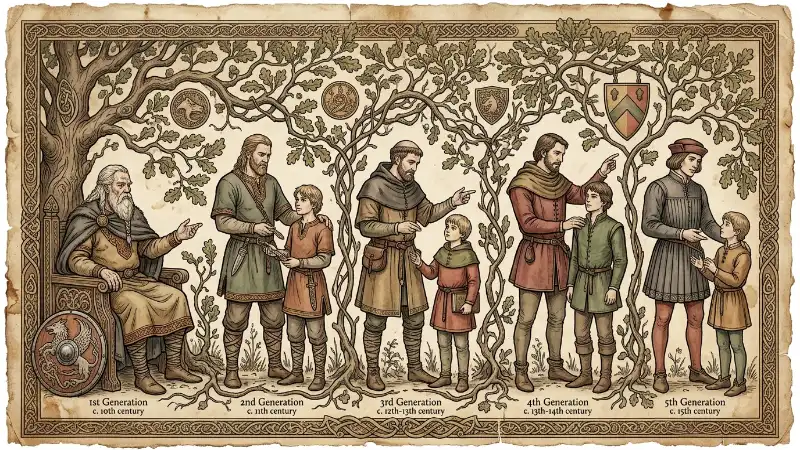
One of the most recognizable ways surnames developed was through patronymics—names connected to a father or male ancestor.
For example, a man named John might have a son identified as John son, eventually producing the surname Johnson.
Different languages created their own patterns.
| Pattern | Example | Basic idea |
| English | Johnson | Son of John |
| Scandinavian | Hansen | Son of Hans |
| Slavic | Petrovic | Associated with/descended from Peter |
| Gaelic | MacDonald | Son of Donald |
But there is an important historical twist: a patronymic was not always hereditary.
In traditional Scandinavian systems, for example, the father’s given name could generate a child’s surname, meaning the family name changed with each generation. Iceland still primarily uses patronymic or matronymic naming rather than a conventional inherited family surname.
So Johnson can be a hereditary surname today, while similar “son of” systems historically functioned as a changing description of parentage.
Occupational Surnames Came From Everyday Work
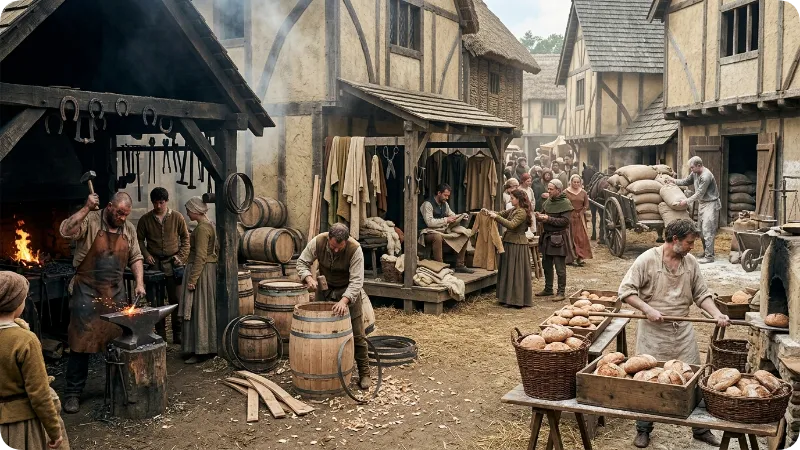
Some of the most familiar surnames began with someone’s occupation.
Smith, Baker, Miller, Potter, Cooper, Tailor, and similar names could identify people by the work they performed.
These names are especially interesting because they preserve traces of ordinary economic life. A surname such as Miller can point toward the importance of milling grain, while Cooper reflects the traditional craft of making barrels and casks.
But occupational surnames should not be treated as proof that every modern person carrying the surname has an ancestor who practiced that exact trade. A surname’s origin can be complicated, and the same spelling may have developed independently in different places.
Why Occupational Names Feel So Familiar
Occupational surnames have an unusually direct quality.
Smith feels sturdy and practical.
Miller feels rural and traditional.
Cooper feels craft oriented and old world.
Baker feels warm and domestic.
Those are modern aesthetic impressions—not historical definitions—but they explain why occupational surnames remain appealing in fiction, character naming, genealogy projects, and even modern baby name inspiration.
Place Names Became Family Names
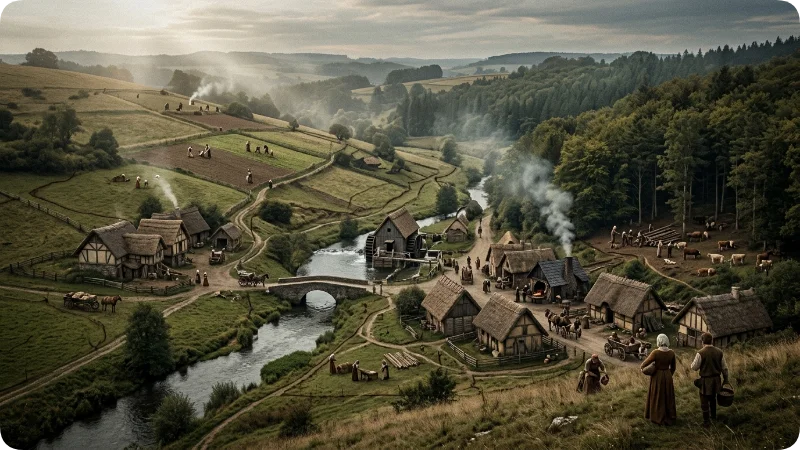
Another major source was geography.
A person could be identified according to:
- A village or town
- A farm
- A nearby river
- A hill
- A forest or wood
- A valley
- A regional homeland
- A recognizable landmark
Names such as Hill, Woods, Lake, Beach, and Meadows illustrate the broader pattern of surnames derived from landscape or location.
Someone who moved from one settlement to another might also acquire a name identifying their place of origin.
This is one reason surnames can act like miniature maps. They may preserve a connection to a landscape even after a family has moved hundreds or thousands of miles away.
Descriptive Surnames Came From Appearance and Personality
Not every surname was flattering.
Some were based on physical appearance, age, size, color, temperament, or another distinguishing characteristic.
Examples include names such as Young, Little, Strong, Brown, or Bigg.
A descriptive byname might have been useful because several people shared the same given name.
For example, if a village contained two men called William, one might become known informally as “William the younger.” Over time, a descriptor could become attached to a family.
This category reminds us that surnames were originally practical labels rather than carefully designed family brands.
Nicknames Could Become Permanent Surnames
Nicknames played a surprisingly important role.
A nickname might refer to someone’s:
- Appearance
- Temperament
- Physical strength
- Size
- Hair color
- Age
- Occupation
- Place of origin
- A memorable event
The Library of Congress notes that some surnames were imposed by friends, enemies, communities, or other people rather than deliberately selected by the person who carried them.
That makes surname history wonderfully human. Behind a modern family name may be an ordinary social observation that happened to survive for centuries.
When Did Last Names Become Hereditary?
This is where the history becomes more complicated.
A person could have a byname without their children automatically inheriting it.
Over time, however, some surnames became fixed family identifiers. Once a name was repeatedly passed from parent to child, it became hereditary.
The process happened at different times in different societies.
In medieval Europe, hereditary surnames developed gradually rather than appearing everywhere simultaneously. In England, surname use became widespread by around 1300, although spelling and inheritance remained inconsistent for centuries.
Also in Scandinavia, fixed surnames became established much later in some regions. Denmark moved toward fixed surnames during the 1800s, while Sweden ended its traditional patronymic system in 1901, Finland in 1921, and Norway in 1923. Iceland retained its patronymic tradition.
So there is no single answer to “When were last names created?”
A better question is:
When did a particular society begin treating additional personal names as permanent family names?
Last Names Did Not Develop the Same Way Everywhere
One of the biggest mistakes in surname history is assuming that the European hereditary surname model describes the entire world.
Different cultures developed very different systems.
Icelandic Names
Iceland provides one of the clearest examples of a living naming tradition that does not depend primarily on inherited family surnames.
A person’s name may identify them through their father’s or mother’s given name. The Library of Congress describes most Icelanders as being known by their first name plus a patronymic derived from the father’s given name.
Spanish Naming Traditions
Traditional Spanish naming commonly uses two surnames, historically connecting a person to both the paternal and maternal family lines. A person’s full name can therefore preserve more than one parental surname.
This is very different from the simplified assumption that everyone simply inherits one father’s last name.
Irish Surnames
Irish surnames also preserve older relationship and occupational patterns.
Prefixes such as Mac historically indicated descent, while Irish names could also develop from occupations and descriptive terms. Historical changes, including anglicization, altered the forms of many Irish surnames over time.
Scandinavian Patronymics
Traditional Scandinavian naming demonstrates particularly well why “last name” and “family name” are not always the same thing.
A name ending in a form meaning “son” could identify a person’s father without necessarily identifying a permanent surname shared by an entire family for centuries.
Famous Surname Examples and What They Reveal
Here are a few useful examples of how different surname categories work.
| Surname | Historical type | Meaning/origin | Modern vibe |
| Johnson | Patronymic | Descendant/son of John | Familiar, classic |
| Smith | Occupational | Associated with a smith | Strong, practical |
| Baker | Occupational | Associated with baking | Warm, friendly |
| Hill | Locational | Connected with a hill | Natural, simple |
| Young | Descriptive | Related to youth/age | Fresh, modern |
| Fox | Natural/descriptive | Connected with the fox | Clever, wild |
| Stone | Natural/topographical | Connected with stone or a stony place | Strong, minimalist |
| MacDonald | Patronymic/clan | “Son of Donald” | Celtic, traditional |
Historical note: The “modern vibe” column is an aesthetic interpretation, not the historical meaning of the surname.
That distinction matters. A surname can feel elegant, mysterious, gothic, powerful, vintage, or minimalist today without having originally carried that symbolism.
Why Surname Spellings Changed
If you’ve ever found an old family record containing several spellings of the same surname, that does not necessarily mean the family changed its name repeatedly.
Before standardized spelling became normal, names were often recorded according to pronunciation. The spelling could depend on the language, dialect, literacy of the writer, or the individual scribe creating the record.
That is why genealogy can become difficult.
A single family might appear under several spellings across historical documents.
For surname research, sound can sometimes be more important than modern spelling.
What Can Your Last Name Tell You?
A surname can provide clues about an ancestral story, but it should not be treated as a complete family biography.
It may suggest:
- An ancestral occupation
- A geographical connection
- A parent or ancestor’s given name
- A physical or personal descriptor
- A clan or lineage connection
- A migration history
- A linguistic background
- A historical naming tradition
But surname meanings are clues, not guarantees.
The same surname can have multiple independent origins, and a popular surname explanation found online may be simplified or incorrect.
For serious genealogy, compare the surname with birth records, marriage records, census documents, land records, church registers, immigration records, and other evidence. Historical records can be difficult because ordinary people were often less thoroughly documented than wealthy landowners, and medieval records themselves can be challenging to interpret.
How to Research Where Your Last Name Came From
If you want to investigate your own surname, start with the family rather than the internet’s most popular surname definition.
1. Find the oldest documented spelling
Look through birth, marriage, death, census, immigration, church, or land records.
2. Record every spelling
Don’t automatically “correct” unusual historical spellings. They may contain important clues.
3. Identify the family’s location
A surname with the same spelling can have different origins in different regions.
4. Look for naming patterns
Repeated first names, patronymics, maternal surnames, and geographic references can reveal how a family used names.
5. Separate evidence from tradition
A family story may be meaningful without being historically proven.
6. Compare multiple sources
A surname dictionary can suggest a possibility, but documentary evidence is much stronger.
The Most Interesting Thing About Last Names
Perhaps the most beautiful thing about surnames is that they were rarely created with the future in mind.
A person may have been called Smith because of work.
Another may have been called Hill because of where they lived.
Someone else may have become Johnson because people needed to distinguish him as John’s son.
A nickname that once described one individual could eventually become the inherited name of thousands of descendants.
That means a modern surname is often a linguistic fossil: a small surviving fragment of an older world.
It can preserve an occupation that disappeared, a landscape a family left behind, a parent’s name, an old language, or a community’s way of identifying its members.
Frequently Asked Questions
Why did people start using last names?
People began using additional names because given names alone were often insufficient to distinguish individuals, especially as communities and towns grew. These additional names could identify someone’s parent, occupation, location, appearance, or another distinguishing characteristic.
What were the first last names?
There was no single worldwide set of “first last names.” Different societies developed surnames at different times. In many European traditions, early surnames grew from patronymics, occupations, locations, and descriptive bynames.
Did everyone have a last name in medieval times?
No. Surname use varied by region, period, social group, and culture. Even in medieval England, surnames were not always used consistently or inherited from parent to child.
Are all people with the same surname related?
No. The same surname can arise independently in different places and from different sources. A shared surname alone is not enough to establish a family relationship.
Why do some surnames mean “son of”?
These are patronymic surnames. They identify a person’s relationship to a father or male ancestor. Examples include Johnson, Hansen, and many names using cultural prefixes or suffixes meaning “son of.”
Can a surname tell you what your ancestors did?
Sometimes. Occupational surnames can preserve the memory of an ancestral trade, but the surname alone does not prove that a particular ancestor practiced that occupation.
Why do old documents spell surnames differently?
Historical spelling was often not standardized. Scribes could record names phonetically, producing different spellings for the same person or family.
Are surnames always inherited from fathers?
No. Naming systems vary widely. Some cultures use maternal surnames, combined parental surnames, patronymics, matronymics, or other systems. Iceland, for example, traditionally uses patronymic and matronymic naming rather than a conventional inherited family surname.
Conclusion
Last names were created in many different ways, but the underlying purpose was remarkably simple: people needed better ways to identify one another.
A surname might begin as a father’s name, a trade, a landscape, a nickname, a physical description, or a connection to a particular community. With time, some of those temporary identifiers became permanent family names.
That is why a last name is more than a word at the end of a person’s full name. It can be a tiny record of ancestry, language, geography, work, migration, and memory.
And sometimes, the ordinary looking surname carried today is the surviving echo of a person who lived hundreds of years ago.
Emma helps authors, screenwriters, and gamers find the perfect names for their fictional characters. She analyzes historical trends and linguistic styles to craft names that carry deep meaning. When she isn’t writing, she loves plotting her next fantasy novel at a local café.