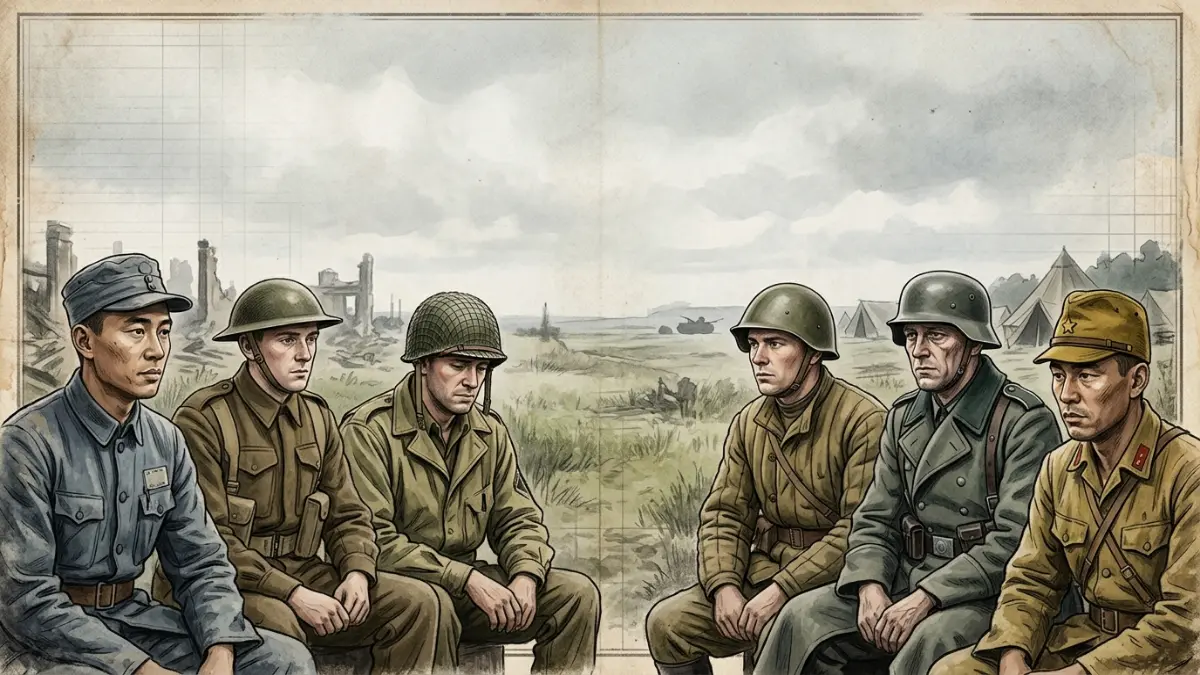
World War II left behind millions of personal stories, of courage, sacrifice, survival, and lives changed forever. Behind every military record was a person with a family, a hometown, and a name that became part of a much larger history.
If you’re researching famous World War 2 soldiers, looking for names for a history project, tracing a relative’s military service, or gathering historically inspired names for a book or game, this guide brings together notable soldiers and military figures from different countries and theaters of the war.
The list focuses on identifiable historical people, their national backgrounds, their wartime roles, and the legacies that make their names worth remembering. It also distinguishes soldiers from generals, resistance fighters, and other military personnel, so you can explore the history with greater accuracy.
Featured snippet
World War 2 soldiers’ names include famous military figures such as Audie Murphy, Richard Winters, Desmond Doss, Bernard Montgomery, Lyudmila Pavlichenko, Vasily Zaitsev, Erwin Rommel, Hiroo Onoda, and Witold Pilecki. These servicemembers represented different countries and roles, including infantry soldiers, medics, snipers, pilots, commanders, and resistance fighters. Their stories reflect the courage, sacrifice, and complex military history of World War II, making their names valuable for historical research, school projects, genealogy, and historically inspired character naming.
World War 2 Soldiers Names List at a Glance

The following table highlights notable military personnel from the Allied and Axis powers. Some were frontline soldiers, while others became famous as commanders, pilots, or resistance leaders.
| Name | Country | Wartime role | Historical association |
| Audie Murphy | United States | Infantry soldier | Decorated combat veteran |
| Desmond Doss | United States | Army medic | Conscientious objector and Medal of Honor recipient |
| Alvin York | United States | Earlier WWI veteran | Often confused with WWII soldiers |
| Richard Winters | United States | Army officer | 101st Airborne Division |
| Douglas MacArthur | United States | General | Pacific theater |
| Bernard Montgomery | United Kingdom | General | North African and European campaigns |
| Guy Gibson | United Kingdom | Bomber pilot | Dambusters raid |
| Lyudmila Pavlichenko | Soviet Union | Sniper | Eastern Front |
| Ivan Konev | Soviet Union | General | Eastern Front |
| Simo Häyhä | Finland | Sniper | Winter War, 1939–1940 |
| Erwin Rommel | Germany | Field marshal | North African campaign |
| Otto Carius | Germany | Tank commander | Eastern Front |
| Hiroo Onoda | Japan | Intelligence officer | Remained in hiding after the war |
| Chūichi Nagumo | Japan | Admiral | Pearl Harbor and Midway |
| Witold Pilecki | Poland | Resistance fighter and soldier | Auschwitz resistance and intelligence |
| Tadeusz Bór Komorowski | Poland | Military commander | Warsaw Uprising |
Historical note: Alvin York and Simo Häyhä are included as useful comparisons, but their best known combat records belong to World War I and the Winter War, respectively, rather than the main World War II campaigns. Rank, role, and national affiliation matter when compiling a historically accurate list.
Famous American World War 2 Soldiers’ Names
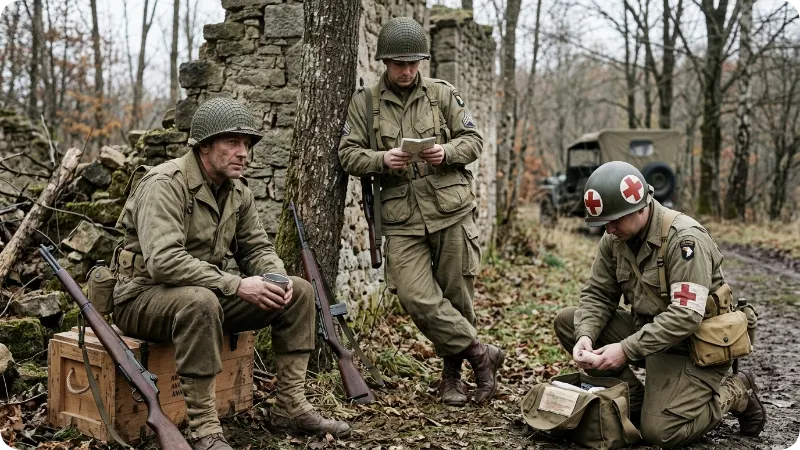
American soldiers served in Europe, North Africa, and the Pacific. Their experiences ranged from infantry combat and battlefield medicine to airborne operations and tank warfare.
| Soldier | Role | Why the name is remembered |
| Audie Murphy | Infantryman | One of America’s most decorated WWII combat soldiers |
| Desmond Doss | Combat medic | Saved wounded soldiers while refusing to carry a weapon |
| Richard Winters | Army officer | Led airborne troops in Europe |
| Edward A. Carter Jr. | Army staff sergeant | Recognized for extraordinary battlefield courage |
| Jacklyn H. Lucas | Marine | Received the Medal of Honor for actions at Iwo Jima |
| Douglas Munro | Coast Guard signalman | Died protecting Marines during the Guadalcanal campaign |
| Joseph P. Kennedy Jr. | Naval aviator | Died during a dangerous wartime mission |
| Henry Mucci | Army officer | Helped lead the raid to rescue Allied prisoners at Cabanatuan |
| Matt Urban | Army officer | Highly decorated infantry officer |
| Charles W. Lindberg | Marine | Participated in the raising of the American flag on Mount Suribachi |
The National WWII Museum’s Medal of Honor profiles provide a useful starting point for verifying individual service records and acts of valor.
American soldier names with a strong historical feel
These names also work well for historical fiction, genealogy research, and character naming.
- Audie , distinctive, compact, and strongly associated with a real WWII combat veteran.
- Richard , classic and formal, with a military history connection through Richard Winters.
- Edward , traditional and dignified, associated with Edward A. Carter Jr.
- Douglas , commanding and formal, with strong associations with wartime leadership.
- Jacklyn , unusual in this context and historically connected to Marine veteran Jacklyn Lucas.
- Desmond , memorable and approachable, with a strong association with courage and humanitarian service.
These are modern interpretations of the names’ impressions, not claims about the personalities of everyone who bears them.
British World War 2 Soldiers’ Names

British forces fought in the Battle of Britain, North Africa, Italy, Western Europe, and other theaters. Their ranks included infantrymen, paratroopers, aircrew, naval personnel, and members of resistance networks.
| Name | Role | Historical significance |
| Bernard Montgomery | General | Led major Allied campaigns in North Africa and Europe |
| Guy Gibson | RAF pilot | Led the Dambusters raid |
| David Stirling | Army officer | Founded the Special Air Service |
| Adrian Carton de Wiart | British Army officer | Veteran whose military career began long before WWII |
| Bill Millin | Piper | Associated with the Normandy landings |
| Nancy Wake | Resistance operative | Helped Allied resistance efforts in occupied France |
| Violette Szabo | Special Operations Executive agent | Worked with the French Resistance |
| Odette Sansom | SOE agent | Served in occupied France and survived imprisonment |
Not every person in this list was an ordinary infantry soldier. Some were officers, aircrew, or resistance operatives whose work contributed to the Allied war effort.
British names for historical characters
- Guy , short, direct, and associated with RAF wartime history.
- David , familiar and versatile, suitable for a British soldier character of the period.
- Bill , informal and grounded, with a mid century feel.
- Violette , elegant and vintage, suitable for a female resistance character.
- Nancy , classic and understated, associated with wartime resistance through Nancy Wake.
- Adrian , refined and traditional, with an unusual military history connection.
Soviet World War 2 Soldiers’ Names
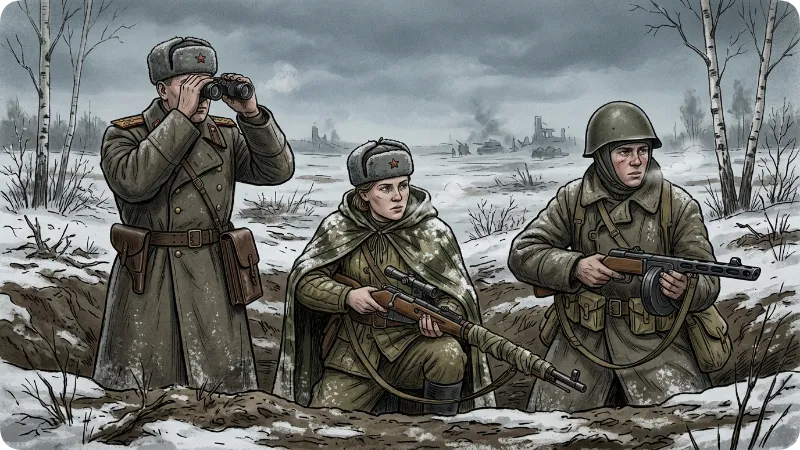
The Soviet Union fought the largest and among the deadliest land campaigns of the war against Nazi Germany. Soviet servicemen and women served as infantry soldiers, snipers, tank crews, pilots, nurses, and commanders.
| Name | Role | Historical association |
| Lyudmila Pavlichenko | Sniper | One of the best known Soviet female combatants |
| Alexander Pokryshkin | Fighter pilot | Major Soviet aviation ace |
| Ivan Konev | General | Commanded Soviet forces on the Eastern Front |
| Georgy Zhukov | Marshal | Led major Soviet operations |
| Vasily Zaitsev | Sniper | Associated with the Battle of Stalingrad |
| Roza Shanina | Sniper | Served on the Eastern Front |
| Aleksandr Matrosov | Infantry soldier | Remembered in Soviet military history for battlefield sacrifice |
| Zoya Kosmodemyanskaya | Partisan | Became a Soviet wartime symbol of resistance |
Soviet names and their aesthetic
Names such as Ivan, Vasily, Alexander, and Georgy have long histories in Russian speaking communities. They can evoke a traditional, formal atmosphere when used in historical fiction, although their meanings and cultural associations extend far beyond warfare.
Lyudmila and Roza offer examples of women’s names connected to Soviet wartime service. Their stories are particularly useful for readers who want to move beyond lists dominated by male combatants.
German World War 2 Soldiers’ Names
Germany’s military included millions of servicemen in the Wehrmacht, Luftwaffe, and Kriegsmarine. A responsible list should distinguish ordinary soldiers, senior commanders, and people who resisted the Nazi regime.
| Name | Role | Historical context |
| Erwin Rommel | Field marshal | German commander in North Africa |
| Claus von Stauffenberg | Army officer | Central figure in the failed July 20, 1944, plot against Hitler |
| Otto Carius | Tank commander | Served on the Eastern Front |
| Hans Ulrich Rudel | Luftwaffe pilot | Noted German ground attack pilot |
| Friedrich Paulus | Field marshal | Commanded German forces at Stalingrad |
| Oskar Schindler | Industrialist and Nazi Party member | Saved Jewish people from persecution; not an ordinary combat soldier |
| Sophie Scholl | Resistance activist | Member of the White Rose anti Nazi movement; not a soldier |
| Hans Scholl | Resistance activist | White Rose member executed for resisting the Nazi regime |
These figures represent very different histories. Rommel and Paulus were senior commanders in Nazi Germany’s armed forces, while Stauffenberg took part in a plot to kill Hitler. The Scholls were civilians and resistance activists, not soldiers. These distinctions should remain clear when names are used for educational purposes.
German names with a vintage or historical feel
- Hans , a traditional German masculine name.
- Otto , concise, old fashioned, and visually distinctive.
- Friedrich , formal and stately.
- Claus , compact and distinctly German in feel.
- Sophie , classic and widely used across Europe, associated with Sophie Scholl’s resistance legacy.
- Erwin , vintage and uncommon in many contemporary English speaking settings.
A name’s national or linguistic origin does not determine a person’s politics, morality, or military role. Historical context is essential.
Japanese World War 2 Soldiers’ Names
Japan’s military fought across China, Southeast Asia, and the Pacific. The Imperial Japanese Army and Navy included infantrymen, naval aviators, officers, and intelligence personnel.
| Name | Role | Historical association |
| Hiroo Onoda | Army intelligence officer | Remained in the Philippines until 1974 |
| Saburō Sakai | Naval aviator | Surviving Japanese fighter ace |
| Isoroku Yamamoto | Admiral | Senior naval commander associated with Pearl Harbor planning |
| Chūichi Nagumo | Admiral | Commanded the Pearl Harbor attack force |
| Tadamichi Kuribayashi | General | Commanded Japanese forces at Iwo Jima |
| Mitsuru Ushijima | General | Commanded Japanese forces during the Battle of Okinawa |
| Takeichi Nishi | Army officer | Olympic equestrian champion who died at Iwo Jima |
| Sakae Ōba | Army officer | Led Japanese soldiers on Saipan after the island’s main battle |
These figures held different positions and had very different wartime experiences. In particular, Onoda’s prolonged refusal to surrender became a postwar historical episode, rather than an example of ordinary frontline service.
Japanese names for historical fiction
| Name | Naming impression |
| Hiroo | Traditional and distinctive |
| Saburō | Strongly traditional; the macron indicates a long vowel |
| Isoroku | Uncommon and historically recognizable |
| Tadamichi | Formal and distinctly Japanese |
| Mitsuru | Smooth and versatile |
| Sakae | Traditional and compact |
Japanese given names may have different meanings depending on the kanji used. Without the original written characters, it is best not to assign a single definitive meaning to these names.
Polish and Other European World War 2 Soldiers
World War II was not fought only by the largest Allied and Axis powers. Polish forces, resistance movements, and military personnel from occupied European countries played important roles in the conflict.
| Name | Country | Role or historical connection |
| Witold Pilecki | Poland | Resistance fighter who voluntarily entered Auschwitz to gather intelligence |
| Tadeusz Bór Komorowski | Poland | Commander associated with the Warsaw Uprising |
| Stanisław Maczek | Poland | General who commanded Polish armored forces |
| Władysław Anders | Poland | General who led the Polish II Corps |
| Jan Karski | Poland | Resistance courier who reported information about Nazi atrocities |
| Václav Morávek | Czechoslovakia | Anti Nazi resistance fighter |
| Simo Häyhä | Finland | Winter War sniper, primarily associated with the 1939–1940 conflict |
| Wojtek | Polish II Corps | Bear adopted by Polish soldiers and associated with their wartime service |
Witold Pilecki is especially significant because his story connects military resistance, intelligence gathering, and the Holocaust. Jan Karski is another important figure, although his principal role was that of a courier and witness rather than a conventional frontline soldier.
The story of Wojtek also shows how military history can preserve unusual names and memorable characters beyond traditional lists of commanders and combatants.
World War 2 Female Soldiers and Military Personnel
Women served in many capacities during World War II, including combat roles in some countries, intelligence, resistance operations, nursing, communications, and military administration. Their experiences varied greatly by country and military organization.
| Name | Country | Role |
| Lyudmila Pavlichenko | Soviet Union | Sniper |
| Roza Shanina | Soviet Union | Sniper |
| Zoya Kosmodemyanskaya | Soviet Union | Partisan and resistance figure |
| Nancy Wake | New Zealand born, Allied resistance | Special Operations Executive operative |
| Violette Szabo | United Kingdom | Special Operations Executive agent |
| Noor Inayat Khan | United Kingdom | Radio operator for the French Resistance |
| Charity Adams | United States | Women’s Army Corps officer |
| Ruby Bradley | United States | Army nurse and prisoner of war |
| Della Raney | United States | Army Nurse Corps officer |
| Jacqueline Cochran | United States | Pilot and director of the Women’s Airforce Service Pilots program |
Charity Adams led the 6888th Central Postal Directory Battalion, an all Black Women’s Army Corps unit deployed to Europe. Its work helped clear a substantial backlog of military mail, connecting servicemembers with families and keeping communications moving.
These women broaden the meaning of military service. Some fought directly, while others took on intelligence, medical, aviation, or logistical responsibilities that were essential to the war effort.
World War 2 Soldiers’ Names by Military Role
If you are searching for a particular kind of servicemember, this list groups recognizable names by their historical role.
| Military role | Names to research |
| Infantry soldiers | Audie Murphy, Edward A. Carter Jr., Matt Urban |
| Snipers | Lyudmila Pavlichenko, Vasily Zaitsev, Roza Shanina |
| Fighter pilots | Alexander Pokryshkin, Saburō Sakai, Hans Ulrich Rudel |
| Tank commanders | Otto Carius, Stanisław Maczek |
| Generals and marshals | Georgy Zhukov, Bernard Montgomery, Douglas MacArthur |
| Resistance fighters | Witold Pilecki, Nancy Wake, Claus von Stauffenberg |
| Intelligence personnel | Hiroo Onoda, Noor Inayat Khan |
| Medics and nurses | Desmond Doss, Ruby Bradley, Della Raney |
| Naval personnel | Douglas Munro, Isoroku Yamamoto |
| Airborne officers | Richard Winters |
Important distinction: A general, pilot, medic, resistance operative, and infantryman may all be associated with World War II, but they did not have the same occupation or experience. This distinction is particularly important for school assignments, historical writing, and genealogy.
Strong and Memorable World War 2 Inspired Names
For readers interested in the names themselves, not only the military history, some historical names have a particularly distinctive sound or style.
These are aesthetic interpretations rather than claims about the character or personality of the people who carried them.
Audie
American • Vintage • Distinctive
A short, memorable name linked to Audie Murphy. Its uncommon sound gives it a strong mid century character.
Richard
English and Germanic roots • Classic • Formal
A familiar traditional name with historical depth. Nicknames include Rich, Rick, and Ricky.
Witold
Polish • Traditional • Uncommon
A distinctive choice for a Polish historical character, with a direct connection to resistance history.
Saburō
Japanese • Traditional • Historically specific
An evocative name for a Japanese historical character. Its correct written form and meaning depend on the kanji.
Nancy
English • Vintage • Understated
A recognizable mid century name associated with Nancy Wake and the history of Allied resistance.
How to choose a historically appropriate name
- For a realistic character: Match the person’s nationality, generation, language, and military role.
- For a family history project: Start with the exact name found in service documents, then verify the person’s unit and dates.
- For a fictional character: Consider If the name sounds plausible for the country and era.
- For a baby name: Treat the historical association separately from the name’s verified meaning and cultural significance.
Lucky numbers, lucky colors, gemstones, and zodiac associations are not established historical attributes of these soldiers. They should not be presented as factual details of a military biography.
Frequently Asked Questions
1. Who were the most famous World War 2 soldiers?
Notable figures include Audie Murphy, Desmond Doss, Richard Winters, Lyudmila Pavlichenko, Vasily Zaitsev, and Witold Pilecki. Each is remembered for a different contribution, from combat service to battlefield medicine or resistance work.
2. What are some common American WWII soldier names?
Names such as Richard, Edward, James, Robert, William, and John were familiar American names during the period. Audie, Desmond, and Richard are also useful search terms when researching specific famous veterans.
3. Who was the most decorated American soldier of World War II?
Audie Murphy is widely recognized as one of the most decorated American combat soldiers of the war. His awards and wartime experiences made him a prominent public figure after the conflict.
4. Were there female soldiers in World War II?
Yes. Women served in military organizations, medical units, aviation, intelligence, communications, and resistance movements. Lyudmila Pavlichenko was a Soviet sniper, while Charity Adams commanded a U.S. Army postal battalion.
5. Where can I find a complete list of World War 2 soldiers?
There is no single, universally complete list covering every country and military branch. National archives, military personnel records, memorial databases, and veterans’ oral histories are the best starting points.
6. How do I find the name of a World War 2 soldier in my family?
Start with the person’s full name, country, approximate birth year, and military branch. Look for enlistment records, unit histories, discharge documents, cemetery records, and official archives. Check alternate spellings when the name has been transliterated.
7. What were German soldiers called in World War II?
German armed forces included the Heer (Army), Luftwaffe (Air Force), and Kriegsmarine (Navy). The term Wehrmacht referred to Germany’s armed forces during the Nazi era, excluding the Waffen SS as a separate organization.
8. Can I use WWII soldiers’ names for fictional characters?
Yes. Historical names can inspire characters in novels, games, and screenplays. For greater authenticity, match the name to the character’s nationality, language, generation, and historical setting. Avoid implying that a fictional character is a real veteran.
Conclusion
A World War 2 soldiers’ names list is more than a collection of surnames and military ranks. It opens a window into the people who fought, served, resisted, cared for the wounded, and endured extraordinary circumstances during one of history’s most consequential conflicts.
From Audie Murphy and Richard Winters to Lyudmila Pavlichenko, Witold Pilecki, and Charity Adams, these names represent different countries, roles, and experiences. Exploring their stories makes the names more meaningful while helping readers distinguish historical facts from modern interpretations.
If you are researching a relative, studying the war, or choosing a name for a historically inspired character, the best starting point is always the same: identify the person accurately, understand their role, and give their story the context it deserves.
Liam tracks digital culture, internet aesthetics, and social media branding. He creates unique, memorable usernames and handles for creators who want to stand out on TikTok, Instagram, and YouTube. In his free time, he edits aesthetic short-form videos.