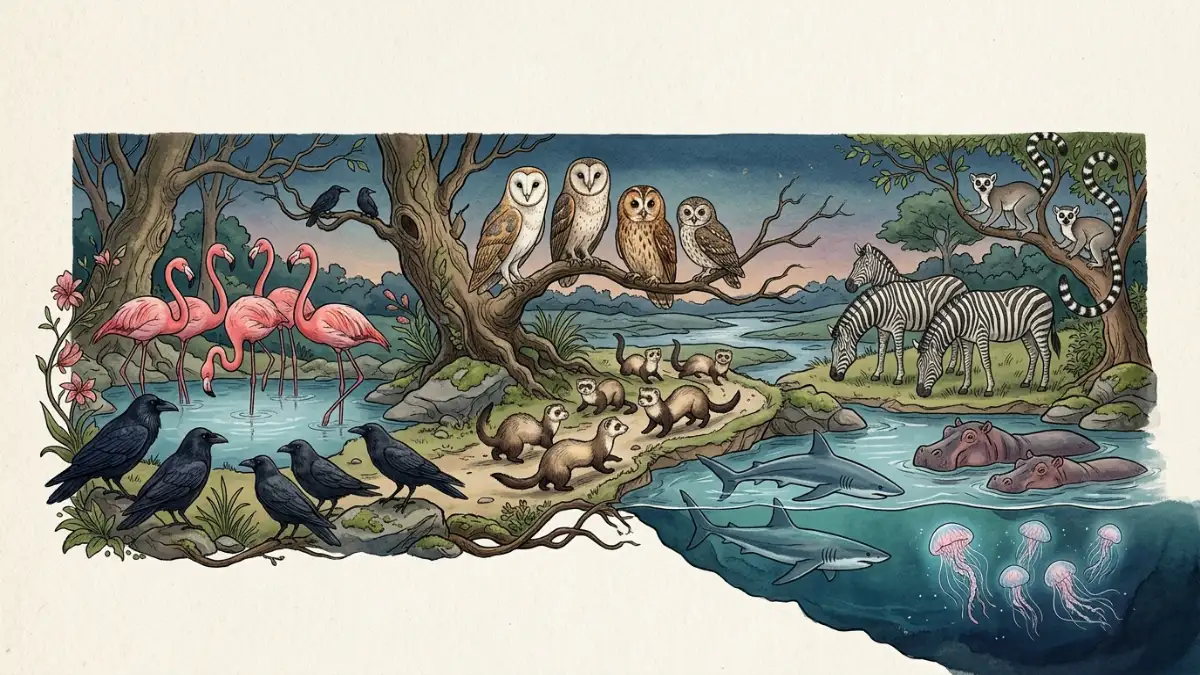
There is something wonderfully strange about the English language. A group of crows isn’t simply a group, it can be a murder. Flamingos gather in a flamboyance, owls in a parliament, and ferrets in a business.
These unusual animal group names are more than quirky vocabulary. Many are tiny pieces of linguistic history, shaped by medieval hunting traditions, animal behavior, appearance, sound, and centuries of storytelling.
If you’re looking for weird animal group names, funny collective nouns, unusual animal group names, or strange names for groups of animals, this guide brings together some of the most memorable examples, with notes on their meaning, personality, history, and modern feel.
What Are Weird Animal Group Names?
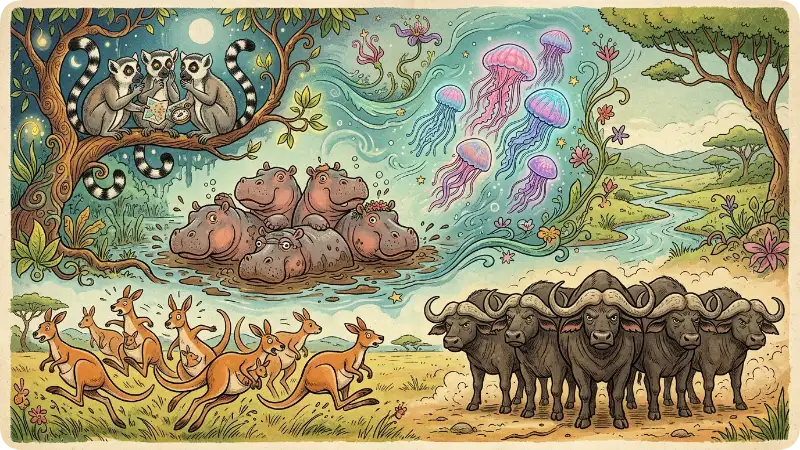
Weird animal group names are unusual collective nouns used to describe groups of particular animals.
Instead of saying “a group of crows,” for example, English has the traditional expression a murder of crows. Instead of simply saying “a group of flamingos,” you may encounter a flamboyance of flamingos.
Many of these expressions belong to the old tradition of terms of venery, a specialized vocabulary associated with medieval hunting and courtly culture. The famous Book of Saint Albans, printed in 1486, preserved a large collection of these expressions. The list included animals and birds, but also humorous collective terms for people and professions.
The fascinating part is that these terms were not necessarily scientific classifications. Many were clever, poetic, humorous, or deliberately memorable expressions.
That is why they still feel so entertaining today.
The Weirdest Animal Group Names at a Glance
| Animal | Unusual group name | Overall vibe |
| Crows | Murder | Dark, gothic |
| Ravens | Unkindness | Mysterious, ominous |
| Flamingos | Flamboyance | Colorful, glamorous |
| Owls | Parliament | Wise, regal |
| Ferrets | Business | Funny, energetic |
| Lemurs | Conspiracy | Mischievous |
| Hippopotamuses | Bloat | Comical |
| Zebras | Dazzle / Zeal | Playful, striking |
| Sharks | Shiver | Chilling |
| Rhinos | Crash | Powerful |
| Leopards | Leap | Fast, graceful |
| Apes | Shrewdness | Clever |
| Jellyfish | Smack | Unexpected |
| Buffalo | Obstinacy | Stubborn, powerful |
| Lizards | Lounge | Relaxed |
| Kangaroos | Mob | Energetic |
| Peacocks | Ostentation | Luxurious |
| Porcupines | Prickle | Spiky, playful |
| Crocodiles | Bask | Lazy, sun soaked |
| Starlings | Murmuration | Dreamy, cinematic |
| Giraffes | Tower | Grand, elegant |
| Foxes | Skulk | Secretive |
| Lions | Pride | Noble |
| Otters | Romp | Playful |
| Tigers | Ambush | Fierce |
| Swans | Ballet | Graceful |
| Hedgehogs | Array | Cute, whimsical |
| Pandas | Embarrassment | Funny |
| Parrots | Pandemonium | Chaotic |
| Vultures | Kettle | Strange, dramatic |
The Most Famous Weird Animal Group Names
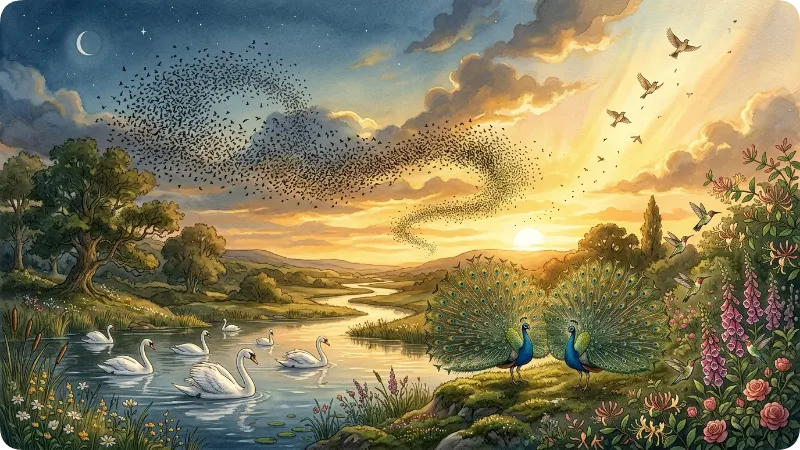
A Murder of Crows
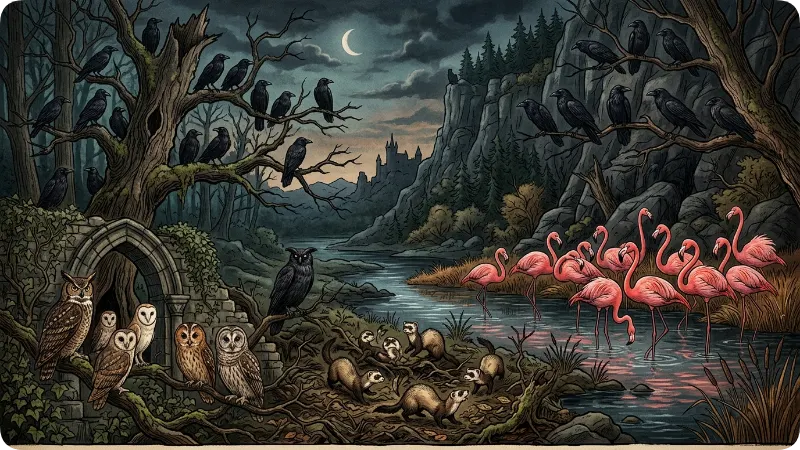
Few collective nouns are as famous, or as wonderfully dark, as a murder of crows.
The word immediately creates a gothic image: black birds gathering together beneath a gray sky.
Meaning: A traditional collective noun for crows.
Origin: English tradition; associated with the medieval tradition of terms of venery.
Vibe: Gothic, mysterious, ominous.
Aesthetic: Dark academia, gothic, Halloween, fantasy.
Social impression: Dramatic and memorable.
Modern feel: Very recognizable, especially in books, quizzes, social media posts, and fantasy inspired writing.
The name feels particularly effective because crows already have strong associations with intelligence, mystery, folklore, and darkness.
An Unkindness of Ravens
A group of ravens can be called an unkindness.
It has a much darker emotional energy than ordinary words such as flock or group. The expression is historically associated with the raven’s reputation in European folklore and older beliefs. A 15th century source, The Book of Saint Albans, is an important early record for the term.
Meaning: Unkindness.
Origin: Traditional English collective terminology.
Vibe: Gothic, mysterious, haunting.
Aesthetic: Gothic literature, dark fantasy, ravencore, dark academia.
Social impression: Dramatic and slightly sinister.
Similar expressions: Murder of crows, conspiracy of ravens.
Modern vs. classic: Extremely old in origin, but still feels surprisingly modern because of its popularity in fantasy and gothic culture.
A Flamboyance of Flamingos
A group of flamingos can be called a flamboyance.
This may be one of the most visually satisfying animal group names in English. Flamingos are colorful, elegant, unusual birds, and “flamboyance” suggests something bold and showy.
Meaning: A striking or showy display.
Origin: Traditional collective noun tradition.
Vibe: Glamorous, playful, colorful.
Aesthetic: Pink, tropical, luxury, maximalist.
Social impression: Fun and fashionable.
Modern association: Particularly suited to Pinterest style tropical aesthetics, colorful design, party themes, and playful captions.
A Parliament of Owls
A group of owls is traditionally called a parliament.
It works because owls have long been associated in popular culture with wisdom, observation, and seriousness.
Meaning: An assembly or formal gathering.
Origin: English literary and collective noun tradition.
Vibe: Wise, intellectual, mysterious.
Aesthetic: Dark academia, fantasy, old libraries.
Social impression: Sophisticated and clever.
The expression also has a long literary history, although the popular claim that it directly originated from Chaucer’s Parliament of Fowls should be treated cautiously rather than presented as established fact.
A Business of Ferrets
A group of ferrets is called a business.
It sounds hilariously modern because “business” normally refers to commerce or work.
The term has much older roots. Dictionary sources connect the word historically with Old English ideas of being occupied or busy, which makes the expression particularly fitting for energetic ferrets.
Vibe: Funny, chaotic, energetic.
Aesthetic: Cute chaos, playful pet culture.
Social impression: Clever and humorous.
Nickname potential: “The Business” works beautifully as a fictional group name.
Weird Animal Group Names That Sound Completely Made Up
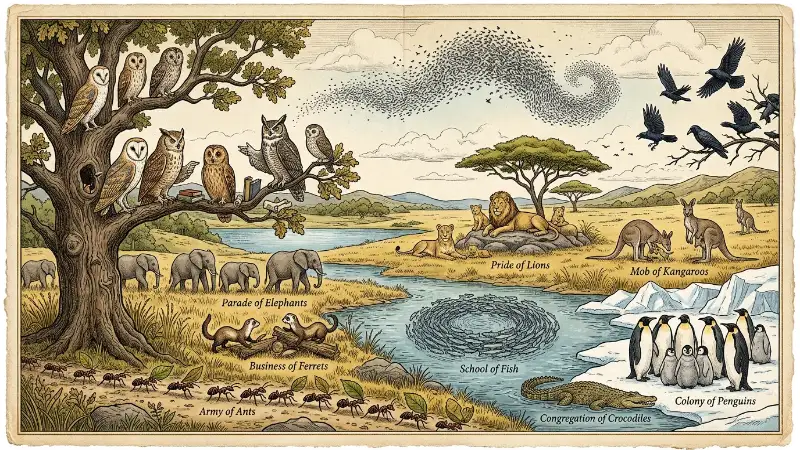
Some collective nouns are so imaginative that they sound as though someone invented them five minutes ago.
They didn’t.
A Conspiracy of Lemurs
Animal: Lemurs
Group name: A conspiracy
This is an especially entertaining combination because “conspiracy” suggests secret planning.
The term has been associated with lemurs’ cooperative behavior and group communication.
Vibe: Mischievous, secretive, intelligent.
Best for: Funny captions, fantasy writing, children’s content.
A Bloat of Hippopotamuses
Animal: Hippopotamuses
Group name: A bloat
It is difficult to hear “bloat of hippos” without imagining a collection of enormous animals packed together beside a river.
The term is descriptive and humorous rather than elegant.
Vibe: Comical, enormous, lovable.
Aesthetic: Funny wildlife, cartoon humor.
A Smack of Jellyfish
Animal: Jellyfish
Group name: A smack
This may be one of the most unexpected combinations on the list.
“Smack” normally suggests a sharp hit, while jellyfish are capable of painful stings. Dictionary.com also notes other group terms such as “bloom” and “swarm.”
Vibe: Strange, slightly threatening, memorable.
Aesthetic: Ocean horror, surreal nature.
An Obstinacy of Buffalo
Animal: Buffalo/bison
Group name: An obstinacy
The word means stubbornness or resistance to change.
It gives the animal a strong personality before you even know anything about the herd.
Vibe: Stubborn, powerful, humorous.
Aesthetic: Western, rugged, wild.
A terminology note: in North American usage, “buffalo” is often used informally for the American bison, although “bison” is preferred in formal scientific contexts.
A Mob of Kangaroos
Animal: Kangaroos
Group name: A mob
This sounds chaotic, but it has a genuine traditional use. Kangaroo groups are commonly described as mobs.
Vibe: Energetic, wild, Australian.
Aesthetic: Adventure, wildlife, outback.
Beautifully Weird Animal Group Names
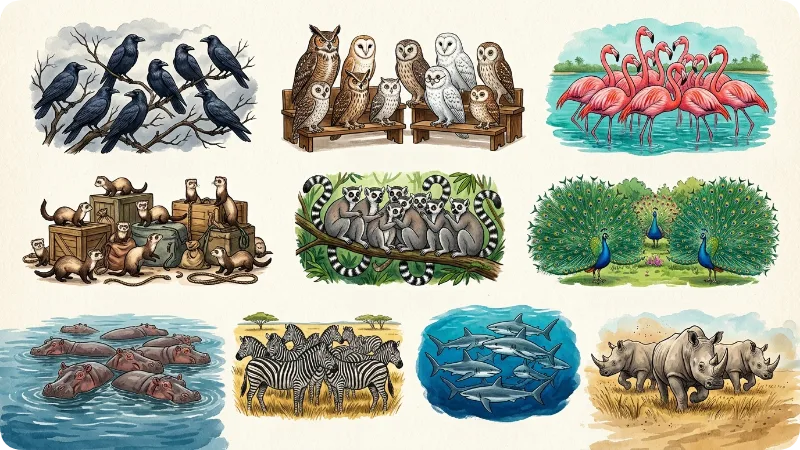
Not every strange collective noun is funny. Some are genuinely poetic.
A Murmuration of Starlings
Murmuration is one of the most beautiful words associated with animal groups.
It describes a flock of starlings, particularly memorable when the birds move together in large, flowing formations.
The word itself is connected to murmuring or soft, continuous sound.
Vibe: Dreamy, cinematic, mysterious.
Aesthetic: Celestial, nature photography, ethereal.
Social impression: Artistic and sophisticated.
This is one of the strongest choices for poetry, photography captions, fantasy writing, and nature inspired branding.
An Exaltation of Larks
Animal: Larks
Group name: An exaltation
“Exaltation” suggests elevation, celebration, or something lifted upward.
It feels almost heavenly, which is particularly fitting for birds associated with song and flight.
Vibe: Uplifting, lyrical, celestial.
Aesthetic: Romantic, vintage, literary.
A Ballet of Swans
Animal: Swans
Group name: A ballet
This expression is immediately visual.
Swans moving across water can look coordinated and graceful, so “ballet” creates a strong connection between movement and language.
Vibe: Elegant, romantic, graceful.
Aesthetic: Luxury, balletcore, soft classical.
A Charm of Hummingbirds
Animal: Hummingbirds
Group name: A charm
The word “charm” feels almost magical.
It suggests something delicate, beautiful, and enchanting.
Vibe: Whimsical, magical, delicate.
Aesthetic: Cottagecore, fairycore, botanical.
Dark and Mysterious Animal Group Names
If you’re looking for the strangest names with a darker personality, these stand out.
| Animal | Group name | Dark vibe |
| Crows | Murder | Gothic |
| Ravens | Unkindness | Ominous |
| Tigers | Ambush | Predatory |
| Foxes | Skulk | Secretive |
| Sharks | Shiver | Chilling |
| Snakes | Knot | Sinister |
| Vultures | Kettle | Macabre |
| Scorpions | Bed | Unsettling |
| Jaguars | Prowl | Mysterious |
| Hyenas | Cackle | Wild |
These aren’t necessarily “dark names” in a scientific sense. The darkness comes from the emotional impression of the words.
That distinction matters.
A collective noun may have a dramatic sound without carrying an official symbolic meaning.
Funny Animal Group Names
Some combinations are funny simply because the group word clashes with the animal.
A Pandemonium of Parrots
Parrots can be noisy, colorful, and highly expressive, making pandemonium feel almost cartoonishly appropriate.
Vibe: Loud, colorful, chaotic.
An Embarrassment of Pandas
Embarrassment is an amusingly human word to attach to pandas.
It feels especially suitable for humorous social media content.
Vibe: Cute, awkward, silly.
A Romp of Otters
Otters are famous for playful behavior, so romp feels cheerful and energetic.
Vibe: Adorable, playful, wholesome.
A Lounge of Lizards
Lounge immediately brings to mind reptiles relaxing in the sun.
Vibe: Lazy, chill, funny.
A Barrel of Monkeys
This is one of the best known humorous expressions associated with monkeys.
Vibe: Chaotic, energetic, playful.
A Clowder of Cats
A clowder of cats has an old fashioned, wonderfully odd sound.
It is also one of the more recognizable traditional collective nouns for cats.
Vibe: Vintage, whimsical, slightly mysterious.
Powerful Animal Group Names
Some group names feel almost cinematic.
| Animal | Collective noun | Personality |
| Rhinos | Crash | Powerful |
| Lions | Pride | Regal |
| Tigers | Ambush | Fierce |
| Leopards | Leap | Agile |
| Eagles | Convocation | Majestic |
| Wolves | Rout | Wild |
| Sharks | Shiver | Intimidating |
| Crocodiles | Bask | Ancient |
| Buffalo | Obstinacy | Stubborn |
| Kangaroos | Mob | Energetic |
A Crash of Rhinoceroses
“Crash” is almost perfect for the mental image of several massive rhinoceroses moving together.
It has appeared in reference works on collective nouns for decades and remains one of the most recognizable unusual animal group names.
Vibe: Heavy, forceful, dramatic.
A Convocation of Eagles
Convocation means a formal gathering.
Paired with eagles, it creates a particularly grand image.
Vibe: Regal, powerful, ceremonial.
A Leap of Leopards
The word leap captures movement and athleticism.
Vibe: Fast, elegant, predatory.
Cute and Whimsical Animal Group Names
Not every weird collective noun needs to sound dramatic.
An Array of Hedgehogs
Array sounds organized and almost mathematical.
With tiny hedgehogs, however, it becomes charmingly whimsical.
Vibe: Cute, neat, quirky.
A Prickle of Porcupines
Prickle is almost impossible to forget.
The connection to their sharp quills gives the term a clear visual logic.
Vibe: Cute but dangerous.
A Kindle of Kittens
A group of young cats can be called a kindle.
The word is especially interesting today because “Kindle” is strongly associated with digital reading, giving an old animal term a distinctly modern association.
Vibe: Soft, cozy, literary.
A Charm of Finches
“Charm” gives a small flock a delicate, almost magical personality.
Vibe: Soft, pretty, vintage.
A Bouquet of Pheasants
Bouquet is an unusually elegant way to describe a group of birds.
Vibe: Floral, luxurious, decorative.
Weird Bird Group Names
Birds have some of the most imaginative collective nouns in English.
| Bird | Weird group name |
| Owls | Parliament |
| Flamingos | Flamboyance |
| Crows | Murder |
| Ravens | Unkindness |
| Starlings | Murmuration |
| Peacocks | Ostentation |
| Eagles | Convocation |
| Larks | Exaltation |
| Geese | Gaggle |
| Swans | Ballet |
| Parrots | Pandemonium |
| Hummingbirds | Charm |
| Finches | Charm |
| Robins | Round |
| Vultures | Kettle |
An Ostentation of Peacocks
Ostentation means an obvious or showy display.
With peacocks, whose elaborate feathers naturally attract attention, the word feels visually appropriate.
Vibe: Luxurious, dramatic, glamorous.
Aesthetic: Maximalist, royal, fashion forward.
A Gaggle of Geese
A gaggle is traditionally used for geese when they are on the ground.
The word itself has an amusing sound and is also used informally for disorderly groups of people.
Vibe: Noisy, chaotic, comic.
A Kettle of Vultures
A kettle can describe vultures when they circle together in the air.
It creates an unexpectedly ordinary word for a rather dramatic sight.
Vibe: Strange, atmospheric, cinematic.
Weird Mammal Group Names
| Animal | Group name | Vibe |
| Hippopotamuses | Bloat | Comical |
| Ferrets | Business | Busy |
| Lemurs | Conspiracy | Mischievous |
| Kangaroos | Mob | Wild |
| Leopards | Leap | Athletic |
| Foxes | Skulk | Secretive |
| Apes | Shrewdness | Intelligent |
| Rhinos | Crash | Powerful |
| Lions | Pride | Regal |
| Otters | Romp | Playful |
| Giraffes | Tower | Grand |
| Moles | Labour | Industrious |
| Badgers | Cete | Ancient |
| Wolves | Rout | Wild |
| Bears | Sleuth | Curious |
A Shrewdness of Apes
Shrewdness originally had somewhat different connotations from its modern meaning.
Today, the word suggests intelligence, cleverness, and astuteness, making it a particularly memorable expression.
Vibe: Intelligent, mischievous, sophisticated.
A Tower of Giraffes
This expression is wonderfully visual.
Several giraffes standing together really can resemble a moving collection of towers.
Vibe: Elegant, tall, whimsical.
A Sleuth of Bears
“Sleuth” usually makes people think of a detective.
That makes this collective noun feel playful and clever.
Vibe: Curious, clever, storybook like.
Weird Reptile, Fish, and Sea Animal Group Names
A Bask of Crocodiles
A group of crocodiles resting together in the sun can be called a bask.
The word refers directly to their sun warming behavior.
Vibe: Ancient, relaxed, prehistoric.
A Shiver of Sharks
Shiver is an especially effective word because it creates an emotional reaction as well as an image.
Vibe: Chilling, dangerous, cinematic.
A Smack of Jellyfish
“Smack” is memorable because it contrasts with the seemingly delicate appearance of jellyfish.
Vibe: Surreal, oceanic, slightly threatening.
A Quiver of Cobras
Quiver suggests trembling or shaking, while cobras are associated with defensive displays and movement.
Vibe: Tense, dangerous, Alluring.
A Knot of Snakes
A knot of snakes creates an instantly recognizable visual.
Vibe: Unsettling, tangled, mysterious.
A Bale of Turtles
Bale is a surprisingly unusual word for turtles.
It has an old fashioned, almost storybook feeling.
Vibe: Slow, earthy, whimsical.
Weird Insect and Small Creature Group Names
Some of the strangest collective nouns belong to creatures people rarely think about collectively.
| Animal | Group name |
| Ants | Army |
| Bees | Swarm |
| Mosquitoes | Swarm |
| Locusts | Plague |
| Flies | Business |
| Gnats | Cloud |
| Grasshoppers | Cloud |
| Spiders | Clutter |
| Scorpions | Bed |
| Porcupines | Prickle |
| Hedgehogs | Array |
A Plague of Locusts
This is both a collective expression and a phrase deeply embedded in religious and historical language.
Vibe: Apocalyptic, biblical, dramatic.
A Cloud of Gnats
This is simple but remarkably visual.
A large number of tiny insects moving together can look like a floating cloud.
Vibe: Atmospheric, natural, slightly annoying.
A Clutter of Spiders
The word “clutter” makes the group sound disorderly and chaotic.
Vibe: Messy, creepy, playful.
The Best Weird Animal Group Names by Vibe
Sometimes the easiest way to remember these expressions is to organize them by personality.
Dark & Gothic
- Murder of crows
- Unkindness of ravens
- Shiver of sharks
- Knot of snakes
- Kettle of vultures
- Skulk of foxes
- Ambush of tigers
Cute & Whimsical
- Romp of otters
- Prickle of porcupines
- Array of hedgehogs
- Kindle of kittens
- Charm of hummingbirds
- Bouquet of pheasants
- Ballet of swans
Elegant & Luxurious
- Flamboyance of flamingos
- Ostentation of peacocks
- Ballet of swans
- Convocation of eagles
- Exaltation of larks
- Pride of lions
Funny & Chaotic
- Business of ferrets
- Pandemonium of parrots
- Embarrassment of pandas
- Mob of kangaroos
- Bloat of hippos
- Gaggle of geese
- Barrel of monkeys
Powerful & Wild
- Crash of rhinos
- Pride of lions
- Ambush of tigers
- Shiver of sharks
- Obstinacy of buffalo
- Leap of leopards
- Rout of wolves
Dreamy & Poetic
- Murmuration of starlings
- Exaltation of larks
- Charm of hummingbirds
- Ballet of swans
- Bouquet of pheasants
- Convocation of eagles
75 Weird Animal Group Names
Here is a larger quick reference collection for quizzes, writing, captions, classroom activities, trivia, and general curiosity.
- Murder of crows
- Unkindness of ravens
- Flamboyance of flamingos
- Parliament of owls
- Business of ferrets
- Conspiracy of lemurs
- Bloat of hippopotamuses
- Smack of jellyfish
- Obstinacy of buffalo
- Mob of kangaroos
- Zeal of zebras
- Dazzle of zebras
- Shrewdness of apes
- Leap of leopards
- Crash of rhinoceroses
- Shiver of sharks
- Ostentation of peacocks
- Murmuration of starlings
- Prickle of porcupines
- Bask of crocodiles
- Parliament of owls
- Convocation of eagles
- Exaltation of larks
- Ballet of swans
- Charm of hummingbirds
- Charm of finches
- Gaggle of geese
- Pandemonium of parrots
- Kettle of vultures
- Round of robins
- Skulk of foxes
- Romp of otters
- Pride of lions
- Rout of wolves
- Tower of giraffes
- Sleuth of bears
- Labour of moles
- Cete of badgers
- Kindle of kittens
- Array of hedgehogs
- Bouquet of pheasants
- Quiver of cobras
- Knot of snakes
- Bale of turtles
- Bed of scorpions
- Clutter of spiders
- Plague of locusts
- Cloud of gnats
- Swarm of bees
- Army of ants
- Barrel of monkeys
- Lounge of lizards
- Ambush of tigers
- A confusion of guinea fowl
- A caravan of camels
- A cast of falcons
- A chain of bobolinks
- A chattering of choughs
- A clamor of rooks
- A covey of quail
- A cowardice of curs
- A fall of woodcocks
- A field of racehorses
Some expressions above have multiple recorded alternatives, and their frequency varies considerably. A traditional collective noun should not automatically be treated as a scientific term or as the only correct way to describe a group. In ordinary wildlife writing, simple terms such as herd, flock, pack, colony, pod, school, or group are often clearer.
Are These Animal Group Names Official?
Not all of them are “official” in the scientific sense.
This is one of the biggest details that gets lost in online lists.
Collective nouns are primarily a matter of English usage and tradition, not biological taxonomy. Many originated in historical hunting vocabulary, while others became literary or humorous expressions.
For example, murder of crows, business of ferrets, and unkindness of ravens have strong traditional associations. Other expressions may be poetic, uncommon, regional, modern, or repeated mainly in word lists.
So if you’re writing a scientific report, “a flock of starlings” may be more appropriate than “a murmuration of starlings.”
If you’re writing a story, caption, quiz, poem, or trivia article, the unusual expression can be exactly what makes the sentence memorable.
Why Are Animal Group Names So Weird?
The weirdness is not accidental.
Medieval English developed a specialized vocabulary around hunting, falconry, and courtly culture. The Book of Saint Albans, published in 1486, became particularly influential in preserving lists of collective expressions. The surviving tradition also contains plenty of playful and humorous constructions, showing that clever wordplay was part of the culture surrounding these terms.
Many names also seem to connect the word with:
- An animal’s appearance
- Its movement
- Its sound
- Its behavior
- Human perceptions of the animal
- Humor or wordplay
- Alliteration
- Cultural symbolism
- Medieval hunting culture
That is why a crash of rhinos feels physical, a dazzle of zebras feels visual, and a murmuration of starlings feels almost musical.
Weird Animal Group Names vs. Scientific Language
It helps to separate three different kinds of terminology.
| Type | Example | Best use |
| Ordinary group term | Herd of elephants | Everyday and scientific writing |
| Traditional collective noun | Murder of crows | Literature, trivia, descriptive writing |
| Playful/modern expression | Embarrassment of pandas | Humor and entertainment |
This distinction makes your writing more accurate.
A collective noun can be wonderfully expressive without being a formal zoological classification.
Do Animal Group Names Have Meanings, Origins, or “Lucky” Attributes?
For this topic, traditional name enrichment fields such as lucky number, lucky color, lucky gemstone, lucky day, zodiac association, and numerology do not legitimately apply.
Those attributes are sometimes attached to human or pet names as modern naming interpretations, but applying them to collective nouns would create information that has no established linguistic basis.
Instead, the useful enrichment for animal group names is:
- Literal meaning
- Historical origin
- Animal association
- Behavioral connection
- Emotional vibe
- Aesthetic
- Cultural associations
- Literary influence
- Modern social impression
- How recognizable the expression is
That approach keeps the article entertaining without inventing etymology or folklore.
How to Choose the Best Weird Animal Group Name
If you’re choosing a term for a story, article, username, classroom activity, caption, or creative project, think about the impression you want.
For something dark
Choose murder, unkindness, shiver, or ambush.
For something elegant
Choose flamboyance, ballet, exaltation, or convocation.
For something funny
Choose business, bloat, pandemonium, embarrassment, or gaggle.
For something magical
Choose charm, murmuration, exaltation, or conspiracy.
For something powerful
Choose crash, pride, obstinacy, ambush, or shiver.
For something cute
Choose romp, prickle, kindle, array, or bouquet.
The best choice is usually the one whose emotional personality matches the animal, not merely the one that sounds strangest.
Frequently Asked Questions
What is the weirdest animal group name?
There is no objectively weirdest collective noun, but some of the most surprising include a murder of crows, an unkindness of ravens, a business of ferrets, a bloat of hippopotamuses, a smack of jellyfish, and a conspiracy of lemurs.
What is a group of crows called?
A group of crows is traditionally called a murder of crows.
What is a group of ravens called?
A group of ravens is traditionally called an unkindness of ravens.
What is a group of flamingos called?
A group of flamingos is commonly known by the colorful expression a flamboyance of flamingos.
What is a group of owls called?
A group of owls is traditionally called a parliament of owls.
What is a group of ferrets called?
A group of ferrets is called a business of ferrets.
What is a group of zebras called?
A group of zebras can be called a dazzle of zebras. Zeal of zebras is another recorded expression.
What is a group of sharks called?
A group of sharks can be called a shiver of sharks.
What is a group of rhinos called?
A group of rhinoceroses is called a crash of rhinoceroses.
What is a group of jellyfish called?
One unusual term is a smack of jellyfish. Other expressions include bloom and swarm.
Are weird animal group names scientifically official?
Usually, no. They are primarily linguistic and traditional expressions rather than scientific classifications. Some are historically established terms, while others are literary, uncommon, or playful.
Final Thoughts
The strangest animal group names reveal something fascinating about language: people have always enjoyed turning observation into wordplay.
A murder of crows sounds gothic. The flamboyance of flamingos feels glamorous. A business of ferrets sounds hilariously modern. A murmuration of starlings feels like poetry.
And that is why these expressions have survived.
They don’t simply tell us that animals are together. They give the group a personality.
If you’re searching for funny animal group names, unusual collective nouns, weird animal names for groups, strange animal vocabulary, or memorable terms for wildlife, these expressions offer a small glimpse into the creativity, and occasional absurdity, of the English language.
The next time you see several animals gathered together, don’t settle for “a group.”
There might be a much stranger word waiting for them.

Liam tracks digital culture, internet aesthetics, and social media branding. He creates unique, memorable usernames and handles for creators who want to stand out on TikTok, Instagram, and YouTube. In his free time, he edits aesthetic short-form videos.