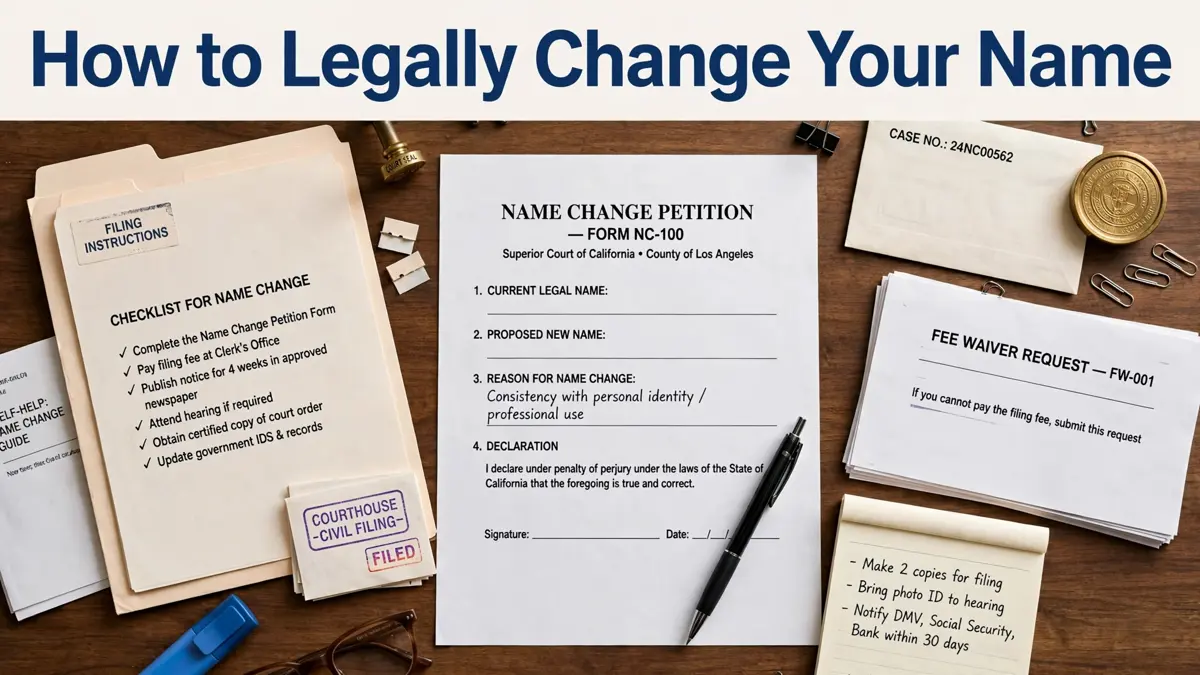
Featured Snippet:
A legal name change is an official process that allows a person to replace their current name with a new one on government and personal records. In the United States, this usually involves marriage, divorce, or a court approved name change petition.
Changing a name can be straightforward, but the requirements depend on the state, the reason for the change, and if the application involves an adult or a minor.
A name is an important part of personal identity. Sometimes, a person may want to change it after marriage, following a divorce, because of a spelling mistake, or simply because a different name feels more suitable. Whatever the reason, understanding how to legally change your name can make the process easier and prevent unnecessary paperwork.
In the United States, the legal name change process generally involves obtaining an acceptable document, such as a marriage certificate, divorce decree, or court order. The exact procedure varies by state, and some situations require additional documents, court appearances, or public notices. After receiving legal approval, government agencies, banks, employers, and other organizations must be notified.
This guide explains the main legal methods, required documents, application steps, costs, and important records to update after a name change.
How to Legally Change Your Name: At a Glance

| Topic | Important Information |
|---|---|
| Main legal methods | Marriage, divorce, or court order |
| Who can apply? | Adults and, under specific rules, minors |
| Where to apply? | Relevant state or local court |
| Common documents | Identification, birth certificate, petition, and supporting records |
| Application fee | Varies by state and court |
| Court hearing | Required in some cases |
| Public notice | Required in some states, with possible exceptions |
| Processing time | Depends on the court and jurisdiction |
| After approval | Update identification and personal records |
| Main consideration | State laws and individual circumstances |
1. What Does It Mean to Legally Change Your Name?

Legally changing a name means officially adopting a different first name, middle name, last name, or complete name through a recognized legal process.
Once the change is legally established, the new name can be used on official identification and personal records, subject to each organization’s documentation requirements.
For example, someone named Daniel James Miller might legally change their name to Daniel James Carter.
A legal name change may involve:
- Replacing a first name.
- Changing a middle name.
- Adopting a different surname.
- Changing several parts of a full name.
- Correcting an existing name under an applicable administrative procedure.
A legal name change is different from using a nickname or an informal name. A nickname does not automatically replace the name recorded on official documents.
2. Common Reasons for Legally Changing a Name

People request legal name changes for personal, family, cultural, and practical reasons.
Common reasons include:
| Reason | Explanation |
|---|---|
| Marriage | Taking a spouse’s surname or adopting a combined surname |
| Divorce | Returning to a former or maiden name |
| Personal preference | Choosing a name that better reflects personal identity |
| Spelling correction | Correcting an error in official records |
| Family reasons | Adopting a family name or changing a surname |
| Cultural reasons | Adopting a name connected to cultural or family heritage |
| Gender identity | Choosing a name that better reflects personal identity |
| Adoption | Establishing a new legal family name |
| Safety concerns | Seeking a name change for personal protection |
A court generally reviews if the requested change complies with applicable law. A request made to commit fraud, avoid debts, escape legal responsibilities, or mislead another person may be rejected or create serious legal consequences.
3. How to Legally Change Your Name in the United

States
The legal process depends on the reason for the change. Marriage and divorce often provide a different route from a personal name change.
For someone who is not changing their name through marriage or divorce, a court petition is commonly required.
Step 1: Check Your State’s Name Change Laws
Start by identifying the legal requirements in the state where you live.
Each state has its own rules concerning:
- Which court handles name change applications.
- Who is eligible to apply.
- Required application forms.
- Filing fees.
- Background checks, where applicable.
- Public notice requirements.
- Court hearings.
- Additional requirements for minors.
Visit the official state court website or contact the appropriate local court clerk.
Step 2: Choose Your New Legal Name
Decide which name you want to adopt before completing the application.
Check that the proposed name complies with local legal requirements. Restrictions can apply to names intended to deceive others, contain prohibited symbols, or interfere with another person’s rights.
Consider checking:
- First, middle, and last name spelling.
- Hyphens and apostrophes.
- Name order.
- Pronunciation.
- Consistency across documents.
Step 3: Complete the Name Change Petition
Obtain the official name change forms from the appropriate court.
An adult application may request:
- Current legal name.
- Requested new name.
- Date of birth.
- Current residential address.
- Reason for requesting the change.
- Identification information.
- Criminal or legal history disclosures, if required.
Complete the application carefully. Incorrect information or missing documents can delay the process.
Step 4: Gather Supporting Documents
Prepare the documents required by the court.
Common examples include:
- Government issued photo identification.
- Birth certificate.
- Proof of residence.
- Completed name change petition.
- Additional declarations or background information.
- Filing fee or fee waiver application.
Requirements vary, so the court’s official checklist should be followed.
Step 5: File the Petition With the Court
Submit the completed paperwork to the appropriate court.
Depending on the state, filing may be available in person, by mail, or electronically.
The court clerk may review the paperwork and explain if additional documents or corrections are necessary.
Keep copies of the submitted documents and any filing receipts.
Step 6: Complete Any Publication or Notice Requirements
Some states require applicants to publish a notice of the requested name change in a newspaper or provide notice to specified parties.
However, publication is not a universal requirement.
Certain courts may allow exceptions for applicants who face safety risks, including domestic violence or stalking concerns.
For example, California generally requires publication for many adult name change petitions, but exceptions may apply in specific circumstances.
Step 7: Attend the Court Hearing, If Required
Some applications require an appearance before a judge.
During the hearing, the judge may:
- Confirm the applicant’s identity.
- Review the requested name.
- Ask why the change is being requested.
- Examine if legal requirements have been satisfied.
- Consider objections, if any.
Not every application requires a hearing. Some courts can approve a request based on submitted paperwork.
Step 8: Obtain the Final Court Order
If the judge approves the petition, the court issues a signed order or decree confirming the legal name change.
Obtain certified copies when available.
These documents serve as important evidence when updating government identification, financial accounts, and other official records.
4. How to Legally Change Your Name Through Marriage
Marriage is one of the most common reasons for changing a surname.
In many U.S. states, a marriage certificate provides sufficient legal evidence for adopting a spouse’s surname.
Common options include:
- Taking a spouse’s last name.
- Keeping the existing surname.
- Combining both surnames.
- Using a hyphenated surname, where permitted.
- Choosing another permitted surname under applicable state rules.
Documents Needed for a Marriage Name Change
Common documents include:
- Certified marriage certificate.
- Current government issued identification.
- Social Security information, if applicable.
- Other supporting documents requested by the relevant agency.
A separate court petition is often unnecessary when the requested change is permitted through the marriage certificate.
However, more complicated changes may require a court order.
5. How to Legally Change Your Name After Divorce
A person may want to return to a former surname after ending a marriage.
In many states, a name restoration can be requested as part of the divorce proceedings.
Steps to Change Your Name After Divorce
- Request the name restoration in the divorce paperwork.
- Ask the court to include the requested name in the final divorce decree.
- Obtain a certified copy of the decree.
- Use the document to update government and personal records.
If the divorce has already been finalized without a name restoration, a separate court application may be necessary.
The requirements depend on state law and the circumstances of the request.
6. How to Legally Change Your Name as an Adult
Adults generally have the right to request a legal name change, provided the application meets applicable requirements.
The usual process involves submitting a petition, providing identification, paying the required fee, and receiving court approval when a court order is necessary.
An adult applicant should:
- Check the local court’s eligibility rules.
- Confirm residency requirements.
- Complete the correct application.
- Provide supporting documents.
- Follow any notice requirements.
- Attend a hearing if scheduled.
- Obtain certified copies of the final order.
Some jurisdictions have additional procedures for people with criminal convictions, outstanding legal obligations, or particular immigration circumstances.
7. How to Legally Change a Child’s Name
Changing a child’s legal name generally involves additional safeguards because parents or guardians must consider the child’s legal interests.
Depending on the jurisdiction, an application may require:
- A petition filed by a parent or legal guardian.
- The child’s birth certificate.
- Proof of parental identity.
- Consent from both parents or notice to the other parent.
- A court hearing.
- The child’s consent when required by age or local law.
Can One Parent Change a Child’s Name Without the Other Parent’s Permission?
Not necessarily.
Many jurisdictions require consent from both legal parents or an opportunity for the other parent to object.
A court may consider exceptions involving abandonment, unavailable parents, termination of parental rights, or other legally recognized circumstances.
The child’s best interests are generally an important consideration.
8. How Much Does It Cost to Legally Change Your Name?
The cost depends on the state, court, and type of application.
There is no single nationwide fee for a court ordered name change.
Potential expenses include:
| Expense | What It Covers |
|---|---|
| Court filing fee | Submitting the name change petition |
| Certified copies | Obtaining official copies of the court order |
| Newspaper publication | Required public notice in some jurisdictions |
| Fingerprinting | Background checks where required |
| Legal assistance | Optional attorney or legal professional fees |
| Document updates | Replacement identification or other records |
Some courts offer fee waivers to applicants who meet financial eligibility requirements.
Before applying, review the court’s current fee schedule and ask about additional expenses.
9. How Long Does It Take to Legally Change Your Name?
Processing times vary significantly by location and application type.
A straightforward marriage related name change may require only the time needed to update agency records.
A court ordered name change can take longer because of paperwork reviews, publication periods, hearing schedules, and administrative processing.
Factors affecting the timeline include:
- Court workload.
- Completeness of the application.
- Publication requirements.
- Background checks.
- Hearing availability.
- Objections or additional documentation.
For an accurate estimate, contact the court handling the application.
10. What Documents Are Needed for a Legal Name Change?
The required documents depend on the legal method and jurisdiction.
The following table provides a general overview.
| Document | Purpose |
|---|---|
| Birth certificate | Establishes birth information and original name |
| Photo identification | Confirms identity |
| Proof of residence | Establishes local residency when required |
| Name change petition | Formally requests court approval |
| Marriage certificate | Supports a marriage related name change |
| Divorce decree | Supports restoration of a former name |
| Court order | Confirms an approved judicial name change |
| Supporting declarations | Provides additional information when requested |
Not every applicant needs every document.
Always check the official requirements before submitting an application.
11. What to Do After Legally Changing Your Name
Receiving a final name change document is an important step, but the process does not end there.
Government agencies and private organizations may maintain separate records. Each must be updated according to its own requirements.
Update Your Social Security Record
In the United States, notify the Social Security Administration (SSA) about the legal name change.
You may need to provide:
- Proof of identity.
- Evidence of the legal name change.
- Citizenship or immigration documentation, when required.
The SSA provides online and in person options depending on eligibility.
Update Your Driver’s License or State ID
Contact the state’s motor vehicle agency to update your driver’s license or identification card.
The agency may request a certified marriage certificate, divorce decree, or court order.
Update Your Passport
Apply to update the name on your U.S. passport through the appropriate U.S. Department of State procedure.
The required application form and supporting documents depend on the passport’s circumstances and the date of the name change.
Update Your Bank Accounts
Contact banks and financial institutions to change the name associated with accounts, debit cards, credit cards, and other financial services.
They may request certified legal documents and updated identification.
Notify Your Employer
Provide the relevant documentation to your employer or human resources department.
This helps maintain consistent payroll, tax, insurance, and employment records.
Update Other Important Records
Additional records to review include:
- Tax records.
- Health insurance.
- Medical records.
- School and university records.
- Professional licenses.
- Property ownership documents.
- Vehicle registration.
- Retirement and investment accounts.
- Utility accounts.
- Travel and loyalty accounts.
Keeping records consistent can prevent delays and identity verification problems.
12. Can a Legal Name Change Be Denied?
Yes. A court can reject a name change petition when legal requirements are not satisfied.
Common reasons include:
- Incomplete or inaccurate paperwork.
- Failure to meet residency requirements.
- Failure to follow publication or notice rules.
- A proposed name intended to commit fraud.
- An attempt to avoid debts or legal responsibilities.
- Failure to provide required consent for a minor’s name change.
- Other reasons recognized under local law.
A rejected application may sometimes be corrected and resubmitted, depending on the court’s decision.
13. Can You Legally Change Your Name Without Going to Court?
Yes, in certain circumstances.
A court petition is not always necessary.
Common examples include:
- Adopting a spouse’s surname through an accepted marriage certificate.
- Restoring a former surname through an appropriate divorce decree.
- Correcting an administrative or clerical error through the relevant government agency.
However, changing a name for personal reasons generally requires following the applicable court procedure in many U.S. jurisdictions.
The correct method depends on the type of change and local law.
14. How to Legally Change Your Name in Other Countries
Name change laws are different around the world. A procedure that works in the United States may not apply in another country.
For example:
| Country | General Legal Process |
|---|---|
| United States | Marriage, divorce, or a state specific court process |
| United Kingdom | Commonly uses a deed poll, subject to regional rules |
| Canada | Usually involves an application through the relevant provincial or territorial authority |
| Australia | Generally involves an application to the state or territory registry of births, deaths, and marriages |
| Pakistan | Requirements depend on the relevant identity and civil registration authorities and applicable legal procedures |
Legal Name Changes in the United Kingdom
In England, Wales, and Northern Ireland, an adult aged 16 or older can generally create an unenrolled deed poll to document a new name.
An adult aged 18 or older can also apply to enrol a deed poll through the High Court.
An enrolled deed poll places the name change on public record. An unenrolled deed poll is sufficient for many everyday purposes.
Scotland follows different procedures.
Legal Name Changes in Pakistan
In Pakistan, name changes involve the relevant civil registration and identity documentation procedures.
The process may involve supporting documents, an affidavit, and verification by the relevant authority, depending on the circumstances.
Applicants should check the current requirements with NADRA and the relevant birth registration authority before applying.
A name change on a national identity card and a correction to a birth record may involve different procedures.
15. Important Tips Before Legally Changing Your Name
A little preparation can make the process more manageable.
Consider these practical points:
- Check the official laws in your jurisdiction before filing.
- Confirm the correct court or government authority.
- Use the exact spelling you want on every document.
- Review the application for errors before submitting it.
- Keep copies of all supporting paperwork.
- Ask if certified copies will be needed later.
- Check if publication or notice is required.
- Review the rules for updating passports and identification.
- Consider privacy and safety concerns before making personal information public.
- Never use a name change to misrepresent identity or avoid legal responsibilities.
Fun Facts About Legal Name Changes
- A legal name change does not automatically update every personal record.
- Marriage certificates can serve as legal evidence for certain surname changes.
- Some jurisdictions allow eligible applicants to request a fee waiver.
- Not every court requires an in person hearing.
- In England and Wales, an unenrolled deed poll can be a valid way to document a name change.
- A court approved name change does not automatically erase debts, criminal records, or other legal obligations.
Key Takeaways
- Legal name change procedures depend on the country and jurisdiction.
- Marriage, divorce, and court orders are common ways to establish a new legal name in the United States.
- Adult and minor applications may have different requirements.
- Court fees, publication rules, and processing times vary.
- Certified documents are useful when updating official records.
- Government agencies, financial institutions, and employers may need separate notifications.
- Checking official requirements before applying helps avoid unnecessary delays.
Frequently Asked Questions
1. How to legally change your name in the United States?
The process usually involves marriage, divorce, or filing a petition with the appropriate local court. Requirements, fees, and paperwork vary by state.
2. Can I legally change my name without getting married?
Yes. Adults can generally request a court ordered name change for personal reasons, provided they meet the applicable legal requirements.
3. How much does it cost to legally change your name?
There is no nationwide standard fee. The total cost may include court filing fees, certified copies, publication expenses, and optional legal assistance.
4. How long does a legal name change take?
The timeline depends on the jurisdiction and application type. Court petitions may take several weeks or months, depending on processing requirements and hearing schedules.
5. Can I change my first and last name at the same time?
In many jurisdictions, an applicant can request changes to multiple parts of their name in one petition. The proposed name must comply with local legal requirements.
6. Do I need a lawyer to legally change my name?
Usually, an attorney is not required for a straightforward adult name change. However, legal assistance may be useful when the case involves objections, complex family circumstances, immigration issues, or safety concerns.
Conclusion
Understanding how to legally change your name makes the process easier to navigate. If the reason involves marriage, divorce, personal preference, or family circumstances, the correct procedure depends on local laws and the type of change requested.
For a smooth experience, check the official requirements, prepare the necessary documents, and follow each application step carefully. Once the change is legally established, update government identification, financial accounts, employment records, and other important documents so everything reflects your new legal name.

Emma helps authors, screenwriters, and gamers find the perfect names for their fictional characters. She analyzes historical trends and linguistic styles to craft names that carry deep meaning. When she isn’t writing, she loves plotting her next fantasy novel at a local café.