
Featured snippet:
The scientific name of a pine tree is Pinus. It is a genus of evergreen coniferous trees belonging to the family Pinaceae. The genus includes 128 accepted species according to the Royal Botanic Gardens, Kew’s Plants of the World Online database. Examples include Scots pine (Pinus sylvestris), Eastern white pine (Pinus strobus), and stone pine (Pinus pinea).
Pine trees are well known evergreen trees found in forests, mountains, parks, and gardens around the world. Their tall trunks, needle shaped leaves, and woody cones make them easy to recognize. They also play an important role in nature by providing shelter for wildlife, protecting soil, and supporting forest ecosystems.
If you are looking for the pine tree scientific name, the answer is Pinus. However, this name represents an entire botanical genus rather than one individual tree species. Each type of pine has its own scientific name, which helps distinguish it from other varieties. For example, Scots pine is known as Pinus sylvestris, while the Eastern white pine is called Pinus strobus. Learning about pine classification, species, and characteristics provides a better understanding of these valuable trees.
Pine Tree Scientific Name at a Glance
| Feature | Information |
| Common name | Pine tree |
| Scientific name | Pinus |
| Scientific rank | Genus |
| Plant family | Pinaceae |
| Order | Pinales |
| Class | Equisetopsida (Kew classification) |
| Kingdom | Plantae |
| Plant group | Gymnosperms |
| Type | Evergreen conifer |
| Leaves | Needle shaped |
| Reproductive structures | Male and female cones |
| Seed type | Naked seeds |
| Natural distribution | Mainly Northern Hemisphere |
| Number of accepted species | 128 (Kew database) |
Kew Science+1
What Is the Scientific Name of a Pine Tree?
The scientific name of a pine tree is Pinus. It is the accepted botanical genus name for pine trees and was first published by Carl Linnaeus in 1753.
The genus belongs to the family Pinaceae, which contains several groups of coniferous trees. Pine trees are recognized by their needle like leaves, woody cones, and seed producing reproductive structures.
The name Pinus applies to different pine species, including:
- Pinus sylvestris – Scots pine.
- Pinus strobus – Eastern white pine.
- Pinus ponderosa – Ponderosa pine.
- Pinus nigra – European black pine.
- Pinus pinea – Stone pine.
Each name identifies a particular species within the genus.
Kew Science+1
Is Pinus a Genus or Species Name?
Pinus is a genus name, not a complete species name.
Scientific plant names generally follow a two part naming system called binomial nomenclature.
- Genus: Identifies the broader group of related plants.
- Specific epithet: Identifies an individual species within that genus.
For example, in Pinus sylvestris:
- Pinus is the genus.
- sylvestris is the specific epithet.
- Pinus sylvestris is the complete scientific species name.
This naming system allows botanists and researchers to identify plants consistently across different countries and languages.
Scientific Classification of the Pine Tree
Pine trees belong to the kingdom Plantae and are classified as gymnosperms. Their botanical classification places them in the order Pinales and family Pinaceae.
The following table uses the classification displayed by Kew’s Plants of the World Online database.
| Taxonomic rank | Classification |
| Kingdom | Plantae |
| Phylum | Streptophyta |
| Class | Equisetopsida |
| Subclass | Pinidae |
| Order | Pinales |
| Family | Pinaceae |
| Genus | Pinus |
Kew Science+1
Taxonomic databases sometimes use different classification systems and rank names. Therefore, older botanical references may list pine trees under the class Pinopsida.
Pine Tree Family: Pinaceae
Pinaceae is the botanical family commonly known as the pine family. It includes several genera of evergreen and deciduous conifers.
Some familiar members include:
| Common name | Scientific genus |
| Pine | Pinus |
| Fir | Abies |
| Spruce | Picea |
| Larch | Larix |
| Hemlock | Tsuga |
| Cedar | Cedrus |
Although these trees share certain characteristics, they belong to separate genera. For example, a spruce tree is not scientifically classified as a pine.
Report: Pinaceae+1
Different Types of Pine Trees and Their Scientific Names
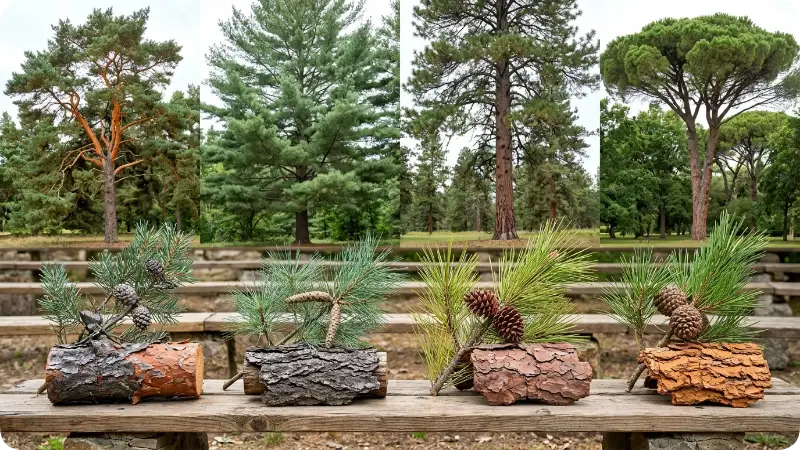
The genus Pinus contains many species with different appearances, habitats, and growth patterns.
Kew’s Plants of the World Online database currently recognizes 128 accepted species in this genus. The exact number may change as botanical research and classification are updated.
Kew Science
Here are some well known pine trees and their scientific names.
| Common name | Scientific name | Main characteristic |
| Scots pine | Pinus sylvestris | Orange brown upper bark |
| Eastern white pine | Pinus strobus | Soft needles in bundles of five |
| Ponderosa pine | Pinus ponderosa | Large trunk and long needles |
| Monterey pine | Pinus radiata | Important plantation tree |
| European black pine | Pinus nigra | Dark, stiff needles |
| Loblolly pine | Pinus taeda | Important timber species |
| Longleaf pine | Pinus palustris | Exceptionally long needles |
| Red pine | Pinus resinosa | Reddish brown bark |
| Lodgepole pine | Pinus contorta | Common in western North America |
| Stone pine | Pinus pinea | Produces edible pine nuts |
Scientific Classification of the Pine Tree
1. Scots Pine (Pinus sylvestris)
Scots pine is a widely distributed pine species native to Europe and parts of Asia. It is known for its distinctive bark and evergreen foliage.
Main characteristics:
- Orange or reddish brown bark on the upper trunk.
- Blue green or green needle shaped leaves.
- Rounded or irregular crown in mature trees.
- Adaptation to different soil and climate conditions.
2. Eastern White Pine (Pinus strobus)
Eastern white pine is a large conifer native to eastern North America. It is recognized by its soft needles and long, narrow cones.
Main characteristics:
- Needles arranged in bundles of five.
- Soft, slender foliage.
- Long, narrow seed cones.
- Important timber and wildlife tree.
3. Ponderosa Pine (Pinus ponderosa)
Ponderosa pine is a large conifer found across western North America. It commonly grows in mountainous regions and dry forests.
Main characteristics:
- Thick bark with distinctive plates.
- Long green needles.
- Large woody cones.
- Tall growth under suitable environmental conditions.
4. Monterey Pine (Pinus radiata)
Monterey pine is native to a limited coastal region of California and several nearby Mexican islands. It is widely cultivated in other parts of the world.
Main characteristics:
- Relatively fast growth.
- Dark green needle shaped leaves.
- Irregular branches.
- Commercial importance in plantation forestry.
5. European Black Pine (Pinus nigra)
European black pine is a conifer native to parts of southern and southeastern Europe. It is recognized by its dark bark and relatively stiff needles.
Main characteristics:
- Dark gray to blackish bark.
- Stiff green needles.
- Woody seed cones.
- Adaptation to various mountainous environments.
6. Stone Pine (Pinus pinea)
Stone pine is a Mediterranean species recognized by its broad, umbrella shaped crown. Its seeds are commonly known as pine nuts.
Main characteristics:
- Distinctive umbrella shaped crown.
- Long green needles.
- Large woody cones.
- Edible seeds used in cooking.
Why Do Pine Trees Have Scientific Names?
Scientific names provide a universal identification system for plants. Common names can vary between countries, languages, and regions, making accurate identification difficult.
For example, the same pine species may have different local names. Its scientific name remains consistent within the accepted botanical classification.
Benefits of Scientific Names
- Accurate identification: Helps distinguish individual pine species.
- Global communication: Provides a shared naming system for researchers.
- Botanical research: Makes scientific studies easier to organize.
- Forestry management: Helps identify trees used for timber production.
- Conservation: Supports species monitoring and biodiversity research.
Scientific names are especially useful when studying closely related plants that may look similar.
Physical Characteristics of Pine Trees
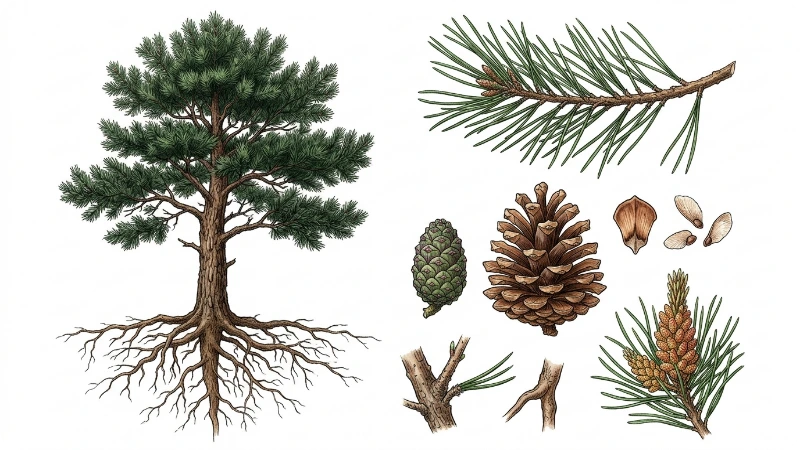
Pine trees have several recognizable features that distinguish them from broad leaved trees and other conifers.
1. Needle Shaped Leaves
Pine trees have narrow, elongated leaves called needles.
Unlike broad leaves, these needles have a relatively small surface area, which helps reduce water loss.
Their needles usually grow in small groups called fascicles. The number of needles in each bundle varies between species and can help with identification.
2. Woody Seed Cones
Pine trees reproduce through cones rather than flowers and fruits.
They produce two main types of reproductive cones:
- Male cones: Produce pollen.
- Female cones: Contain ovules that develop into seeds after pollination and fertilization.
The seeds develop on the scales of female cones. In many species, mature cones open to release them.
3. Evergreen Growth
Most pine species are evergreen. Their needles remain on the branches for more than one growing season.
However, individual needles eventually become old, turn brown, and fall as new growth develops.
4. Strong Woody Trunks
Pine trees generally develop woody trunks and branches. Their height, trunk thickness, and crown shape depend on the species and growing environment.
Some species grow into tall forest trees, while others remain relatively small shrubs.
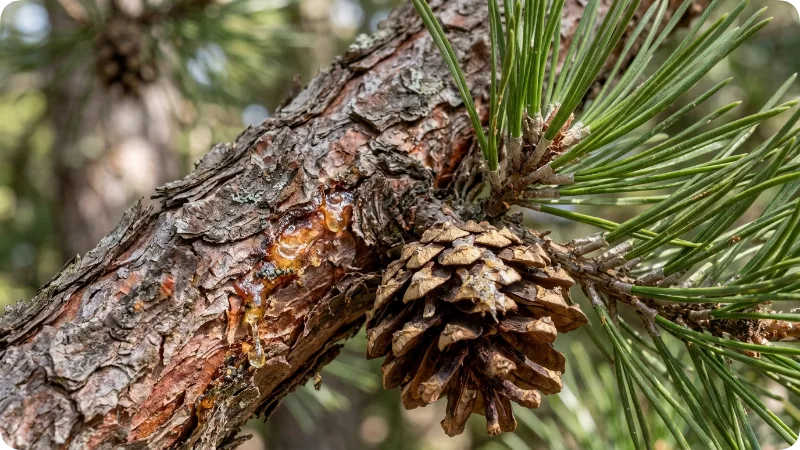
5. Resin Production
Many pine trees produce sticky resin through specialized structures called resin ducts.
Resin helps protect trees against certain insects and injuries. It is also collected for commercial purposes.
Where Do Pine Trees Grow?

Pine trees naturally occur across much of the Northern Hemisphere, including North America, Europe, and Asia. Their native range extends into parts of the tropics and subtropics, including Malesia and the Caribbean.
Different species grow in different environments.
Common pine habitats include:
- Mountain slopes.
- Temperate forests.
- Coastal landscapes.
- Dry woodland areas.
- Cold northern regions.
- Sandy and rocky soils.
Some pine species tolerate cold winters, while others grow in warmer climates. Their environmental requirements vary according to their natural distribution.
What Is the Meaning of the Word Pinus?
Pinus is the Latin botanical name used for the pine genus.
The genus name was formally published by Carl Linnaeus in 1753 in his botanical work Species Plantarum. It remains the accepted scientific name for this group of trees.
Kew Science+1
The name is used internationally in botanical publications, scientific databases, forestry research, and plant identification guides.
Are Pine Trees and Evergreen Trees the Same?
No. Pine trees are a type of evergreen tree, but not all evergreen trees belong to the pine genus.
The word evergreen describes a plant that retains its foliage throughout the year. Pine identifies a particular botanical genus.
| Tree | Scientific name | Botanical group |
| Scots pine | Pinus sylvestris | Pine |
| Norway spruce | Picea abies | Spruce |
| European silver fir | Abies alba | Fir |
| Western hemlock | Tsuga heterophylla | Hemlock |
| Eastern red cedar | Juniperus virginiana | Juniper |
These trees belong to different genera, even though they share the evergreen growth habit.
Importance and Uses of Pine Trees
Pine trees provide environmental, commercial, and practical benefits. They are important components of many forest ecosystems and support several industries.
Environmental Importance
Pine trees contribute to natural environments in different ways:
- Provide shelter and nesting places for wildlife.
- Help stabilize soil and reduce erosion.
- Store carbon as they grow.
- Support forest biodiversity.
- Provide seeds and food resources for certain animals.
Commercial and Practical Uses
| Use | Description |
| Timber | Used in construction and woodworking |
| Paper production | Pine wood is processed into pulp |
| Furniture | Used for shelves, cabinets, and household products |
| Resin | Collected for commercial applications |
| Landscaping | Planted in parks, gardens, and public spaces |
| Pine nuts | Seeds from selected species are harvested as food |
Not every pine species is suitable for every commercial purpose. Their uses depend on wood quality, seed size, growth characteristics, and availability.
Fun Facts About Pine Trees
Pine trees have several interesting features that make them important in forests and natural landscapes.
- Long lived species: Some pine species can survive for hundreds or even thousands of years.
- Different needle bundles: Pine needles commonly grow in bundles of two, three, or five, depending on the species.
- Edible seeds: Stone pine (Pinus pinea) produces pine nuts used in various foods.
- Fire adaptations: Some pine species have cones that remain closed until exposed to particular environmental conditions, including heat.
- Wide distribution: Pine species naturally occur across many regions of the Northern Hemisphere.
- Different cone shapes: Pine cones vary considerably in size, shape, and structure.
How Many Species of Pine Trees Exist?
According to Kew’s Plants of the World Online database, the genus Pinus includes 128 accepted species. This figure reflects its current taxonomic treatment and may change as scientific classification develops.
Kew Science
Key Takeaways
- The scientific name of a pine tree is Pinus.
- Pinus is a botanical genus, not an individual species.
- Pine trees belong to the family Pinaceae.
- They are evergreen conifers and gymnosperms.
- Kew recognizes 128 accepted species in the genus.
- Examples include Scots pine, Eastern white pine, and stone pine.
- Pine trees reproduce through male and female cones.
- They provide timber, food resources, wildlife habitats, and environmental benefits.
Frequently Asked Questions
1. What is the scientific name of a pine tree?
The scientific name of a pine tree is Pinus. It is the botanical genus that includes many different evergreen coniferous species.
2. What is the family name of a pine tree?
Pine trees belong to the family Pinaceae, commonly called the pine family. It also includes firs, spruces, hemlocks, and larches.
3. Is Pinus the scientific name of all pine trees?
Pinus is the genus name shared by pine species. Each individual species has a complete scientific name, such as Pinus sylvestris or Pinus strobus.
4. What is the scientific name of the Scots pine?
The scientific name of the Scots pine is Pinus sylvestris. It is native to Europe and parts of Asia.
5. What is the scientific name of the white pine?
The Eastern white pine is scientifically known as Pinus strobus. It is native to eastern North America and has soft needles arranged in bundles of five.
6. Are pine trees flowering plants?
No. Pine trees are gymnosperms, which reproduce through cones rather than flowers and fruits. Their seeds develop on the scales of female cones.
Conclusion
The scientific name of a pine tree is Pinus, a genus belonging to the family Pinaceae. It includes numerous species with different appearances, natural habitats, and uses.
From Scots pine (Pinus sylvestris) to stone pine (Pinus pinea), every species has its own botanical identity. Understanding the pine tree scientific name makes plant identification easier and provides a clearer understanding of pine classification, characteristics, and ecological importance. These remarkable evergreen trees remain valuable parts of natural forests and human environments.

Sophia explores the history, global origins, and deep etymology behind popular and rare names. She curates beautiful, meaningful baby name guides and historical name lists for families and researchers. She also enjoys learning new languages and traveling.