Featured snippet: How do you find obituaries by last name?
You can find obituaries by last name using online obituary databases, local newspaper archives, funeral home websites, and genealogy resources. Start with the person’s surname, then narrow your search using their first name, location, approximate date of death, or family details. If you cannot find a match online, check historical newspaper collections and local library archives.
Searching for an obituary can be a personal and meaningful task. You may be looking for a loved one’s memorial, confirming a death announcement, reconnecting with family history, or learning more about someone whose story has been passed down through generations.
Searching by last name is a practical starting point, especially when you do not know the person’s full name or exact date of death. However, a surname alone may produce hundreds or thousands of results. Combining it with a location, first name, or approximate year can make the search much more precise.
Several resources can help, including online obituary databases, funeral home websites, local newspapers, and historical genealogy archives. Understanding which source to use, and how to verify the information, can save time and help you locate the correct notice.
How to Find Obituaries by Last Name

The easiest way to find an obituary is to search the person’s last name alongside any additional information you know. A first name, hometown, approximate age, or date of death can help distinguish the correct person from others with the same surname.
Start with an online obituary database or search engine. If the results are too broad, add the person’s location or narrow the date range. You can also check local funeral home websites and newspaper archives, which may contain notices that are missing from larger databases.
For recent deaths, funeral homes and local newspapers are useful starting points. For older records, historical newspaper collections and genealogy websites may provide better results.
Quick obituary search guide
| Resource | Best use |
| Legacy.com | Searching recent and archived online obituaries |
| FamilySearch | Exploring genealogy resources and historical records |
| Find a Grave | Locating cemetery memorials and related information |
| Local funeral home websites | Finding recent obituaries and service announcements |
| Newspaper and library archives | Researching older death notices and regional records |
Availability varies by location, publication, and time period. Some historical records may require a subscription or an in person visit to a library.
Obituaries by Last Name: A–Z Search
An alphabetical surname search can help you organize your research when you know the family name but not the complete name of the deceased. Historical newspaper indexes sometimes arrange notices alphabetically, while modern obituary websites generally let you search by name and apply filters.
If you are unsure how a surname was spelled, try several variations. This can be especially helpful when researching older family records, names that changed after immigration, or surnames containing accents and hyphens.
Common last names to search
The following examples demonstrate how to phrase an obituary search. They are search suggestions, not lists of verified obituaries.
| Last name | Example search phrase |
| Smith | Smith obituary |
| Johnson | Johnson obituary notices |
| Williams | Williams death notices |
| Brown | Brown obituary archive |
| Jones | Jones obituary and funeral details |
| Garcia | Garcia family obituary |
| Miller | Miller obituary by city |
| Davis | Davis obituary by year |
| Wilson | Wilson memorial notice |
| Anderson | Anderson newspaper obituary |
Common surnames often return numerous unrelated results. Add a first name, middle initial, hometown, or approximate death year to narrow the list.
For historical research, consider searching local newspaper indexes and library genealogy guides. These resources may help you locate notices that are not available through a general online search.
How to Search for an Obituary Using a Last Name
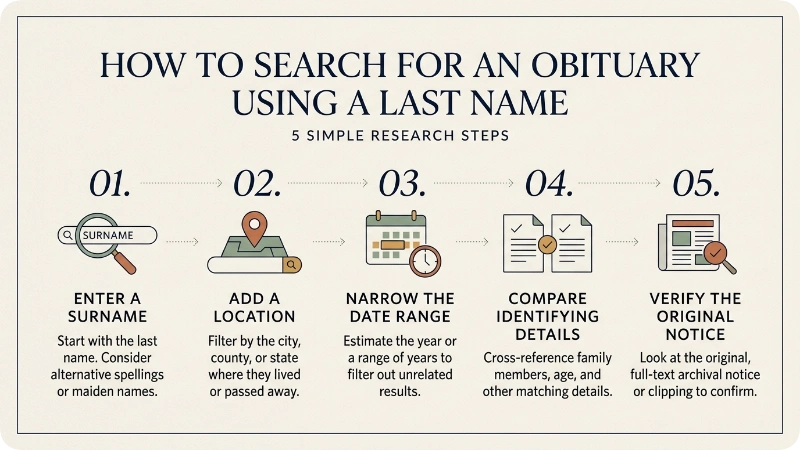
Follow these five steps to move from a broad surname search to a more reliable match.
1. Start with the surname
Enter the last name into an obituary database or search engine. If you know the person’s first name, include it to reduce unrelated results.
2. Add the location
Include the city, state, province, or country where the person lived. Their longtime residence may be more useful than the place where they died.
3. Narrow the date range
For a recent death, check current funeral home announcements and local newspaper notices. For an older death, expand the date range and explore historical newspaper archives.
Remember that an obituary’s publication date may differ from the actual date of death.
4. Compare identifying details
Check the full name, age, residence, relatives, and dates. A matching surname by itself does not prove that you have found the correct person.
5. Verify the original notice
Whenever possible, open the original obituary or funeral home memorial page. Compare the details with another reliable source if the identity remains uncertain.
These steps are useful for both personal searches and genealogy research, particularly when several people share the same name.
Best Websites for Obituaries by Last Name

Different websites serve different research needs. Some specialize in recent memorials, while others focus on genealogy, cemetery records, or historical newspapers.
| Resource | Best for | Important consideration |
| Legacy.com | Recent and archived online obituaries | Coverage depends on participating publications and funeral homes. |
| FamilySearch | Genealogy and historical research | Some collections are indexed; others require browsing digitized records. |
| Find a Grave | Cemetery and memorial research | Memorial pages may include obituary text or links to related records. |
| Local funeral home websites | Recent deaths and funeral arrangements | Notices may provide service dates, family details, and memorial information. |
| Local newspapers and libraries | Older death notices and regional archives | Some records require subscriptions or in person research. |
No single website contains every obituary. Searching more than one source is often necessary, especially for older records or people who lived in several locations.
Which obituary source should you try first?
- Recent death: Begin with the funeral home serving the person’s community and the local newspaper.
- Death from several years ago: Search online obituary databases and newspaper archives.
- Family history research: Combine genealogy collections, historical newspapers, and cemetery records.
- Very common surname: Add the person’s location, approximate age, relatives, and dates.
- No online results: Contact a local library or historical society to ask about archived newspapers.
Choosing the right source for the time period and location can make the search considerably more efficient.
Searching by Maiden Name, Married Name, or Alternate Spelling
A person’s obituary may not appear under the surname you expect. Someone might have used a maiden name, married surname, hyphenated surname, middle name, nickname, or an alternative spelling.
If your first search does not produce a reliable match, try these variations:
- Maiden name: Search the surname the person used before marriage.
- Married name: Search the surname used later in life.
- Hyphenated surname: Try the complete surname and each part separately.
- Middle name or initial: Some people were known by their middle names.
- Nickname: Search a familiar name alongside the formal name.
- Spelling variations: Consider alternate transliterations, missing accents, and common spelling differences.
For example, if you are searching for Mary Thompson but believe she may have used another surname earlier in life, search both “Mary Thompson obituary” and “Mary” with the earlier surname.
You can also include a spouse’s name, hometown, or approximate death year. These details may help distinguish the correct record from someone with a similar name.
Finding Recent vs. Historical Obituaries
The age of an obituary affects where you should search. Notices are often available online, while older records may require additional research.
Recent obituaries
Recent obituaries are commonly published on funeral home websites, local newspaper websites, and online obituary platforms.
Depending on the publication, a notice may include:
- A photograph and biographical summary
- Birth and death dates
- Names of surviving relatives
- Funeral or memorial service arrangements
- Personal achievements and memories
- A guestbook or memorial page
If someone died within the past few days, allow time for the family, funeral home, or newspaper to publish a notice. Not every death results in a publicly available obituary.
Historical obituaries
Older notices may be preserved in digitized newspaper collections, microfilm archives, local libraries, and genealogy databases. Some records are searchable by surname, while others require you to browse scanned newspaper pages.
Before searching, write down the information you already know, including the person’s full name, approximate birth and death years, residence, spouse, and parents.
These details can help you identify the correct person when multiple historical records share a surname. Local library genealogy guides can also explain how to access newspaper microfilm and regional archives.
What Information Can You Find in an Obituary?
An obituary can provide a meaningful account of someone’s life, but the information varies according to the family, publication, and historical period.
| Information | Why it matters |
| Full name and alternate names | Helps identify the correct person |
| Birth and death dates | Supports identification and verification |
| Age and hometown | Distinguishes people with similar names |
| Parents, spouse, children, and siblings | Helps establish family connections |
| Personal biography | Provides context about the person’s life |
| Funeral or memorial details | Explains service arrangements |
| Burial information | Supports cemetery and genealogy research |
Some obituaries include detailed life stories, while others contain only a brief death announcement and funeral information. Older notices may be especially limited.
When using an obituary for family history, treat it as a valuable research source rather than assuming every detail is complete or error free. Whenever possible, compare important dates and relationships with other records.
What to Do If You Cannot Find an Obituary
A missing search result does not necessarily mean an obituary does not exist. The family may not have published one, the notice may use another name, or the relevant newspaper may not be available online.
Try these alternatives:
- Search the surname with the person’s hometown, county, or surrounding region.
- Check neighboring towns and newspapers serving the area.
- Contact local libraries or historical societies about newspaper archives.
- Search funeral home memorial pages and cemetery records.
- Try maiden names, middle names, initials, nicknames, and spelling variations.
- Look for a death record that can help establish the person’s dates and location.
- Expand the search to include a spouse or other known family member.
A death record and an obituary are not the same thing. A death record documents information about a death, while an obituary usually provides a public announcement or account of the person’s life.
If the death occurred many decades ago, a library’s newspaper collection or microfilm archive may be particularly helpful. Some historical notices have not been digitized, so a manual search may be necessary.
Frequently Asked Questions
Can I find an obituary using only a last name?
Yes. You can start with a surname in an obituary database or search engine. However, common surnames may return many unrelated results. Adding a first name, location, approximate age, or death year usually makes the search more effective.
Where can I search obituaries by last name for free?
Start with free searches on Legacy.com, FamilySearch, funeral home websites, and local newspaper websites. The availability of records varies, and some historical collections or newspaper archives may require a subscription or library access.
How do I find an obituary from many years ago?
Search historical newspaper archives, genealogy databases, and local library collections. Combine the surname with the person’s hometown and approximate death year. If the newspaper has not been digitized, you may need to consult microfilm or ask a librarian for assistance.
Why can’t I find a person’s obituary online?
The family may not have published an obituary, the notice may use a different surname, or the newspaper may not be indexed online. Try alternate spellings, regional newspapers, funeral home websites, cemetery records, and historical archives.
Are obituaries and death notices the same thing?
Not exactly. A death notice is generally a brief announcement containing basic information and sometimes funeral details. An obituary usually provides a fuller account of the person’s life, family, and accomplishments. However, the terms can vary by publication.
Can I search obituaries by last name and date of death?
Yes. Many obituary websites offer search filters, although the available options vary. You can also enter an approximate death date or year into a search engine. Remember that the obituary’s publication date may differ from the date of death.
How can I tell if I found the correct obituary?
Compare several identifying details, including the person’s full name, age, location, dates, and family relationships. Whenever possible, confirm the information using the original obituary or another reliable record. Do not rely on a matching surname alone.
Conclusion
Searching for obituaries by last name is a useful first step when you want to find a loved one’s memorial, verify a death announcement, or explore your family history. A surname gives you a starting point, but location, dates, alternate names, and family connections help you identify the right record.
Begin with a trusted obituary database, then check local funeral homes, newspapers, and historical archives. If your first search comes up empty, try another spelling, broaden the date range, or ask a local library for help.
Every obituary preserves part of a person’s story. Taking the time to verify the details can help you locate the notice you need and build a more accurate understanding of the life it remembers.

Sophia explores the history, global origins, and deep etymology behind popular and rare names. She curates beautiful, meaningful baby name guides and historical name lists for families and researchers. She also enjoys learning new languages and traveling.